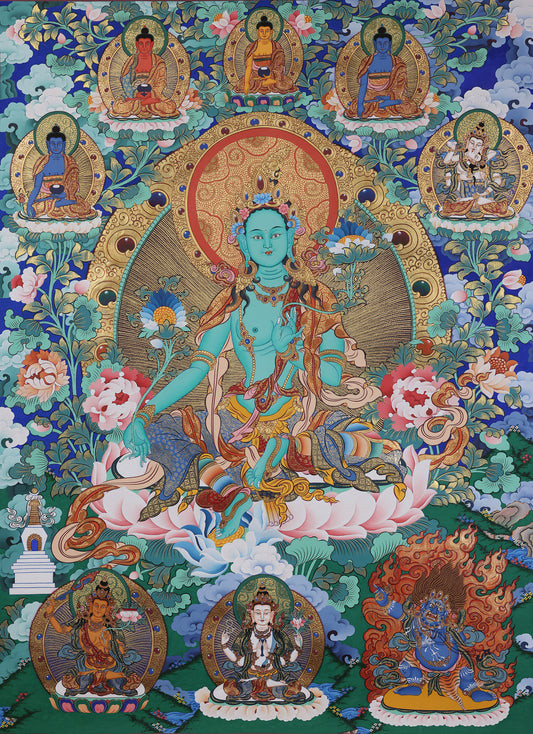
Yellow Dzambhala: The Wealth Protector in Tibetan Buddhism and the Compassionate Blessing of the Six-Syllable Mantra Beneath Black-Gold Thangkas

When your gaze rests on this black-and-gold Tibetan Thangka, it’s hard not to be drawn to the bright yellow figure seated at its center: his face is full like a full moon, his eyebrows slightly furrowed yet his expression serene; his left arm cradles a small sharp-mouthed creature, as if treasures are about to spill from its mouth; pink flowers bloom beside him, and the golden Six-Syllable Mantra swirling around him glows like stardust against the black background. This is Yellow Dzambhala (Zambala Serpo in Tibetan), the widely known wealth protector in Tibetan Buddhism.
1. Yellow Dzambhala: The True Identity of the "Wealth Protector" in Tibetan Buddhism
In the protector system of Tibetan Buddhism, Yellow Dzambhala is not a simple symbol of "worldly fortune-bringing"—he is a compassionate incarnation embodying the wisdom of "entering the path through wealth."
According to the Sutra of the Dharani of the Five Wealth Gods (a Tibetan Buddhist text), Yellow Dzambhala’s prototype traces back to Kubera, the wealth god of ancient Indian Brahmanism, who was later absorbed into Buddhism as a retinue of Vaisravana (the Guardian King of the North). A more prevalent account in Tibetan esoteric traditions holds that he is an emanation of Ratnasambhava Buddha (the Buddha of the Southern Pure Land)—out of compassion for sentient beings’ suffering from poverty (both material and spiritual), he vowed to manifest in the form of a wealth god to support practitioners in acquiring "merit and virtue resources."
As the head of the Five Wealth Gods (Yellow, White, Red, Green, Black), Yellow Dzambhala oversees "central merit": unlike White Dzambhala (an emanation of Avalokitesvara, governing "pure wealth") and Red Dzambhala (an emanation of Amitabha, governing "social connection wealth"), his core vow is to "balance material and spiritual resources"—helping the destitute secure basic livelihoods while freeing practitioners from financial stress so they can focus on Dharma practice.
Research from the China Tibetology Research Center notes: "The essence of Yellow Dzambhala belief is an extension of Tibetan Buddhism’s concept of ‘enlightenment in this lifetime’—wealth is not the goal, but a tool to support practice and benefit sentient beings."
2. Decoding Thangka Symbols: Every Detail Is a Metaphor for Practice
The Yellow Dzambhala Thangka provided by the user is a classic example of "symbols as doctrine" in Tibetan Buddhist art; every color and element holds hidden meaning:
1. Form and Implements: Compassion Made Tangible
- Bright yellow form: Created using natural yellow ochre mineral pigment from the Khamba region (per Palace Museum research on Thangka techniques, yellow ochre has stable color and corresponds to the "earth" element in the five elements, symbolizing merit as vast as the earth). His large, round belly is not a "gluttonous form" but a "compassionate heart that embraces impoverished sentient beings" (in the words of the Akya Rinpoche).
- Treasure-vomiting rat (Nakala in Sanskrit, Nevldy in Tibetan): This small sharp-mouthed creature is not a rat, but an Indian mongoose—since it preys on snakes (which symbolized "wealth guardians" in ancient India), it represents "acquiring wealth." In the Thangka, it vomits treasures, signifying "endless generosity": Yellow Dzambhala’s "wealth" is about giving, not hoarding; practitioners who seek it with greedy attachment will stray from his vow.
- Foot resting on a conch: His right foot presses a white conch, symbolizing "retrieving treasures from the sea"—meaning wealth acquisition requires wisdom as a boat, not blind craving.
2. The Encircling Six-Syllable Mantra: Linking Compassion and Wealth
The "Om Mani Padme Hum" Six-Syllable Mantra on the Thangka’s outer black background is not a decorative element, but the core source of blessing for Yellow Dzambhala practice.
The Six-Syllable Mantra is the fundamental heart mantra of Avalokitesvara, meaning "Om (homage), Mani (jewel), Padme (lotus), Hum (accomplishment)"—symbolizing "upholding treasures with compassion, achieving purity like a lotus." In Tibetan Buddhist rituals, Yellow Dzambhala practice often centers on the Six-Syllable Mantra: reciting it purifies one’s motivation, then one invokes Yellow Dzambhala’s blessing to merge compassionate intent with the vow of wealth.
The Six-Syllable Mantra on this Thangka is painted with 24K gold powder (in Regong Thangka techniques, gold powder must be ground to 5μm precision), while the black background is mixed with carbon powder and gelatin—black symbolizes "the emptiness that dispels afflictions," and gold symbolizes "the eternal blessing of Dharma." Their interweaving implies: Yellow Dzambhala’s "wealth" is compassionate giving rooted in the wisdom of emptiness.
3. Thangka Craftsmanship: An Extension of Practice
This Thangka follows traditional Regong production procedures: the canvas is repeatedly polished with ox bone glue and chalk, and all pigments are natural minerals (e.g., red from cinnabar, blue from lapis lazuli). Research from the Chinese Academy of Sciences Materials Research Institute shows these mineral pigments not only retain color long-term but also their trace elements resonate subtly with practitioners’ biofields—the Thangka-painting process itself is a form of practice, with every brushstroke requiring the artist’s devotion.
3. The Six-Syllable Mantra and Yellow Dzambhala: The Spiritual Essence of "Wealth"
Many associate Yellow Dzambhala with "seeking fortune," but this misinterprets his doctrine. Yellow Dzambhala’s "wealth" is essentially merit and virtue resources, and the Six-Syllable Mantra is the bond that ties this concept together.
The Praise to Yellow Dzambhala states: "Holding the treasure rat that vomits wonderful jewels, resting on a conch to increase merit and wisdom; devoutly reciting the heart mantra and practicing generosity, poverty karmas are eliminated, and abundance and wisdom arise." Here, "abundance" refers to three layers:
- Material resources: Meeting basic livelihood needs to avoid negative karma caused by poverty;
- Spiritual resources: Dispelling the "poverty karmas" of stinginess and greed to gain "the wealth of contentment";
- Practice resources: Enabling practitioners to give alms, build monasteries, and fund scripture printing to benefit sentient beings.
Master Tsongkhapa further explains in The Great Treatise on the Stages of the Path to Enlightenment: "Practicing Yellow Dzambhala Dharma is not for accumulating wealth to indulge in pleasure, but to cut the ‘heart of poverty’—material poverty is suffering, and spiritual greed is also suffering; Yellow Dzambhala’s blessing is to free sentient beings from suffering and bring joy."
The integration of the Six-Syllable Mantra ensures that the motivation to "seek wealth" does not deviate from compassion: when reciting the mantra, one visualizes "treasures raining down to benefit all sentient beings" rather than "hoarding wealth"—this is why Yellow Dzambhala is encircled by the Six-Syllable Mantra in this Thangka: compassion is the foundation of wealth.
4. Practicing Yellow Dzambhala Dharma: Connecting to the Protector’s Blessing with Right View
For those wishing to practice Yellow Dzambhala Dharma, it is essential to follow Tibetan Buddhism’s "right view" principles, not just worship blindly:
1. Motivation as the Foundation: Replace Greed with Bodhicitta
The first step in Yellow Dzambhala Practice Ritual (by Venerable Renqing) is "taking refuge and generating bodhicitta": "May all merits from my generosity lead to Buddhahood for the benefit of sentient beings"—the core of practice is "benefiting sentient beings," not satisfying personal greed.
2. Good Karma as the Cause: Wealth Aligns with Merit
Tibetan esoteric scriptures emphasize: "Yellow Dzambhala’s blessing is a supporting condition, not a gift of wealth out of thin air." Without a foundation of good karma (e.g., generosity, precept-keeping), even worship will not yield corresponding blessings; conversely, with a basis of good karma, wealth naturally becomes a tool to benefit sentient beings.
3. Rely on a Qualified Guru: Avoid Blind Practice
Yellow Dzambhala Dharma belongs to esoteric practice and requires guidance from a qualified guru; one should not practice rituals or recite mantras independently—this is both a respect for the lineage and a way to avoid straying from right view due to "improper practice."
5. Conclusion: Encountering the True Meaning of "Wealth" in Thangkas and Mantras
When we look at this Yellow Dzambhala Thangka again, we should see not just a "wealth god holding a treasure rat," but a compassionate teacher who uses wealth as a medium:
- His bright yellow form symbolizes the inclusiveness of the earth;
- The treasure-vomiting rat’s jewels signify giving, not hoarding;
- The encircling Six-Syllable Mantra represents the dual blessing of compassion and wisdom.
Tibetan Buddhism’s view of wealth is never about "craving gold and silver," but about "nurturing the path with wealth, and guiding wealth with the path"—Yellow Dzambhala exists to remind us: true "abundance" means freedom from both material poverty and spiritual greed, and the ability to benefit sentient beings with a pure heart.
#YellowDzambhala #TibetanBuddhismYellowDzambhala #YellowDzambhalaThangka #YellowDzambhalaSixSyllableMantra #TibetanBuddhismWealthProtector #FiveWealthGods #TibetanBuddhistThangkaArt #RegongThangkaCraft #OmManiPadmeHumMantra #MeritResourcesInBuddhism #TibetanEsotericWealthPractice #MineralPigmentThangka #KuberaInTibetanBuddhism
Schlagwörter:
Vorherige
Siddhartha Gautama in Tibetan Buddhism: Understanding the Compassion and Teachings of the Original Teacher Through a Colored Thangka
Nächste
Shakyamuni in Tibetan Buddhism: The Color and Spiritual Code of the Enlightened One