Siddhartha Gautama in Tibetan Buddhism: Understanding the Compassion and Teachings of the Original Teacher Through a Colored Thangka

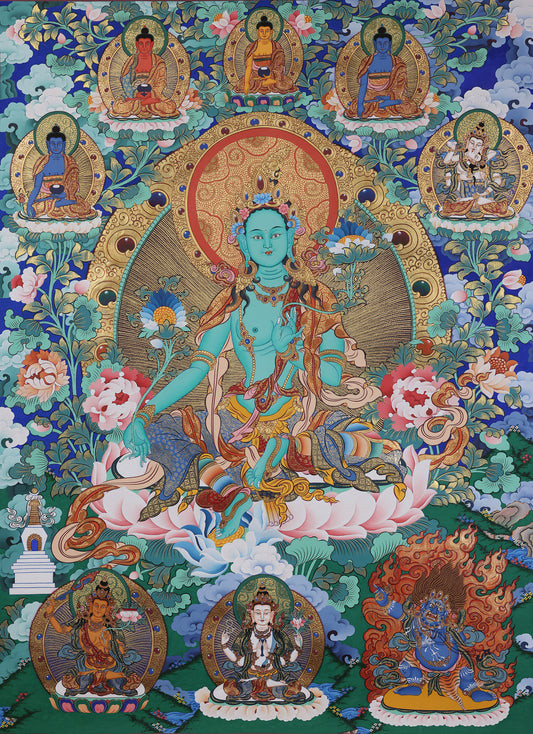
When I first saw this Tibetan colored Thangka of Siddhartha Gautama, I was immediately struck by its vivid yet solemn hues: the Buddha with a yellow body sits serenely on a lotus throne at the center, the gilded patterns on his robes glow with a warm luster, and the simple earthen alms bowl in his palm stands out subtly; Buddhas with red and blue bodies above, and disciples holding tin staffs below, surround him, while lotuses and swirling clouds fill the background—this is not just a painting, but a tangible 载体 of the devotion and understanding Tibetan Buddhists have for their Original Teacher.
Though Tibetan Buddhism is known for its esoteric rituals and pantheon of Buddhas and Bodhisattvas, it has always revered Siddhartha Gautama as the "fundamental anchor": the source of all exoteric and esoteric teachings, and the starting point of all spiritual practice, all pointing back to this enlightened one who lived over 2,500 years ago. This Thangka is the most vivid expression of Tibetan believers’ worship and understanding of him.
I. The "Original Teacher" in Tibetan Buddhism: Siddhartha Gautama’s Central Role
In the context of Tibetan Buddhism, Siddhartha Gautama is always preceded by the title "Original Teacher"—"Original" meaning "fundamental," and "Teacher" meaning "guide," signifying the "root guru who personally transmitted the Dharma." This identity distinguishes him from other Buddhas and Bodhisattvas (most of whom are his emanations, retinue, or enlightened beings in different dimensions), making him the cornerstone of the Tibetan devotional system.
Tibetan monastery layouts best reflect this: the central hall of almost every monastery houses a statue of Siddhartha Gautama (such as the 12-year-old Jowo Shakyamuni statue in the Jokhang Temple, regarded by Tibetans as a "living Buddha"), with Bodhisattvas like Manjushri and Avalokiteshvara, or successive masters like Tsongkhapa, placed around him. When believers enter the hall, the first to be worshipped is always the Original Teacher Siddhartha Gautama—a millennium-old Tibetan consensus: "Without the Original Teacher’s preaching, there would be no Dharma to practice."
Even in esoteric practice, Siddhartha Gautama’s status is irreplaceable: in the Tibetan "exoteric first, esoteric later" practice sequence, the foundational exoteric scriptures (such as the Diamond Sutra and Heart Sutra) are all taught by Siddhartha Gautama; in esoteric visualization rituals, many yidams are interpreted as "esoteric manifestations of Siddhartha Gautama’s intent"—he is the core link uniting exoteric and esoteric traditions.
II. The Colored Thangka: Siddhartha Gautama’s "Visual Code" (Taking This Thangka as an Example)
Every detail in a Tibetan Thangka is not decoration, but "the language of the Dharma." The elements of this Siddhartha Gautama Thangka hold the full understanding Tibetan believers have of their Original Teacher:
1. The Central Buddha: Symbolism of Body and Ritual Objects
- Yellow body: In Tibetan Buddhism, the Buddha’s body color corresponds to the attributes of the Five Dhyani Buddhas; yellow represents the "Central Buddha," corresponding to the earth element—symbolizing stability, inclusiveness, and compassion that illuminates all sentient beings. This body color also implies that Siddhartha Gautama is the "bridge between the secular and the transcendental," manifesting enlightenment in the human world while bearing the afflictions of sentient beings.
- Alms bowl (earthen bowl): The bowl in the Buddha’s palm symbolizes his alms-giving practice. In Siddhartha Gautama’s time, he led his disciples to live on alms: first, to avoid accumulating wealth and practice the precept of "contentment with little"; second, to break class barriers—whether nobles or commoners could offer a bowl of food to the Buddha, embodying the core teaching of "equality of all sentient beings." When Tibetan believers see this detail, they immediately associate it with "the Buddha practicing enlightenment through ordinariness."
- Full lotus position + meditation mudra holding the alms bowl: This posture is the "demon-subduing position," representing the Buddha’s posture when he attained enlightenment; the mudra of holding the alms bowl is the "alms-seeking mudra," symbolizing nourishing sentient beings’ spiritual lives with the Dharma after enlightenment—the former is "self-enlightenment," the latter is "universal salvation," fully encapsulating the Buddha’s life.
2. The Surrounding Sacred Retinue: Metaphors of Transmission
- Buddhas with red and blue bodies above: These are usually two of the Seven Past Buddhas (such as Krakuchchanda Buddha and Kanakamuni Buddha). Tibetan Buddhism holds that Siddhartha Gautama is not the only Buddha, but the "fourth Buddha of the fortunate eon"—past Buddhas preached the Dharma, Siddhartha Gautama preaches it now, and Maitreya Buddha will preach it in the future, embodying the belief that "the Dharma is eternal and passed down through generations."
- Disciples holding tin staffs below: On the left, holding a tin staff and clasping hands, is Ananda (the foremost in hearing, the Buddha’s attendant who recorded most scriptures); on the right, holding a tin staff and with downcast eyes, is Kasyapa (the foremost in asceticism, who presided over the first council after the Buddha’s nirvana). They symbolize the "disciple transmission"—when Tibetan believers see these two, they are reminded that "the Original Teacher’s Dharma has been preserved to this day through the practice of his disciples."
3. Background Elements: Materialization of Spiritual Realms
- Lotus throne (red lotus): In Tibetan Thangkas, the Buddha always sits on a lotus—red lotuses symbolize "rising unsoiled from mud," corresponding to Siddhartha Gautama’s "secular enlightenment": he was born in a royal palace (mud) but was not bound by desire, eventually attaining enlightenment under the Bodhi tree (the lotus blooms).
- Swirling clouds and flowers: The red swirling clouds in the background are a classic element of Tibetan Thangkas, representing the "transcendental realm"; the large pink flowers (similar to peonies) symbolize "the abundance of compassion"—meaning the Buddha’s Dharma can nourish sentient beings’ minds like flowers.
III. Transmission of the Dharma in Tibet: How Siddhartha Gautama "Came to the Snowy Land"
The introduction of Siddhartha Gautama’s teachings to Tibet was a millennium-long "spiritual migration," eventually merging with Himalayan culture to form the unique Tibetan Buddhist tradition:
- Initial transmission: Buddhas first: During the reign of Songtsen Gampo (7th century), Princess Bhrikuti of Nepal and Princess Wencheng of the Tang Dynasty entered Tibet, bringing an 8-year-old Jowo Shakyamuni statue and a 12-year-old Jowo Shakyamuni statue respectively—this was the first time Siddhartha Gautama entered Tibet in a tangible form. The Jokhang and Ramoche Temples thus became the birthplaces of Tibetan Buddhism, and remain core pilgrimage sites for believers to circumambulate and worship today.
- Propagation: Centered on the Original Teacher’s Dharma: In the 11th century, Atisha Dipankara entered Tibet, bringing the "complete system of Siddhartha Gautama’s teachings." His work Lamp for the Path to Enlightenment clarified the sequence from ordinary being to Buddha—and the foundation of this sequence is the core exoteric doctrines of Siddhartha Gautama, such as the Four Noble Truths and the Eightfold Path. Later, all Tibetan Buddhist schools (Gelug, Sakya, etc.) took the "Original Teacher’s Dharma" as their foundation, developing different practice paths.
- Popularization: Integrated into daily life: During the Ming and Qing dynasties, Tibetan Buddhism penetrated into folk life; images of Siddhartha Gautama appeared in the Thangka shrines of every household, and "reciting the Original Teacher’s name" became a daily practice for believers—Tibetan elders often say: "Even if you can’t recite scriptures, chanting ‘Namo Original Teacher Siddhartha Gautama Buddha’ connects you to enlightenment."
IV. Daily Practices of Tibetan Devotion: Living with the Original Teacher
For Tibetan believers, Siddhartha Gautama is not a "distant idol" but a "guide for life." Devotional practices centered on him have long been integrated into daily routines:
1. Thangka worship: The spiritual center of the home
Almost every Tibetan family’s living room hangs a Siddhartha Gautama Thangka, with butter lamps, water bowls, and barley flour placed below—when waking up in the morning, believers first offer a lamp to the Thangka (symbolizing "igniting the spiritual life") and pour a bowl of pure water (symbolizing "a pure mind"); before going to bed at night, they chant the Buddha’s name to the Thangka and reflect on their day’s words and deeds. For them, the Thangka is not decoration, but proof that "the Original Teacher is by our side."
2. Saga Dawa Festival: Honoring the Original Teacher through action
Every Tibetan calendar April (Saga Dawa Month) marks the month of Siddhartha Gautama’s birth, enlightenment, and nirvana. During this time, Tibetan believers engage in "month-long good deeds": circumambulating monasteries (Barkhor Street in Lhasa is crowded with pilgrims), releasing living beings (buying fish and birds from markets to set them free), and giving alms (donating money or goods to beggars or monasteries)—this is one of Tibet’s grandest festivals, centered on "practicing the Original Teacher’s Dharma with his compassion."
3. Worship and recitation: The simplest connection
Tibetan believers often carry a small Thangka or prayer beads of "Original Teacher Siddhartha Gautama" in their pockets. They twirl the beads and chant the Buddha’s name while walking, and stop to worship when encountering a statue of Siddhartha Gautama in a monastery—this "constant connection" is the backdrop of Tibetan devotion: "The Original Teacher’s Dharma is not meant to be ‘studied,’ but to be ‘lived.’"
V. Modern Insights: Siddhartha Gautama’s Spirit Beyond Religion
Even for non-Tibetan Buddhist believers, this Thangka and Siddhartha Gautama’s teachings offer insights for modern life:
- Equality and minimalism: The Buddha’s alms-giving practice reminds us to let go of "status arrogance" and treat others with equality; the precept of "contentment with little" is an antidote to modern "consumerist anxiety"—like the Buddha, focus on "necessary needs" rather than "endless desires."
- Compassion and diligence: Siddhartha Gautama’s journey from prince (abandoning pleasure) to ascetic (undergoing hardship) to enlightenment tells us that "growth requires diligence"; his act of nourishing sentient beings with the Dharma is the best example of "compassion"—modern society’s "involution" and "indifference" need this balance of "diligence for self-improvement, compassion for others."
- Enlightenment in ordinariness: The Buddha in this Thangka has no ornate decorations, only a simple alms bowl and a gentle face—this is the core message Tibetan believers wish to convey: enlightenment is not a "transcendent miracle," but "maintaining clarity and kindness in ordinary life."
This colored Thangka is ultimately a dialogue between "humanity" and "enlightenment": Tibetan believers see the Original Teacher’s Dharma in it, while modern people see a direction for life. He is an enlightened one from 2,500 years ago, and a spiritual guide transcending time and space—as long as someone is willing to treat others equally and care for the world with compassion, the Original Teacher’s spirit will live on forever.
#TibetanBuddhismThangka #SiddharthaGautamaInTibet #ThangkaSymbolism #SagaDawaFestival #BuddhistTeachingsForModernLife #OriginalTeacherBuddha #TibetanSpiritualPractice #ColoredThangkaArt #BuddhaThangkaVisuals #FiveDhyaniBuddhas #JokhangTempleJowoShakyamuni #TibetanDailyBuddhism #ThangkaAsSpiritualArt #BuddhistWisdomForToday #SevenPastBuddhas #BuddhaAlmsBowlSymbolism
Schlagwörter:
Vorherige
The Embodiment of Wisdom in Black-Gold Thangka: Manjushri in Tibetan Buddhism
Nächste
Yellow Dzambhala: The Wealth Protector in Tibetan Buddhism and the Compassionate Blessing of the Six-Syllable Mantra Beneath Black-Gold Thangkas