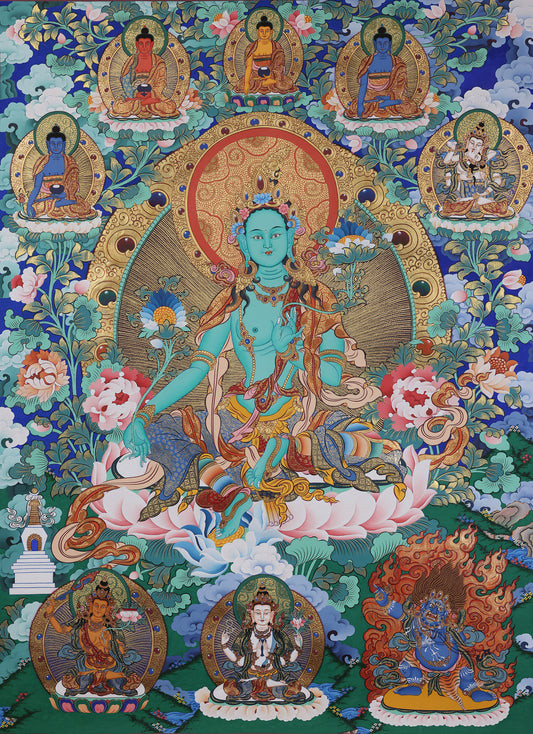
Tibetan Buddhist Black-Gold Green Tara Thangka: In-Depth Analysis of Theme, Iconography, and Craftsmanship

In the Tibetan Buddhist art system, thangka paintings are not merely religious artworks—they are visual rituals for meditation and practice. Among them, Green Tara thangkas are particularly revered for her vows of “swift rescue” and compassionate protection, making them essential in contemporary Tibetan Buddhist devotion and the global Buddhist art market. When presented in black-gold thangka form (known in Tibetan as “Na Thangka”), the artistic, meditative, and esoteric significance reaches a heightened level of solemnity and depth.
This article offers a comprehensive analysis of the Tibetan Buddhist Black-Gold Green Tara Thangka from four perspectives: theme, main deity iconography, attendant deities, and artistic craftsmanship, providing readers with a thorough understanding of the religious symbolism and artistic mastery embedded in this classic Bodhisattva depiction.
I. Theme: A Visualized Ritual of Compassionate Rescue
The central theme of this black-gold Green Tara thangka is her most iconic vow: “rescue from the eight dangers” and the compassionate embrace of all sentient beings.
In Tibetan Buddhism, Green Tara (Tibetan: Dolma) is recognized as the manifestation of Avalokiteshvara’s compassion, known as a swift rescuer who responds immediately to the suffering of beings. Her practice focuses on skillful means and timely intervention. The “eight dangers” (lion, elephant, snake, fire, water, thieves, non-human beings, and imprisonment) represent both external worldly threats and internal psychological afflictions such as fear, attachment, aversion, and ignorance. Through visualizing the thangka and reciting Tara mantras, practitioners experience a direct sense of protection and spiritual support, transforming abstract vows into tangible, accessible devotion.
The black-gold format further deepens the esoteric layer of the theme. In Vajrayana philosophy, the black background symbolizes the primordial nature of dharmadhatu—emptiness and the undifferentiated cosmos—while the gold lines represent enlightened wisdom. This stark contrast visually embodies the tantric principle of “manifesting wisdom amid ignorance,” emphasizing that Tara’s rescue transcends worldly protection, pointing toward ultimate liberation and compassionate action beyond samsara.
II. Main Deity: Iconography and Symbolism of Green Tara
At the center of the painting sits the serene form of Green Tara, meticulously rendered according to the Tibetan canonical measurements for deity iconography (Zang Zang Lingtse). Every detail carries symbolic meaning.
1. Body Color and Facial Features: Vitality and Purification
Green Tara is depicted in emerald green, representing life force, purification, and subjugation of obstacles, associated with the Non-Empty Accomplished Buddha seed in Tibetan color symbolism.
Her face embodies a sixteen-year-old maiden, with soft contours, lotus-shaped eyes, and a gentle smile that conveys infinite compassion. This youthful appearance transcends human aging, symbolizing the timeless and eternal nature of Tara’s compassion, a common motif in tantric visual language.
2. Posture and Mudras: Ready-to-Act Compassion
Tara adopts the “right leg extended, left leg folded” posture, known as the “pose of immediate rescue”. The right leg rests on a small lotus, signifying her readiness to act, while the left leg folds in meditation, balancing activity and stillness.
-
Right hand: Vajra wish-granting mudra, extending blessings and protection.
-
Left hand: Holds the three-jewel mudra at the chest, thumb and index finger delicately pinching a blue utpala lotus.
-
Lotus flowers on shoulders: Representing bud, blossom, and fruit, symbolizing past, present, and future rescue vows, reflecting Tara’s commitment across all temporal dimensions.
3. Attire and Ornamentation: Symbols of Complete Buddhahood
The deity wears a five-Buddha crown, signifying mastery over the five wisdoms, and is adorned with necklaces, armlets, anklets, and other eight outer secret ornaments, denoting the perfection of the dharmakaya body.
The U-shaped pleated robe follows the traditional Men-Tang style, adhering to canonical rules of “three folds, nine layers” while visually emphasizing fluidity and spiritual elegance.
III. Attendant Deities: Structured Support and Offerings
Although not all attendant deities are fully depicted, the thangka reflects a structured religious function of rescue, protection, and offering.
1. Upper Deities: Source of Compassion
Typically, the top of a Green Tara thangka depicts Amitabha Buddha (the dharmakaya source) or Four-Armed Avalokiteshvara (emanation body). This forms a triple sequence of dharmakaya—nirmanakaya—sambhogakaya, reinforcing Tara’s authentic lineage and legitimizing her vows.
2. Side Attendants and Protectors
At the margins, a blue wrathful figure—usually Vaiśravaṇa or Vajrapani—represents external protective power, safeguarding the practitioner and the Dharma.
If a White Tara appears at the lower section, she complements Green Tara with the qualities of longevity and wisdom, forming a balance between active rescue (Green Tara) and enduring support (White Tara).
3. Offerings: Material and Spiritual Fulfillment
The lotus base combines upturned and downturned petals, symbolizing liberation without attachment. The background often contains makara (sea creature) patterned petals and jewel offerings, representing the eradication of obstacles and the accumulation of merit, creating a visually complete ritual space of prayer and devotion.
IV. Artistic Craftsmanship: The Black-Gold Thangka as Spiritual Practice
This piece is a hotong (Rebgong) black-gold embossed thangka, where artistic technique is inseparable from meditative practice.
1. Canvas and Black Base: Purification
High-quality cotton or silk canvas is stretched, coated with a mixture of yak glue and gypsum, and polished to a smooth mirror-like finish. The black pigment, made from magnetite and antler ash, is applied in multiple layers. Each layer is painted with mantra recitation and mindfulness, symbolizing the removal of mundane distractions and preparation for sacred painting.
2. Gold Lines: Materialized Wisdom
The gold, 24K pure leaf, is ground with agate into a fine paste and applied with a soft cat-hair brush using embossed techniques. Light reflecting off the raised gold lines evokes flowing Buddha light, visually representing the tantric principle of wisdom illuminating ignorance.
3. Colors and Details: Spiritual Significance of Mineral Pigments
The emerald green is made from azurite and pearl powder, creating a blue-tinged green that conveys vitality and the interweaving of emptiness (blue) and compassionate activity (green). The fine line drawing (tie xian miao) on robes and lotus petals ensures every stroke aligns with canonical proportions, requiring months of retreat-like concentration from the artist—illustrating “painting the Buddha is practicing the Buddha.”
Conclusion: Thangka as a Living Ritual
The Black-Gold Green Tara Thangka is far more than a static painting—it is a living ritual tool, a medium for meditation, prayer, and devotional interaction.
-
For practitioners: It manifests Tara as the immediate, visible object of meditation.
-
For devotees: It becomes a responsive presence, blessing and protecting.
-
For collectors and art lovers: It is a masterpiece of faith, artistry, and cultural heritage, blending religious symbolism with visual sophistication.
Through the contrast of black and gold, precise iconography, and exquisite craftsmanship, this thangka embodies the tantric teaching of “wisdom dispelling ignorance, compassion liberating beings”. It transforms abstract teachings into perceptible, tangible spiritual support, making rescue and compassion accessible to all who encounter it.
#TibetanBuddhistArt #GreenTaraThangka #BlackGoldThangka #TibetanThangka #BodhisattvaThangka #TibetanBuddhism #MeditationArt #BuddhistRitualArt #SpiritualProtection #Compassion #VajrayanaArt #RebgongThangka #SacredArt #ThangkaCollectors #MindfulnessDecor
Schlagwörter:
Vorherige
Black-Gold Medicine Buddha Thangka in Tibetan Buddhism
Nächste
Tibetan Hand-Painted Thangka "Four-Faced Vairocana": A Visual Vehicle for Esoteric Buddhist Practice