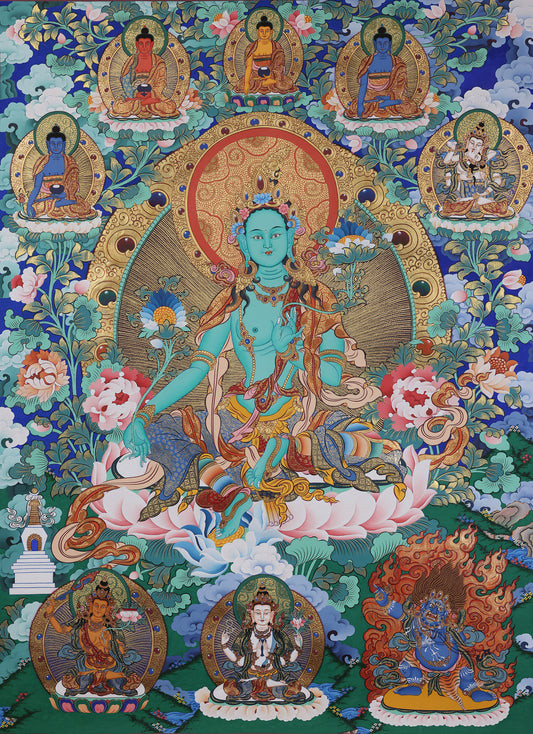

A Dual Vessel of Life Salvation and Artistic Spiritual Practice**
Within the Tibetan Buddhist thangka tradition, Black-Gold Thangka—distinguished by its profound black ground and luminous gold linework—stands as one of the most solemn and powerful visual forms for expressing themes of life salvation and spiritual healing.
This meticulously hand-painted thangka, centered on Medicine Buddha (Bhaisajyaguru), serves not only as a sacred visualization object for Tibetan devotees seeking healing and longevity, but also as a crystallization of Tibetan Buddhism’s principle of “transmitting the Dharma through art.”
Its thematic conception, iconography, and craftsmanship are all deeply rooted in both esoteric Buddhist doctrine and centuries-old artisanal discipline.
I. Core Theme: Worldly Healing and Ultimate Liberation
The spiritual core of this thangka lies in the Medicine Buddha’s vow of life protection and liberation from suffering.
Medicine Buddha, Sanskrit Bhaisajyaguru, fully known as The Lapis Lazuli Light Tathāgata, is revered in Tibetan Buddhism as the “Buddha of the Present Age.”
Unlike Dipankara Buddha, who represents the past, or Maitreya Buddha, who embodies the future, Medicine Buddha’s compassionate power is directed toward the physical and mental well-being of sentient beings in this very life.
According to The Medicine Buddha Sutra, he made Twelve Great Vows, including:
-
Eliminating illness and physical suffering
-
Protecting beings from untimely death
-
Granting abundance to those living in poverty
These vows address immediate human needs—health, safety, and sustenance—while simultaneously guiding practitioners toward ultimate enlightenment through purification of body and mind.
In Tibetan culture, devotion to Medicine Buddha is deeply intertwined with the realities of the plateau environment. Harsh climates, high altitudes, and limited medical resources have made healing deities especially vital.
Thus, Medicine Buddha is regarded as one of the most accessible and compassionate Buddhas, responding directly to lived human suffering.
In this thangka, the black background symbolizes ignorance, suffering, and existential hardship, while the gold lines represent the radiant vow-power of Medicine Buddha.
The central figure embodies salvation that arises within suffering, offering hope and protection amid adversity.
II. Iconography of the Main Deity: Ritual Codes of Healing
The depiction of Medicine Buddha strictly follows the canonical prescriptions of The Iconometric Treatises and The Medicine Buddha Sutra. Every visual detail carries doctrinal meaning.
Body Color and Auspicious Marks
The deity’s body appears in pure white or pale gold, symbolizing the clarity of Lapis Lazuli Light and the power of purification.
His face manifests the Thirty-Two Major Marks and Eighty Minor Signs, with a luminous ūrṇā (white curl) radiating cooling light.
The gently lowered eyes convey impartial compassion toward all beings, while the softly red lips suggest nourishment and healing through mercy.
Mudra and Sacred Implements
Medicine Buddha’s hands form the Medicine Mudra or Dhyāna Mudra, holding a Medicine Stupa or Lapis Lazuli Vessel filled with ambrosial nectar.
This nectar symbolizes the eradication of disease and karmic obscurations.
While some iconographies feature a medicinal plant or vajra pestle, the stupa here emphasizes ultimate spiritual healing beyond material remedies.
Attire and Posture
He wears a Five-Buddha Crown, signifying the embodiment of the Five Wisdoms, and is adorned with celestial garments and ornaments while exposing the right shoulder—typical of peaceful Buddhas.
Seated in full lotus posture upon a double-layered lotus throne, the partially opened lower petals represent unrealized Buddha-nature in beings, while the fully opened upper petals symbolize the perfected healing power of the Buddha.
A Dharma Wheel beneath the lotus signifies that his vow-power permeates all realms.
III. Attendant Deities: An Invisible Mandala of Protection
Rather than depicting attendants in explicit form, this black-gold thangka integrates them symbolically through ornamental motifs—a hallmark of refined Black-Gold Thangka aesthetics.
Ritual Symbols in the Halo
Surrounding the deity’s halo are symbolic references to the Seven Medicine Buddhas and Eight Auspicious Symbols.
The Treasure Vase echoes the Medicine Buddha’s nectar, while the Dharma Wheel represents his salvific teaching activity.
These motifs subtly invoke the blessings of Sunlight Bodhisattva, Moonlight Bodhisattva, and the Twelve Yaksha Generals.
Seed Syllables and Cloud Motifs
Seed syllables such as “Om” and “Hum” appear within the background, representing mantra power and the alignment of body, speech, and mind.
Flowing auspicious cloud patterns symbolize the manifestations of dakini protectors, illustrating the boundless reach of healing compassion.
This symbolic approach preserves visual solemnity while remaining faithful to Vajrayāna principles: the main deity as the source, attendants as extensions of enlightened activity.
IV. Artistic Technique: Healing Through the Black-Gold Process
This thangka employs the highly demanding Nag-thang (Black-Gold Thangka) technique. The creative process itself is a spiritual practice mirroring the Medicine Buddha’s healing activity.
Canvas and Pigments
The canvas is woven Tibetan cotton, prepared through multiple stages of stretching, gluing, and polishing with yak-hide glue and chalk powder until mirror-smooth—symbolizing the purification of mental defilements.
The black ground is composed of magnetite powder mixed with antler ash, representing the solidity of suffering and the unshakable power of salvation.
Gold is derived from 24K gold leaf, ground with agate stones for over 36 hours, then mixed with aged yak glue.
Gold’s imperishability symbolizes the eternal nature of the Buddha’s vows. The grinding process requires intense concentration, embodying meditative discipline.
Line Work and Raised Gold
The defining feature is iron-wire line drawing, executed with ultra-fine brushes.
Radiating gold lines behind the Buddha simulate Lapis Lazuli Light, dramatically emerging from the darkness.
Raised gold techniques create subtle relief effects, changing with light to signify that healing manifests according to each being’s capacity.
Facial Opening and Consecration
“Opening the eyes” (ka yan) is the most sacred phase. The artist undergoes purification, mantra recitation, and visualization retreats before painting the facial features with restrained, flowing strokes.
Upon completion, high monks consecrate the thangka, inscribing mantras on the reverse and sealing it with ritual handprints—transforming it from art into a living vessel of blessing.
V. Cultural Significance: From Survival to Spiritual Redemption
This Black-Gold Medicine Buddha Thangka is both an artistic expression of Tibetan survival experience and a visualization of compassion and wisdom united.
-
Environmental Context: The Medicine Buddha’s healing vows respond directly to the harsh realities of plateau life, while black-gold aesthetics amplify sacred solemnity.
-
Spiritual Elevation: Though centered on physical healing, the iconography ultimately guides practitioners toward liberation from mental suffering.
Through the stark contrast of black and gold, the thangka constructs a spiritual space where suffering and salvation coexist.
The black ground represents human affliction; the golden lines embody enlightened vow-power; the Medicine Buddha stands as the ultimate symbol of hope within suffering.
This work is not merely a piece of religious art—it is a cultural crystallization of Tibetan Buddhism’s belief in healing through vision, devotion through craftsmanship, and liberation through compassionate wisdom.
#Medicine Buddha Thangka,
#Black Gold Thangka,
#Tibetan Buddhist Thangka,
#Healing Buddha Art,
#Bhaisajyaguru Thangka,
#Hand Painted Thangka,
#Vajrayana Buddhist Art,
#Sacred Buddhist Artwork,
#Tibetan Religious Art,
#Spiritual Healing Thangka
#MedicineBuddha
#Bhaisajyaguru
#BlackGoldThangka
#TibetanBuddhistArt
#HealingBuddha
#VajrayanaArt
#SacredArt
#BuddhistThangka
#SpiritualHealing
#HandPaintedThangka
Schlagwörter:
Vorherige
Black-Gold Ākāśagarbha Bodhisattva Thangka in Tibetan Buddhism
Nächste
Tibetan Buddhist Black-Gold Green Tara Thangka: In-Depth Analysis of Theme, Iconography, and Craftsmanship