The Compassion of the Snowlands in Thangka Art: The Four-Armed Chenrezig in Tibetan Buddhism – Belief, Symbolism, and Art

When gilded moonlight falls on the canvas of a colored thangka, the white, moon-like four-armed figure holds a wish-fulfilling gem in palms pressed together: this is the Four-Armed Chenrezig, revered as the "Protector of the Snowlands" in Tibetan Buddhism. Amidst the clink of prayer wheels and the mineral pigments of thangka painters, he is more than a statue – he is a spiritual totem where compassion and wisdom intertwine.
I. From Mandala to the Snowlands: The Origins of the Four-Armed Chenrezig Belief
The Four-Armed Chenrezig in Tibetan Buddhism is no arbitrary deity; its roots trace to the 6th-century Sutra of the Great Vehicle’s Solemn Jewel King. In this text, Chenrezig first appears as the "Six-Syllable Great Brightness" in the mandala of Amitabha (the Buddha of Infinite Life), serving as an attendant bodhisattva holding a lotus and prayer beads, guarding the power of the Six-Syllable Mantra.
By the 11th century, as Tibetan Buddhism evolved indigenously, the Four-Armed Chenrezig gradually replaced Amitabha as the central deity of the mandala – a shift that transformed compassion rooted in pure land belief into a "liberation dharma" more accessible to Tibetan people. Professor Xie Jisheng notes that the rise of the Four-Armed Chenrezig reflects the process of "Chenrezig’s compassion practice replacing Amitabha’s ultimate pure land belief": when Tibetans recognized the Dalai Lama as an incarnation of Chenrezig, this four-armed figure truly became the "Guardian of the Snowlands."
Today in Tibet, from the murals of the Potala Palace to the thangkas in herders’ homes, the Four-Armed Chenrezig is ubiquitous – he has transcended religious symbolism to become the spiritual foundation of Tibetan culture’s "compassionate engagement with the world."
II. The Symbolic Code in the Thangka: The Imagery of the Four-Armed Chenrezig
Every detail of this colored thangka is a metaphor for the Dharma:
1. Form: The Purity of Moonlight
The Four-Armed Chenrezig’s body is as "radiant as the light of ten thousand autumn moons." White is not merely a soft visual hue; it symbolizes "innate purity without defilement" – untainted by the suffering of birth and death, yet unattached to the stillness of nirvana. Thangka painters layer mineral white pigments to recreate this "moonlight over snow-capped mountains" purity.
2. Four Arms: The Four Actions of Compassion
- Palms pressed together at the chest, holding a wish-fulfilling gem: The joined hands represent "the union of wisdom and skillful means," while the gem symbolizes "fulfilling all beings’ wishes" – the core of Chenrezig’s compassion: wisdom as the foundation, altruism as the practice.
- Right hand holding a crystal prayer bead: Each bead turned represents "liberating one being from samsara," a tangible expression of the vow "never forgetting the suffering of sentient beings."
- Left hand holding an eight-petaled white lotus: The lotus, unsoiled by mud, signifies maintaining a pure mind amid worldly chaos; the thangka’s cyan-blue lotus hue further alludes to "purifying afflictions."
- Left shoulder draped with a deer skin: Often overlooked, this detail symbolizes a "pure, compassionate heart" – deer are gentle creatures, and wearing their skin reflects Chenrezig’s compassion as "harmless and non-violent."
3. Adornments: Dharma in Jewelry
The five-buddha crown corresponds to "the wisdom of the five directional buddhas"; the necklaces and bracelets represent the "Six Paramitas" – generosity, morality, patience, diligence, meditation, and wisdom – all woven into this solemn regalia. Thangka painters inlay lapis lazuli and turquoise with gold powder, turning worldly opulence into a "vessel of the sacred."
III. From Visualization to Mantra Recitation: The Four-Armed Chenrezig’s Practice Rituals
For Tibetan Buddhist practitioners, the Four-Armed Chenrezig is not an "idol to worship" but a "dharma for mind cultivation." The Atisha-transmitted Four-Armed Chenrezig ritual fully embodies this process:
1. Visualization: Purifying Body, Speech, and Mind
Practitioners first visualize themselves as the Four-Armed Chenrezig, with the syllable "She" in their heart emitting light to invite the main deity and retinue – this is not "becoming Chenrezig," but awakening the inherent compassion within one’s own mind through visualization. The aura around Chenrezig in the thangka mirrors the "white light enveloping the self" in visualization.
2. Mantra Recitation: The Power of the Six-Syllable Mantra
The six-character mantra "Om Mani Padme Hum" is called the "King of All Mantras" by Tibetans. According to the Sutra of the Jewel King, reciting it can "alleviate illness, extend life, and seal the gates of the lower realms" – but its deeper meaning lies in stilling scattered thoughts through repetition, making compassion a subconscious habit.
In Tibet, herders count recitations with prayer wheels, while monks use beads to complete 108 daily recitations – this is not "mechanical repetition," but a practice of "infusing compassion into breath."
3. Dedication: Compassion in Action
The ritual concludes with practitioners dedicating merits to "all hungry ghost beings": visualizing nectar flowing from their hearts to satiate and comfort the hungry ghosts. This is the core of Chenrezig’s spirit: "self-benefit" paired with an unwavering commitment to "benefiting others."
IV. Colored Thangka: Frozen Art of Compassion
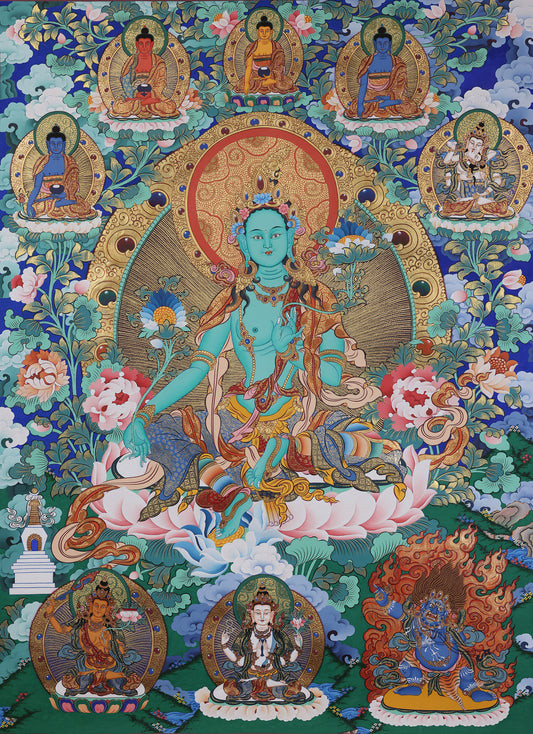
This Four-Armed Chenrezig thangka is itself a masterpiece of Regong thangka art:
1. Colors: The Sacredness of Mineral Pigments
Painters use mineral pigments like azurite, malachite, and cinnabar, processed through grinding, soaking, and filtering – these pigments resist fading for centuries, just as Chenrezig’s compassion "endures through time." The gold-outlined halos and robes lend the figure both "solemnity" and "vitality."
2. Composition: A Hierarchical Cosmic View
The central deity anchors the image, surrounded by clouds, flowers, and auspicious beasts – this "Chenrezig-centered" composition reflects Tibetan Buddhism’s worldview of "compassion as the core of all beings." The peacock and dragon motifs in the thangka are not mere decorations, but symbols of "dharma protectors guarding compassion."
3. Lineage: The Painter’s Faith and Craft
Regong thangka painters chant sutras to purify their minds before painting the Four-Armed Chenrezig – for them, this is not "drawing" but "painting the Buddha with a brush, transmitting the dharma with the heart." A Four-Armed Chenrezig thangka may take months or years to complete, with each stroke a "dialogue with compassion."
V. Contemporary Compassionate Insights: The Four-Armed Chenrezig’s Spiritual Value
In today’s fast-paced society, the Four-Armed Chenrezig’s spirit remains vibrant:
- Easing Anxiety: When overwhelmed by stress, visualize "moonlight-like white light" enveloping you – this is essentially mental regulation of "replacing panic with calm."
- Harmonious Relationships: The four arms remind us: when resolving conflicts, be humble like "joined palms," empathetic like "holding beads," and clear-minded like "holding a lotus."
- Ecological Coexistence: Chenrezig’s "deer skin" detail embodies an ecological view of "equality for all beings" – treating nature with compassion is practicing Chenrezig’s "nectar spirit."
A Tibetan proverb says: "Where Chenrezig is in the heart, every place is a pure land." The four-armed figure in this thangka was never a distant deity – he is the aspiration to "do good" in our hearts, the kindness to "help others," and the resolve to "remain pure in a complex world."
#FourArmedChenrezig #TibetanBuddhism #ThangkaArt #CompassionInBuddhism #SixSyllableMantra #TibetanCulture #Bodhisattva #SpiritualPractice #TibetanArt #ChenrezigSymbolism
Schlagwörter:
Vorherige
Manjushri in Tibetan Buddhism: The Deity of Wisdom in Black-Gold Thangka Art
Nächste
The Wisdom King in Silver Thangka: Manjushri in Tibetan Buddhism – Beliefs and Symbolism