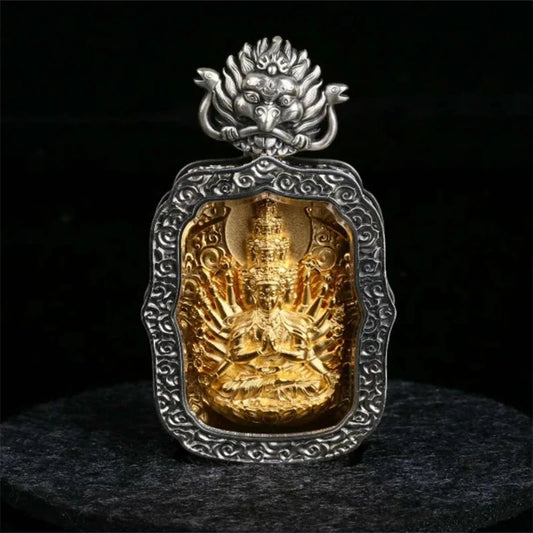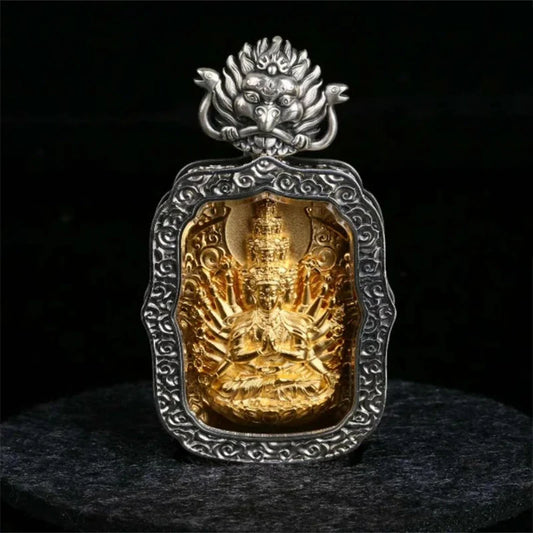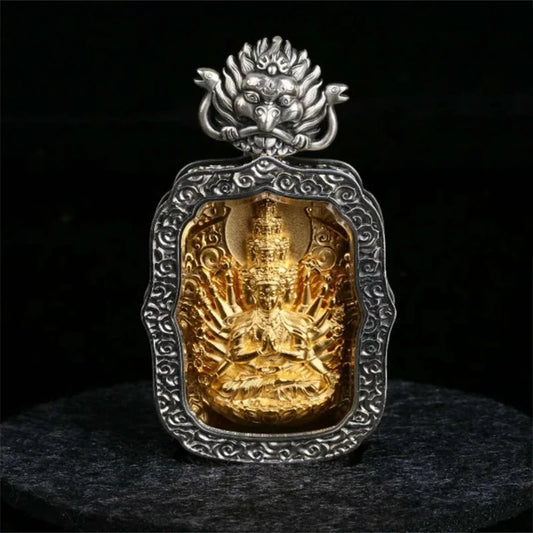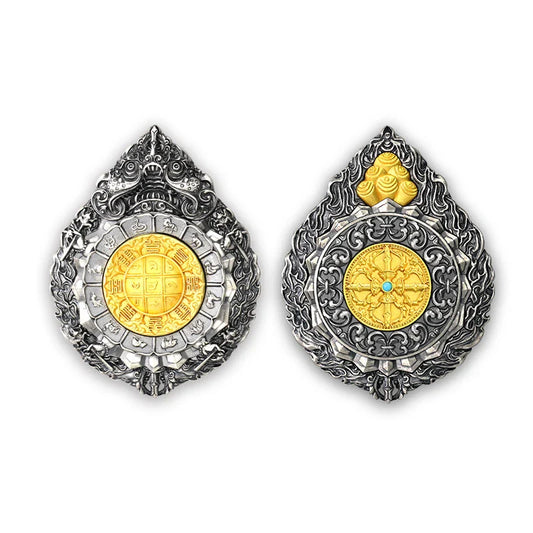
The Wisdom King in Silver Thangka: Manjushri in Tibetan Buddhism – Beliefs and Symbolism

When light catches the gold patterns of this silver thangka, the wisdom sword in Manjushri’s hand seems to pierce the fog of ignorance—one of the most moving moments in Tibetan Buddhist art: with silver foil as the base and mineral pigments as colors, "wisdom" is embodied as a bejeweled dharma body, letting faith grow in every texture. In the cosmology of Tibetan Buddhism, Manjushri (known as Jampelyang in Tibetan) is never a distant symbol, but the "core of wisdom" that runs through doctrine, practice, and culture.
I. "Teacher of All Buddhas": Manjushri’s Fundamental Status in Tibetan Buddhism
To understand the spiritual thread of Tibetan Buddhism, Manjushri is an unavoidable starting point.
In the Bowl-Releasing Sutra, Shakyamuni Buddha stated: "My attainment of Buddhahood is entirely due to Manjushri’s grace; countless Buddhas of the past were all Manjushri’s disciples." This positioning as the "parent of the Buddhist path" is further emphasized in Tibetan Buddhism: he is not only the embodiment of Mahayana wisdom, but also a "Buddha of the Three Times"—having previously been Mahasattva Tathagata and Nagaraja Tathagata, he will attain Buddhahood in the Stainless World as Universal Manifestation Tathagata in the future, and now "descends from his Buddha-realm" to liberate sentient beings in the form of a Bodhisattva.
In Tibet, this status is directly reflected in religious practice:
- Spiritual Totem of the Gelug School: Je Tsongkhapa is widely regarded as an incarnation of Manjushri. In Gelug monasteries (e.g., Ganden Monastery), Manjushri icons are often placed alongside Tsongkhapa’s image, symbolizing the "transmission of wisdom";
- Embodiment of the Five Wisdoms: The five-Buddha crown on Manjushri’s head corresponds to Vairocana’s "Dharmadhatu Wisdom, Great Perfect Mirror Wisdom, Equality Wisdom, Discriminating Wisdom, and Accomplishing Wisdom," representing the unification of all Buddhist virtues through wisdom;
- Core Yidam in Esoteric Buddhism: In Tibetan tantric scriptures such as The Sutra of Manjushri’s Ritual to Eliminate Ignorance, Manjushri is titled the "King of Wisdom," and his practices (e.g., the Manjushri Five-Character Mantra) are key methods for overcoming delusion and awakening prajna.
II. Symbolic Code in the Silver Thangka: Every Detail of Manjushri’s Iconography is "the Language of Wisdom"
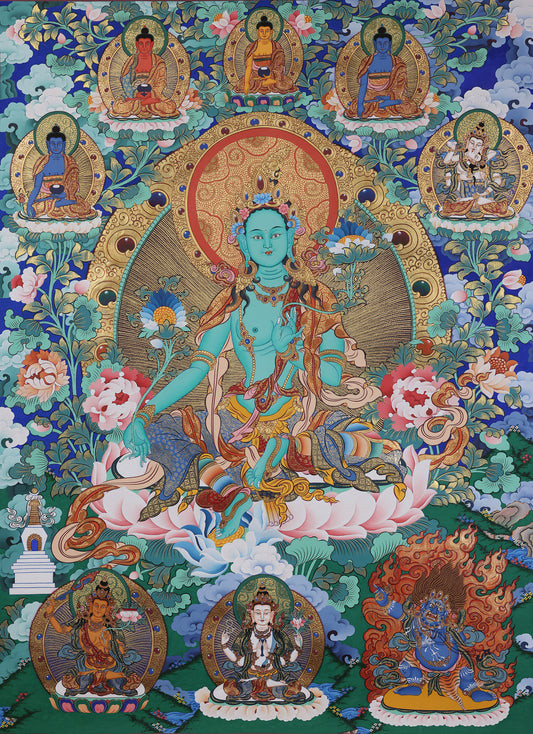
This silver thangka is a prime example of Tibetan Buddhism’s "conveying the Dharma through icons"—every detail speaks to Manjushri’s wisdom:
- Wisdom Sword and Prajna Sutra: The sword raised in his right hand is no ordinary metal, but a blade of wisdom that "cuts through the three poisons of greed, anger, and delusion"; the Prajnaparamita Sutra on the blue lotus in his left hand represents "ultimate wisdom untainted by defilement." Together, they form a logical loop of "dispelling delusion with wisdom, realizing enlightenment with the Dharma";
- Form and Ornaments: His "childlike form" symbolizes "wisdom’s inherent purity," while the gem-studded ornaments are not decorations, but the "embodiment of merit from the six paramitas and ten thousand practices";
- Lotus Seat and Retinue: The lotus seat below symbolizes "enlightenment rising untainted from the mire," while the surrounding Five Dhyani Buddhas (or Bodhisattvas) imply "Manjushri’s wisdom unifies all Buddhas’ virtues." The offering Bodhisattvas and protectors at the bottom are metaphors for "wisdom attracting good karma and subduing obstacles."
The "silver base" craftsmanship of this thangka also aligns with Manjushri’s essence: silver’s simplicity corresponds to "the purity of wisdom," and the durability of mineral pigments corresponds to "the eternity of wisdom"—as Tibetan painters say: "Every stroke of a thangka is painting ‘the shape of wisdom.’"
III. Manjushri Practice in Tibet: Wisdom Belief from Monasteries to Daily Life
In Tibet, Manjushri devotion is never "doctrine in books," but a spiritual practice embedded in daily life:
- Pilgrimage to Manjushri’s Sacred Sites: While Wutai Mountain is Manjushri’s sacred site in Han China, Tibet also has sites like the "Manjushri Cave in Medog Gongkar." During the Manjushri Dharma Assembly in the first month of the Tibetan calendar, devotees circumambulate the mountain holding scriptures, praying to awaken wisdom;
- Manjushri in Education: Manjushri icons are often enshrined in traditional Tibetan 私塾 (chokhang), and students worship him before starting school, symbolizing "opening academic pursuits with wisdom";
- Wisdom in Art: Beyond thangkas, Tibetan opera Manjushri and Tara and the "wise counselors" in the Gesar Epic are extensions of Manjushri belief in secular culture.
Even in history, Manjushri belief served as a cultural link: Emperor Qianlong of the Qing Dynasty was called the "Manjushri Emperor" in Tibet. This positioning as "secular ruler + wisdom incarnation" strengthened political legitimacy and made Manjushri belief a symbol of Han-Tibetan cultural integration.
IV. Behind the Silver Thangka: Craftsmanship as "Another Practice of Wisdom"
The value of this silver thangka lies not only in its religious symbolism, but also in its craftsmanship as "practice of wisdom":
Creating a Tibetan thangka is itself a "practice"—the canvas undergoes "nine layers of glue and nine polishes" to achieve "smoothness like a mirror"; pigments use minerals like gold, silver, and coral (the silver foil of this thangka is hammered to 1/1000 of a millimeter); painters must recite sutras and observe precepts before starting, with every stroke requiring "a mind free of distractions."
As the creator of this thangka said: "Painting Manjushri is not painting an ‘image,’ but painting ‘one’s own understanding of wisdom’—the hand must be steady, the heart pure, so that wisdom can ‘reside’ in the thangka." This approach of "attesting to wisdom through craftsmanship" embodies Tibetan Buddhism’s principle of "life as practice."
Conclusion: Manjushri’s Wisdom – "Letting Everyone Become Their Own Wise One"
When we gaze at this silver thangka, we see not just a Bodhisattva icon, but Tibetan Buddhism’s ultimate answer to "wisdom": it is not unreachable "supernatural power," but "the ability to see things as they are," "the courage to overcome afflictions," and "the aspiration for every being to awaken their inherent light."
In Tibet’s winds and the thangka’s patterns, Manjushri has never left—he is the scripture on every devotee’s desk, the line in every painter’s brush, and the original intention of every life "longing to be more awake and compassionate."
#ManjushriInTibetanBuddhism #SilverThangkaArt #TeacherOfAllBuddhas #WisdomSymbolism #TibetanEsotericManjushriPractice #ThangkaSymbolAnalysis #TibetanManjushriDevotion #ManjushriIconography #BuddhistWisdomCulture #TibetanBuddhistArt
Schlagwörter:
Vorherige
The Compassion of the Snowlands in Thangka Art: The Four-Armed Chenrezig in Tibetan Buddhism – Belief, Symbolism, and Art
Nächste
The Wisdom of Wealth in Silver Thangka: The Millennium-Old Belief and Contemporary Enlightenment of Yellow Jambhala in Tibetan Buddhism