The Embodiment of Wisdom in Black-Gold Thangka: Manjushri in Tibetan Buddhism

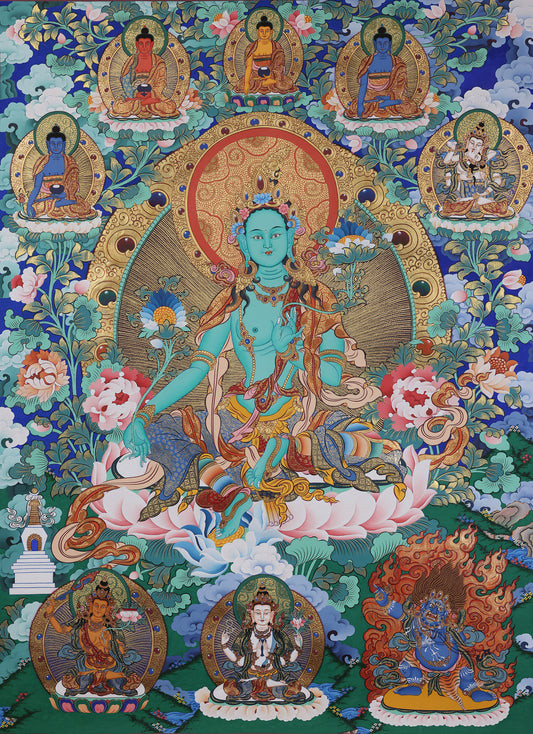
When a black-gold thangka, outlined in pure gold and dyed with natural mineral pigments, unfolds, the golden-bodied Manjushri—holding a wisdom sword and a scripture scroll, seated serenely on a lotus throne—reveals itself not only as a masterpiece of the Regong painting school but also as the tangible manifestation of the "sum of all wisdom" in Tibetan Buddhism. In the Tibetan Buddhist belief system, Manjushri (Sanskrit: Maňjuśrī, meaning "Wondrous Auspiciousness") is no ordinary protective deity; he is the ultimate embodiment of the wisdom of all Buddhas, a core spiritual symbol that runs through both exoteric and esoteric teachings.
I. The Source of Wisdom in the Three Realms: Manjushri’s Sacred Status
In the "Three Protectors" (Rigsum Gonpo) system of Tibetan Buddhism, Manjushri (Wisdom), Avalokiteshvara (Compassion), and Vajrapani (Power) are collectively called the "Clan Three Lords," with Manjushri taking precedence—for wisdom is the foundation of Buddhahood. Scriptures record that he was once the "teacher of the Seven Past Buddhas," and even Shakyamuni Buddha received his guidance, earning him the title "Teacher of All Buddhas."
In esoteric texts, Manjushri is further endowed with the secret meaning of "Vajra of Speech": the wisdom contained in the Buddha’s words is as firm as a vajra, capable of destroying all delusions and heretical views. In the Gelug tradition, the founder Tsongkhapa is widely recognized as an incarnation of Manjushri, and his work The Great Treatise on the Stages of the Path to Enlightenment stands as the pinnacle of wisdom teachings; Sakya lineage master Khön Könchok Gyalpo encountered Manjushri at the age of eight and received the "Path and Fruit Dharma," which has been passed down through successive Sakya Trizins.
II. Esoteric Codes in Iconography: Manjushri’s Symbols in the Black-Gold Thangka
Every detail of this black-gold thangka is a metaphor for wisdom:
- Wisdom Sword and Scripture Scroll: The Prajna Flame Sword held aloft in the right hand symbolizes cutting through the roots of ignorance, affliction, and heresy; the Prajna Scripture Scroll resting on a blue lotus in the left hand signifies that wisdom, like a lotus rising untainted from mud, takes the sutras as the carrier of truth.
- Five-Jewel Crown: The five jewels on the crown correspond to the "Five Buddha Wisdoms" (Dharmadhatu Nature Wisdom, Great Perfect Mirror Wisdom, etc.), representing the ultimate state of perfect enlightenment.
- Golden Body and Lotus Throne: The golden body radiates the light of wisdom, and the lotus throne signifies the pure nature transcending samsara; the background clouds and baoxiang flowers are typical elements of "pure land solemnity" in Regong thangkas.
This black-gold thangka, rendered with 24K pure gold outlines and natural mineral pigments, is precisely the cultural expression of Tibet’s "using gold to metaphorize wisdom"—the eternal luster of gold mirrors the indestructibility of Manjushri’s wisdom.
III. The Unity of Five Wisdoms: The Five Manjushris System in Tibetan Buddhism
In Tibetan Buddhism, Manjushri appears in the form of the "Five Manjushris," corresponding to the five wisdoms of the Five Dhyani Buddhas:
- Yellow Manjushri (Manjushri the King): Yellow in body, holding a wisdom sword and scripture scroll, he is the principal deity of the Five Manjushris, representing the "Dharmadhatu Nature Wisdom."
- White Manjushri: White in body, making the wish-fulfilling mudra, he symbolizes the "Great Perfect Mirror Wisdom"; his practice methods enhance wisdom and memory.
- Red Manjushri: Red in body, holding a bow and arrow, he embodies the "Subtle Observing Wisdom," corresponding to the wisdom of harmonizing sentient beings.
- Green Manjushri: Green in body, holding a lotus and sword, he represents the "Equality Wisdom."
- Blue Manjushri: Blue in body, he signifies the "Accomplishing Wisdom," symbolizing the actionable power of wisdom.
The main deity in this black-gold thangka is precisely Yellow Manjushri—the tangible embodiment of the unity of the five wisdoms.
IV. From Thangka to Practice: Devotional Practices of Manjushri
Manjushri devotion is not an abstract concept but a daily practice integrated into Tibetan life:
- Mantras and Rituals: The White Manjushri mantra ("Om Va Gyad Na Ma") is one of the most popular practices; the ritual requires visualizing the "Milk Lake Lotus" pure land and reciting the mantra to purify karmic obstacles and awaken wisdom. Traditional retreats involve reciting the mantra over 1.8 million times to attain the "non-forgetting" accomplishment (enhancing memory).
- Pilgrimage to Mount Wutai: Both Han and Tibetan Buddhists revere Mount Wutai in Shanxi as Manjushri’s dharma realm. Tibetan monks crossed snow-capped mountains to pilgrimage here as early as the Tibetan Empire period, and masters like Milarepa once practiced there.
- Academic and Career Blessings: Folk belief holds that Manjushri aids children’s studies, officials’ good fortune, and merchants’ prosperity—essentially an extension of the belief that "wisdom overcomes obstacles."
V. Art as Devotion: Black-Gold Thangka and Manjushri Culture
Black-gold thangka is a representative of Tibet’s "wisdom art":
- Material Symbolism: The white cotton base (purity), mineral pigments (eternity), and gold outlines (wisdom) align with the esoteric concept that "materials are blessings."
- Painting School Tradition: This work originates from the Regong Namgyal Painting Academy. Regong thangkas are renowned for their "sublime facial expressions"—Manjushri’s compassionate visage embodies the idea that "wisdom and compassion are non-dual."
- Functional Attribute: Thangkas were originally "mobile sutras," serving both as objects of visualization for practice and carriers of wisdom transmission; today, black-gold Manjushri thangkas remain "wisdom sacred objects" enshrined in Tibetan households.
Conclusion: The Eternal Embodiment of Wisdom
When we gaze at this black-gold thangka, we see not just the iconography of a bodhisattva, but Tibetan Buddhism’s ultimate interpretation of "wisdom": it is not a pile of knowledge, but a sword that cuts through delusion, a light that transcends samsara.
Schlagwörter:
Vorherige
Yellow Jambhala in Tibetan Buddhism: More Than Wealth Attraction – The Wisdom of Blessings in Symbolism, Worship, and Practice
Nächste
Siddhartha Gautama in Tibetan Buddhism: Understanding the Compassion and Teachings of the Original Teacher Through a Colored Thangka