Vairocana Buddha in Tibetan Buddhism: The Wisdom and Spiritual Symbol of the Dharmakaya Buddha in Color Thangka

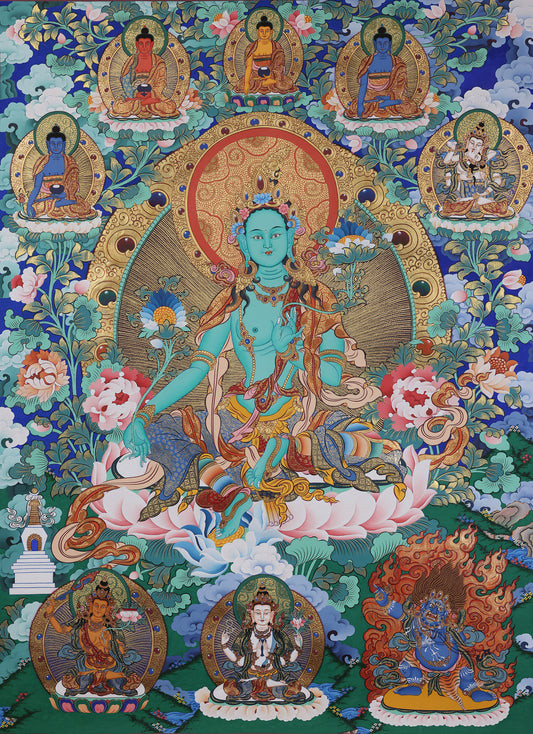
When you gaze at this Color Thangka, it’s hard not to be drawn to its rich hues and solemn atmosphere: a warm golden halo spreads like sunlight, a crimson monk’s robe is woven with intricate patterns, and a thousand-petal lotus throne supports the Buddha seated in full lotus position. His right hand is raised gently as if to soothe the world’s chaos, while his left hand rests open as if granting sentient beings’ good wishes—this is Vairocana Buddha, the most core Dharmakaya Buddha in Tibetan Buddhism.
In the cosmology of Tibetan Buddhism, Vairocana Buddha is not a “deity” but the embodiment of the essence of Dharma. He is the central core of the “Five Dhyani Buddhas” system, a symbol of “all-pervading light” wisdom, and this Color Thangka is a microcosm of how Tibetans fuse faith, art, and philosophy into one.
1. Vairocana Buddha: The Core Dharmakaya Buddha in Tibetan Buddhism
In Tibetan Buddhism’s system of Buddha bodies, a Buddha manifests in three forms:
- Nirmanakaya (Emanation Body): The concrete form a Buddha takes to liberate sentient beings (e.g., Shakyamuni Buddha);
- Sambhogakaya (Enjoyment Body): The majestic form a Buddha assumes after attaining full enlightenment;
- Dharmakaya (Truth Body): The “original nature” of a Buddha—representing the essence of Dharma and the truth of the universe, an unborn, undying wisdom that permeates all realms.
In Tibetan Buddhism, Vairocana Buddha and the Great Sun Tathagata are one and the same. “Vairocana” means “all-pervading light” in Sanskrit, hence its Chinese name “Great Sun Tathagata”—just as the sun warms the world without discrimination, his wisdom illuminates all sentient beings in the Dharmadhatu.
As the central Buddha of the Five Dhyani Buddhas, Vairocana presides over the other four:
- Aksobhya Buddha (East, corresponding to “Mirror-like Wisdom”);
- Ratnasambhava Buddha (South, corresponding to “Equality Wisdom”);
- Amitabha Buddha (West, corresponding to “Discriminating Wisdom”);
- Amoghasiddhi Buddha (North, corresponding to “Accomplishing Wisdom”).
Vairocana’s own corresponding “Dharmadhatu Vagishvara Wisdom” is the foundation of these five wisdoms—it represents the “equality and non-difference of all phenomena,” purifying sentient beings’ “ignorant afflictions” and transforming the “form skandha” into pure Dharma nature.
2. This Color Thangka: The Faith Codes in Its Iconography
This work belongs to “Color Thangka”—one of the most visually striking types of Tibetan Thangka. Its core feature is the use of natural mineral pigments (cinnabar, azurite, malachite) and gold leaf, resulting in vivid colors that remain unfaded for millennia (per traditional Tibetan craftsmanship records, high-quality Color Thangkas require blending over 30 colors). Every detail of this Thangka hides Tibetan Buddhist rituals and symbolism:
1. Physique: Rituals Behind the Solemnity
- Posture: The Buddha sits in the “full lotus position” (legs crossed with soles upward)—a symbol of “stability and meditative concentration” in Tibetan Buddhist iconography, representing the Buddha’s transcendence of worldly restlessness.
- Mudras: The right hand forms the “Abhaya Mudra” (palm outward, fingers extended), symbolizing “granting fearlessness and ease to sentient beings”; the left hand forms the “Varada Mudra” (palm upward, resting on the knee), symbolizing “fulfilling sentient beings’ good wishes.” Unlike the “Wisdom Fist Mudra” commonly seen in the Vajra Realm Vairocana, this combination emphasizes his “compassionate liberation of beings” aspect.
- Robes: The monk’s robe exposes the right shoulder and covers the left— a classic style in Tibetan Buddhist iconography. The exposed right shoulder represents “letting go of attachment,” while the covered left shoulder symbolizes “protecting sentient beings.” The geometric patterns on the robe derive from traditional Tibetan textiles, implying a “connection between the secular and the transcendent.”
2. Background: Auspicious Metaphors in the Elements
- Halo and Aura: The nimbus (circular halo) and body aura (radiating halo) are laid with gold leaf, edged with the “Eight Auspicious Symbols” (Dharma wheel, treasure vase, etc.)—gold symbolizes “the all-pervading light of the Buddha,” while the Eight Auspicious Symbols represent “perfection and protection.”
- Lotus Throne: The Buddha sits atop a “thousand-petal lotus” with layers of 舒展 petals. In Tibetan Buddhism, the lotus—“rising unsullied from mud”—symbolizes “the pure Buddha-nature inherent in all sentient beings”; the water patterns beneath the lotus represent the “transition between worldly afflictions and transcendent wisdom.”
- Environmental Elements: The yellow auspicious clouds (called “lucky clouds” in Tibet) symbolize “good fortune and auspiciousness”; the pink flowers (a blend of peony and lotus) represent “beauty and purity”; the green trees signify “the vitality and inheritance of Dharma.”
3. Vairocana Buddha: Spiritual Guidance Beyond Form
For Tibetan believers, Vairocana Buddha’s image is not an “idol to worship” but a “tool for visualization.” Practitioners gaze at the Thangka, gradually visualizing the Buddha’s form and light, and ultimately realize the Dharmadhatu Vagishvara Wisdom that “one’s own nature is no different from Vairocana’s.”
The core of this visualization is understanding the “Great Sun” meaning of Vairocana: just as the sun does not shine on only one place, wisdom does not exclude any sentient being. As stated in the Commentary on the Great Sun Sutra (a Tibetan Buddhist classic), Vairocana’s “light” is wisdom that “dispels darkness, fulfills all things, and is unborn and undying”—it is not just “knowledge,” but “the awakening to one’s own pure nature.”
The value of this Color Thangka lies in its transformation of abstract “Dharma nature” into a visible form: when a believer looks into the Buddha’s gaze, they see not “a single Buddha,” but “their own inherent pure mind.”
4. Color Thangka: A Living Art Fossil Bearing Faith
Tibetan Color Thangka is more than “art”—it is a “carrier of practice”:
- Production Process: Before painting, the artist must purify themselves and chant sutras, strictly following the proportions in the Iconometric Sutra (e.g., the Buddha’s face length must equal the length of his palm). Every stroke is not “creation,” but a “reproduction of Dharma nature.”
- Cultural Value: This Color Thangka retains the “magnificent color scheme” of the Menri School (a Tibetan painting school) while integrating Han-style flower-painting techniques (e.g., petal shading)—it is tangible evidence of “Han-Tibetan cultural integration.”
Today, Color Thangka is listed as a Tibetan intangible cultural heritage, and young artists still learn to grind mineral pigments and apply gold leaf. This is not just the inheritance of craftsmanship, but the continuation of Vairocana Buddha’s wisdom.
5. Contemporary Perspective: Vairocana’s “All-Pervading” Wisdom
In the fast-paced modern world, Vairocana’s “all-pervading” wisdom still offers insights:
- It reminds us of “the equality of all sentient beings”—just as the sun does not discriminate between creatures, we can let go of prejudice against others;
- It guides us to “return to our original mind”—just as the lotus blooms from mud, we can awaken our inherent pure nature amid afflictions.
This Color Thangka of Vairocana Buddha is both a Tibetan Buddhist faith symbol and a masterpiece of humanity’s transformation of “abstract wisdom into visual art.” It shows us that faith has never been far from life—it quietly tells the ancient truth of “all-pervading light” through colors and lines.
#VairocanaBuddhaInTibetanBuddhism #ColorThangka #FiveDhyaniBuddhas #DharmakayaBuddha #TibetanCulturalHeritage #ThangkaArt #TibetanBuddhistArt #MineralPigmentThangka #DharmadhatuVagishvaraWisdom #MenriSchoolThangka #BuddhistIconography #VairocanaThangka #TibetanSpiritualArt
Schlagwörter:
Vorherige
Shakyamuni in Tibetan Buddhism: The Color and Spiritual Code of the Enlightened One
Nächste
Kubera (Yellow God of Wealth): The Guardian of Prosperity and Wisdom in Tibetan Buddhism, Balancing Tangka Symbols with Modern Views on Wealth