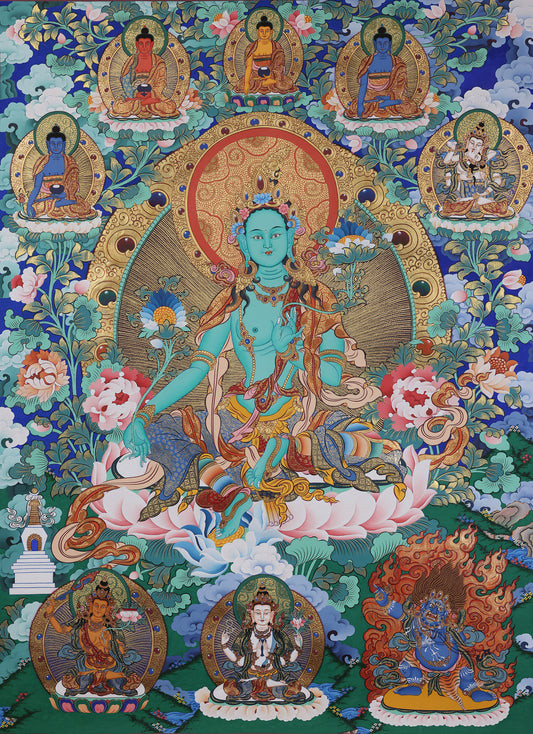
Tibetan Yellow Jambhala Thangka: Decoding Faith and Artistic Symbolism in the Visual Ritual of Accumulating Wealth

1. Core Theme: The Dialectical Faith Field of “Merit and Wisdom Wealth”
The Tibetan Yellow Jambhala (Tibetan: Zang-la Se-po) Thangka is one of the most representative devotional icons within the “Five Jambhala” system of Tibetan Buddhism. Unlike the secular, utilitarian perception of a “wealth deity,” in the Tibetan context, Yellow Jambhala is a “dual protector of material resources and spiritual merit and wisdom.” His image embodies not only wishes for worldly abundance but also the Tibetan Buddhist logic of practice: “wealth as a supportive means, wisdom as the ultimate foundation.”
Within the doctrine of “dual cultivation of merit and wisdom,” wealth is defined as a resource for practice rather than the goal itself. Without a stable material foundation, practitioners cannot engage in practice wholeheartedly; yet attachment to wealth leads to greed and ignorance. Therefore, the essence of the Yellow Jambhala Thangka is a “visualized ritual of accumulating resources and awakening wisdom.” In the composition, the main deity represents the “skillful means to overcome poverty,” while the attendant deities symbolize the “supportive power to protect wealth.” Together, the scene forms a faith field of “using wealth as a vessel to cross toward liberation,” addressing worldly needs while anchoring the spiritual principle of non-attachment.
2. Main Deity: Iconography and Esoteric Symbolism
The central figure is Yellow Jambhala in his manifestation as Ratnasambhava Buddha, strictly following the canonical Sutra on Measurements for Iconography and the Ritual Manual of Jambhala. Every detail embodies esoteric symbolism.
a. Body, Color, and Symbolism
Yellow Jambhala is depicted in a bright earth-yellow hue, corresponding to Ratnasambhava of the Five Dhyani Buddhas, symbolizing equanimous wisdom—treating beings and wealth without discrimination, dissolving the attachment to wealth disparities. His plump body and exposed belly represent worldly abundance and signify the doctrine of generosity and non-attachment—the exposed belly represents openness and absence of greed.
b. Ritual Implements and Mudras
-
Left Hand: Wealth-spouting Weasel (Tibetan: Nü-lé)
The weasel continually emits treasures, symbolizing unceasing flow of wealth and resources, while also representing the transformation of greed into wisdom, turning afflictions into aids for practice. -
Right Hand: Varada Mudra or Holding Cintamani
The gesture symbolizes granting beings fearlessness and joy. The Cintamani represents pure wisdom that fulfills all virtuous wishes. -
Side: Wish-Fulfilling Vase
Filled with nectar and treasures, it symbolizes the perfection of merit and wisdom, implying that wealth must be purified by wisdom to become a wholesome resource.
c. Headdress and Attire
Yellow Jambhala wears the Five-Buddha Crown, symbolizing the blessings of the Five Dhyani Buddhas, signifying that the protection of wealth is the collective manifestation of Buddha wisdom. Adorned with precious jewelry—gold bangles, jade earrings, gemstone necklaces—the ornaments reflect nobility but are worn in non-attachment, embodying the principle of mastering wealth with a pure mind.
d. Posture and Lotus Throne
Seated in half-lotus posture atop a thousand-petal red lotus, the lotus symbolizes purity—wealth arises in the mundane world (mud) yet remains uncontaminated (lotus). The Mount Sumeru base below represents that the root of wealth is the Bodhicitta; only wealth gained with altruistic intention constitutes pure merit resources.
3. Attendant Deities: Supportive System for Wealth Protection
The attendants are functional companions of Yellow Jambhala’s wealth activities, not mere decoration, corresponding to categories in Tibetan esoteric rituals.
-
Left Attendant: Sudhana or Treasure-bearing Female Deity
Holding a treasure plate, this figure represents skillful means to actively accumulate wealth. In esoteric rituals, Sudhana symbolizes diligence and faith in acquiring wealth through virtuous means, highlighting that wealth should be gained through integrity, not speculation. -
Right Attendant: Wealth Protector (or Black Jambhala)
Deep blue and wrathful, holding a vajra and treasure bag, representing subduing obstacles that steal or deplete wealth. Black Jambhala, the wrathful manifestation, removes the negative influence of greed, hatred, and ignorance, ensuring wealth is preserved for spiritual and practical purposes. -
Background Elements
Above the main deity, auspicious clouds and treasure umbrella symbolize purified protection of wealth. Below, the Seven Treasures (coral, agate, glass, etc.) represent both worldly wealth and transcendent wisdom, corresponding to the seven resources (faith, diligence, mindfulness, concentration, wisdom, shame, and embarrassment), emphasizing that wealth is ultimately a means to support practice aligned with virtue.
4. Artistic Craftsmanship: Natural Materials and Ritualized Creation
This Thangka, a pure hand-painted masterpiece of the Rebgong or Menri school, embodies both artistic skill and religious practice of “materializing spiritual intent.”
a. Materials: Eternal Blessing of Earthly Treasures
-
Yellow Pigment: Orpiment + 24K gold powder, processed through 12 steps, producing rich earth-yellow tones.
-
Blue Pigment: Lapis lazuli + malachite ground to micron-level, yielding deep space-blue, symbolizing vast and inclusive wisdom.
-
Red Pigment: Cinnabar + wild Tibetan safflower, vivid and symbolizing compassion and generosity.
b. Process: Ritualized Devotional Practice
The creation involves 12 core steps, each accompanied by mantra recitation:
-
Canvas Preparation: Cowhide glue + Tibetan paper, repeatedly polished and dried 7 times, symbolizing purification of mind.
-
Preliminary Drawing: Laid out with golden ratio (37:25) to ensure deity’s features conform to canonical standards.
-
Face Completion: Eyes painted by a skilled artist on an auspicious day with mantra blessings, imbuing the Thangka with spiritual presence.
-
Consecration: Back of the Thangka holds Yellow Jambhala heart-mantra scrolls, relic powder, and nectar pills, blessed by senior monks, making it a reliable support of body, speech, and mind for devotees.
c. Style Features
-
Composition: Main deity at center, attendants and background symmetrically layered for visual and spiritual hierarchy.
-
Line Work: Iron-line for tools and robes, fine wispy lines for hair and jewelry, combining strength and delicacy.
-
Color Technique: High saturation, layered shading (yellow up to 7 layers, background gradient blue-green), evoking all-encompassing void.
-
Gold Decoration: Pure gold lines + gilded embellishments, refined to 0.045mm, enhancing sacredness and symbolizing Buddha’s illuminating wisdom.
5. Cultural Significance: Thangka as Mediator of Wealth and Wisdom
Yellow Jambhala Thangka is not a mere money-attracting talisman, but a spiritual medium connecting practitioners with the deity.
-
Meditation Tool: Practitioners focus on the deity’s form and esoteric symbolism, transforming external wealth imagery into internal wisdom.
-
Ritual Offering: Observing purity of offerings (water, flowers, incense) and practicing generosity aligns with Yellow Jambhala’s teaching.
-
Symbolism: The wealth-spouting weasel embodies transformation of greed into spiritual resources, reflecting the core Tibetan Buddhist principle: “Afflictions themselves are Bodhi.”
This Thangka encapsulates esoteric symbolism, sacred craftsmanship, and dialectical doctrine. It is both a devotional icon for accumulating resources in Tibetan households and a vivid testament to how art embodies philosophical and spiritual teachings—wealth is no longer mundane utility but a means for dual cultivation of compassion and wisdom.
#TibetanBuddhism #YellowJambhala #ThangkaArt #WealthDeityThangka #TibetanThangka #BuddhistArt #SpiritualWealth #MeditationTool #HandPaintedThangka #TibetanCulture #BuddhistWisdom #CompassionAndWisdom #EsotericBuddhism #RebgongArt #MenriThangka
Schlagwörter:
Vorherige
Decoding the Faith Behind Yellow Jambhala Thangka A Visual Ritual of Wealth and Wisdom in Tibetan Buddhism
Nächste
Faith and Artistic Deconstruction of the Tibetan Yellow Jambhala Thangka: