Decoding the Faith Behind Yellow Jambhala Thangka A Visual Ritual of Wealth and Wisdom in Tibetan Buddhism

In the artistic universe of Tibetan Buddhism, a thangka is far more than a religious painting or decorative object. It is a comprehensive visual system that integrates doctrine, meditation practice, ritual function, and sacred aesthetics. Among all thangka subjects, those dedicated to Yellow Jambhala (Dzambhala) stand out as profound visual teachings on how Tibetan Buddhism responds to the worldly theme of wealth—not by rejecting it, but by transforming it through wisdom and compassion.
This article offers an in-depth interpretation of Yellow Jambhala Thangka through five dimensions: spiritual doctrine, iconographic symbolism, retinue structure, painting craftsmanship, and cultural significance. Together, these elements reveal how wealth and enlightenment are unified within a sacred visual ritual.
I. Core Theme: Wealth as the Union of Compassion and Wisdom
Yellow Jambhala, known in Tibetan as Dzambhala Serpo, is the most central and widely venerated deity within the Five Wealth Deities system of Tibetan Buddhism. However, in the Vajrayana tradition, Yellow Jambhala is never regarded as a mere “god of money” in a secular sense.
Instead, he is understood as the protector of both material prosperity and spiritual merit:
-
On one level, he alleviates poverty and removes financial obstacles so practitioners can pursue the Dharma without hardship.
-
On a deeper level, he guides beings to relate to wealth with wisdom, preventing attachment, greed, and moral corruption.
In Tibetan Buddhist philosophy, wealth is neither condemned nor worshipped—it is seen as a supportive condition for practice. Without material stability, sustained spiritual cultivation is difficult; with excessive attachment, wealth becomes a source of suffering. Yellow Jambhala Thangka visually resolves this paradox by presenting wealth as a vehicle toward awakening rather than an object of craving.
The main deity represents the power to dispel poverty, while the surrounding retinue symbolizes supportive forces that protect and regulate wealth. Together, they form a complete visual mandala of “accumulating resources to support the path to liberation.”
II. The Iconography of the Main Deity: Symbolic Structure and Esoteric Meaning
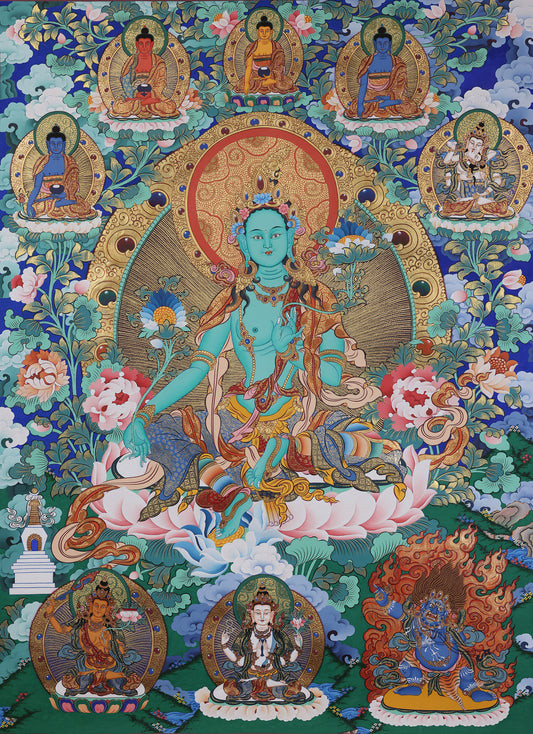
At the center of the thangka, Yellow Jambhala appears in his fully adorned, majestic form. His iconography strictly follows classical Vajrayana texts such as the Iconometric Treatises and Wealth Deity Sadhanas. In tantric art, every visual element conveys doctrinal meaning—nothing is merely decorative.
1. Body Color and Form
Yellow Jambhala’s body is rendered in a rich golden-yellow tone, corresponding to Ratnasambhava Buddha and the wisdom of equanimity. His corpulent form symbolizes abundance, generosity, and the elimination of miserliness. It teaches that true prosperity arises from openness rather than hoarding.
2. Mudras and Attributes
-
His right hand holds a wish-fulfilling jewel or displays the gesture of generosity and fearlessness.
-
His left hand cradles a treasure-spouting mongoose, an ancient Indian symbol of wealth that continuously produces jewels, representing inexhaustible resources.
-
A wish-fulfilling vase rests at his side, containing both nectar and treasures—an emblem of the unity of material and spiritual fulfillment.
3. Posture and Lotus Throne
Yellow Jambhala sits in a relaxed semi-lotus posture upon a fully bloomed lotus throne. The lotus signifies purity arising from samsaric conditions, reminding practitioners that wealth, though worldly, can remain unstained. The lotus rests upon a Mount Meru base, emphasizing that wealth must be grounded in bodhicitta and ethical intention.
III. Retinue Deities: The Functional Network of Wealth Protection
In Yellow Jambhala Thangka, the surrounding deities are not secondary decorations but integral components of his enlightened activity. They reflect the Vajrayana principle of differentiated functions within enlightened action.
-
Treasure-bearing attendants or celestial maidens hold jewel trays, symbolizing honest livelihood, faith, and diligence as sources of prosperity.
-
Wrathful wealth protectors, often represented by Black Jambhala, embody the force that subdues theft, loss, and financial obstacles. As a wrathful emanation, Black Jambhala protects wealth by transforming destructive energies.
At the lower section of the composition, heaps of jewels often represent the Seven Royal Treasures, symbolizing both worldly abundance and supramundane merit.
IV. Painting Craftsmanship: Material as a Vessel of Spiritual Practice
Authentic Yellow Jambhala Thangkas are traditionally produced within lineages such as the Menri (Mentri) and Regong (Rebkong) painting schools. The artistic process itself is considered a form of meditation and ritual discipline.
1. Natural Mineral Pigments
-
Yellow hues are derived from orpiment blended with 24K gold powder, symbolizing enduring wealth and sacred luminosity.
-
Blue pigments come from finely ground lapis lazuli and azurite, evoking the depth of wisdom and boundless space.
-
Reds are created from cinnabar and safflower, expressing compassion and generosity.
2. The Twelve Ritualized Painting Stages
From canvas preparation and precise line drawing to layered coloring, gold detailing, and final consecration, each stage is accompanied by mantra recitation. The most sacred moment is the eye-opening ceremony, during which the deity’s eyes are painted—transforming the image from art into a living field of blessing suitable for meditation and offering.
V. Cultural Significance: Thangka as a Mediator Between Wealth and Wisdom
Within Tibetan Buddhist practice, Yellow Jambhala Thangka is not used as a talisman for blind wealth-seeking. Instead, it functions as a meditative and ethical guide:
-
In contemplation, practitioners internalize the outer image of wealth and transform it into inner wisdom.
-
In offering practice, generosity and ethical conduct align the practitioner with Jambhala’s enlightened intention.
-
Symbolically, the jewel-spouting mongoose represents the transformation of greed into generosity—an embodiment of the Vajrayana principle that afflictions themselves can become wisdom.
Conclusion: Wealth as Enlightened Support, Not Attachment
This Yellow Jambhala Thangka condenses Tibetan Buddhism’s sophisticated view of wealth into a single sacred image. Through symbolic iconography, ritual craftsmanship, and philosophical depth, it presents wealth not as an end in itself, but as a supportive condition for compassion, wisdom, and awakening.
Here, wealth is no longer a worldly obsession—it becomes a skillful means guided by enlightened intention.
#YellowJambhala
#YellowJambhalaThangka
#WealthDeityThangka
#TibetanBuddhistThangka
#Dzambhala
#TibetanBuddhistArt
#VajrayanaBuddhism
#SacredBuddhistArt
#BuddhistWealthDeity
#TibetanThangkaPainting
#ProsperityAndWisdom
#SpiritualWealth
#BuddhistMeditationArt
#BusinessAndSpirituality
#MindfulAbundance
#HandPaintedThangka
#TraditionalThangka
#MineralPigmentArt
#HimalayanArt
Schlagwörter:
Vorherige
The Wealth Guardian in Thangka Art: Vaishravana in Tibetan Buddhism – Beliefs, Symbols, and Modern Insights
Nächste
Tibetan Yellow Jambhala Thangka: Decoding Faith and Artistic Symbolism in the Visual Ritual of Accumulating Wealth