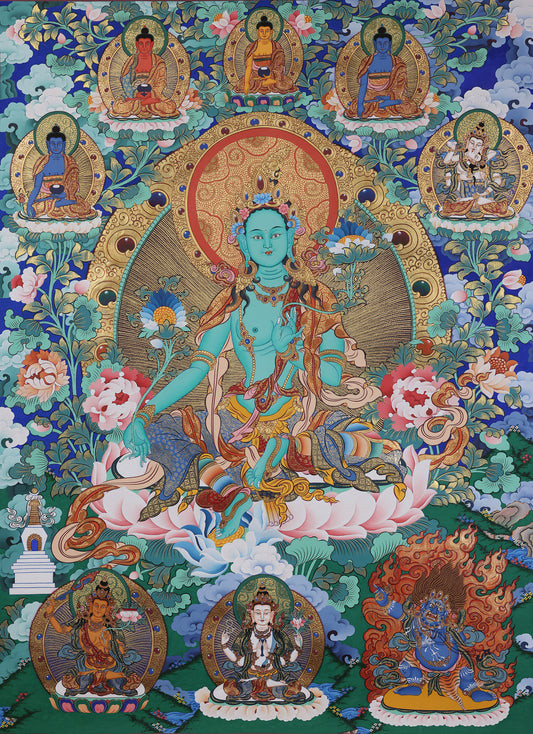
Tibetan Buddhist Black-Gold Thangka: Interpreting the Wrathful Form of Vajrapani and the Hidden Codes of Sacred Craftsmanship

In the artistic system of Tibetan Buddhism, a Thangka is often described as “visible Dharma.” It is not merely a religious painting, but a spiritual medium that integrates faith, meditation, and sacred art. Among all Thangka traditions, Black-Gold Thangka represents one of the highest and most demanding forms of Vajrayana artistic expression. When the subject is Wrathful Vajrapani, the result is a work that embodies unparalleled power, protection, and symbolic depth within Tantric Buddhism.
This article explores the spiritual meaning, iconographic system, retinue structure, artistic craftsmanship, and cultural value of Black-Gold Thangkas depicting Wrathful Vajrapani, revealing the profound religious and artistic codes behind this extraordinary tradition.
I. Spiritual Core: “The Secret Lord Who Subdues Demons” in Tantric Buddhism
The central theme of this Black-Gold Thangka is Wrathful Vajrapani, a classic example of the Tantric protector category known as the “Subjugation of Bhūtas.”
In the Tibetan Buddhist cosmology, Vajrapani (Tibetan: Chagna Dorje) is one of the Three Lords of Protection, alongside Avalokiteshvara (Compassion) and Manjushri (Wisdom). While Avalokiteshvara represents compassion and Manjushri represents wisdom, Vajrapani embodies spiritual power and decisive action. He is regarded as both the wrathful emanation of Mahasthamaprapta Bodhisattva and the secret guardian of the Buddha’s esoteric teachings.
His primary function is to subdue bhūtas—external negative forces that obstruct spiritual practice, as well as the inner afflictions of ignorance, attachment, and delusion. Therefore, this Thangka is not simply a depiction of a fierce deity, but a visual teaching that communicates a core Tantric principle:
obstacles are not avoided, but transformed and destroyed through enlightened power.
The black background symbolizes the ultimate reality of emptiness beyond birth and death, while the golden flames represent awakened wisdom. The wrathful appearance, though fearsome, is in essence a manifestation of compassion in its most powerful and uncompromising form.
II. Iconography of the Deity: The Symbolic System of Wrathful Vajrapani
The central figure is depicted as deep blue in color, with one face, two arms, and three eyes, strictly adhering to Vajrayana iconographic canons. Every detail carries precise ritual and symbolic meaning.
1. Body Color and Facial Expression
The deep blue body represents immovable, pristine wisdom and indestructible authority. The three wide-open eyes—especially the vertical wisdom eye—symbolize omniscient awareness that penetrates the roots of ignorance. Bared fangs and blazing hair create a powerful visual presence, corresponding to scriptural descriptions likening Vajrapani’s energy to a cosmic fire capable of consuming all obstacles.
2. Ritual Implements and Mudras
The raised vajra in the right hand symbolizes indestructible bodhicitta, capable of shattering all karmic obstructions. The left hand forms a subjugation mudra while holding a vajra lasso, signifying the binding and restraint of negative forces. The serpent coiled around the waist represents mastery over desire and the transformation of primal energies into wisdom.
3. Ornaments, Halo, and Posture
The five-skull crown symbolizes transcendence over samsara and the blessings of the Five Wisdom Buddhas. Serpent garlands indicate subjugation in all directions, while the surrounding golden flames—known as the Flames of Wisdom—purify all defilements through enlightened awareness.
The deity stands in the classic wrathful posture known as the “left-leg-extended stance,” dynamic yet grounded. The lotus throne represents purity beyond worldly defilement, and the multicolored base symbolizes the transition from the mundane realm to the sacred domain.
III. The Retinue Deities: A Complete System of Three Realms Protection
Although this Thangka adopts a single-deity composition, it implicitly contains Vajrapani’s complete retinue system through the structure of the Three Realms:
-
Upper Realm (Heavenly Realm): Implied presence of Akshobhya Buddha and lineage masters, symbolizing immovable enlightenment and authentic transmission
-
Middle Realm (Human Realm): Vajrapani himself, surrounded by flames and cloud patterns forming a sacred protector field
-
Lower Realm (Earthly Realm): Symbolic inclusion of deities such as Vaishravana, Tara, or Bhurkumkuta Vajra, reinforcing both material protection and subjugation power
The vajra embodies the unified blessings of the Five Wisdom Buddhas, while the flames represent the collective power of protector deities, creating a complete and self-contained mandalic field.
IV. Artistic Craftsmanship: Materials and Devotion in Black-Gold Thangka
This work belongs to the revered tradition of Black-Gold Thangka (Nag Thang), one of the most technically demanding forms of Tibetan sacred art.
The black ground is prepared using high-purity natural graphite mixed with traditional ash, applied to cotton canvas in over fifty ultra-thin layers, each approximately 0.02 mm thick. Every layer is naturally dried to ensure a deep, even, non-reflective surface.
The gold lines are created from 24K gold leaf ground into fine powder, refined over many hours to achieve microscopic fineness. Lines thinner than 0.1 mm are used to outline the deity and halo. Variations in brightness are achieved through subtle changes in gold density rather than pigment layering, producing rich, multi-dimensional luminosity.
Mineral pigments such as lapis lazuli, cinnabar, and malachite are sparingly applied to ritual implements and ornaments, maintaining the solemn dominance of black and gold while highlighting sacred focal points.
Based on the precision of linework and shading techniques, this Thangka follows the Rebgong (Regong) painting tradition, an officially recognized intangible cultural heritage of Qinghai Province. Mastery of this style typically requires more than a decade of disciplined training.
V. Cultural Value: The Dual Nature of Tantric Art
From a religious perspective, this Black-Gold Thangka serves as a powerful support for visualization practice. Through contemplation of Vajrapani’s wrathful form, practitioners cultivate courage, determination, and the ability to confront and subdue inner afflictions.
From an artistic and collectible standpoint, the dramatic contrast of black and gold reflects a unique Tibetan aesthetic philosophy—black as primordial depth, gold as sacred illumination. Black derives from pre-Buddhist Bon cosmology, while gold reflects solar symbolism and enlightenment, representing a profound fusion of indigenous belief systems and Buddhist doctrine.
Most importantly, its entirely hand-painted and non-reproducible nature transforms each Black-Gold Thangka into a unique spiritual vessel. Every line, every transition of gold, and every layer of pigment embodies the artist’s devotion of body, speech, and mind—carrying forward the Tibetan tradition of “transmitting the Dharma through art.”
#TibetanBuddhism
#BlackGoldThangka
#Vajrapani
#WrathfulVajrapani
#TibetanThangka#VajrayanaBuddhism
#TantricBuddhism
#BuddhistProtector
#TantricDeity
#EsotericBuddhism#TibetanSacredArt
#HandPaintedThangka
#RegongThangka
#TraditionalThangka
#BuddhistArt#SacredArt
#ReligiousArt
#SpiritualHeritage
#BuddhistCulture
#CollectibleArt
Schlagwörter:
Vorherige
Guru Rinpoche: The "Second Buddha" of Tibetan Buddhism and Sacred Symbols in Thangka Art
Nächste
Tibetan Buddhist Gold Thangka: The Compassionate Icon of Green Tara and the Secrets of Reigong Carved Gold Technique