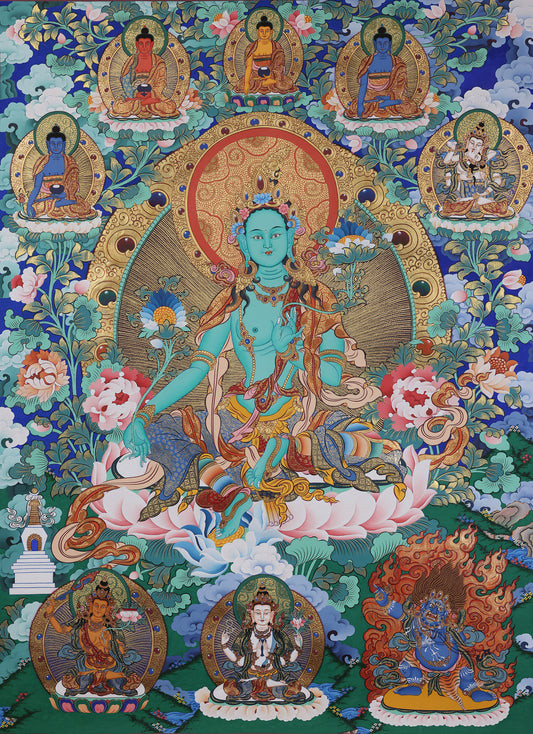
Hand-Painted Tibetan Thangka: The Spiritual Dimensions and Artistic Texture of Guru Padmasambhava’s Refuge Field

Within the visual culture of Tibetan Buddhism, a Thangka is never merely decorative art. It is a sacred visual system in which faith, meditation practice, lineage transmission, and artistic discipline converge. Among the most profound of these sacred images is the Refuge Field Thangka of Guru Padmasambhava, regarded as one of the most representative and complete visual embodiments of the Nyingma (Ancient) tradition.
This article explores the Padmasambhava Refuge Field Thangka through five interrelated dimensions: spiritual structure, iconographic discipline, lineage composition, painting craftsmanship, and cultural significance—revealing how this sacred artwork functions simultaneously as a meditation field, lineage map, and living cultural archive.
I. Core Theme: The “Total Object of Refuge” in the Nyingma Tradition
In Tibetan Buddhist practice, a Refuge Field is not a portrait of a single deity. Rather, it is a highly condensed visualization of an entire lineage universe, integrating the Buddhas of the three times, lineage masters, yidam deities, dakinis, and Dharma protectors into a single sacred composition.
The Refuge Field of Guru Padmasambhava represents the most essential devotional image of the Nyingma school. Its primary function is to enable practitioners, through visualization, to establish a direct alignment of body, speech, and mind with the complete lineage transmission, thereby receiving what is understood as collective and uninterrupted blessings.
This structure is inseparable from the historical role of Guru Padmasambhava as the founder of Tibetan Buddhism. In the 8th century, he was invited to Tibet by King Trisong Detsen, where he subdued indigenous spirit forces, integrated indigenous beliefs with Indian Vajrayana teachings, and helped establish Samye Monastery. Through his guidance, the first Tibetan monks—known as the “Seven Awakened Ones”—were ordained, laying the foundation for Tibetan Buddhism itself.
Thus, the Refuge Field Thangka is a visual crystallization of Guru Padmasambhava’s body, speech, and mind blessings. To contemplate this image is considered equivalent to simultaneously taking refuge in the Three Jewels, the Guru, the Yidam, the Dakinis, and the Dharma Protectors—making it a fundamental preparatory practice within Dzogchen and Nyingma Vajrayana traditions.
II. The Central Deity: Iconographic Discipline and Symbolic Language
At the center of the composition sits Guru Padmasambhava, depicted in strict accordance with classical iconometric texts and Nyingma ritual manuals. Every element of his form functions as a visual translation of Vajrayana doctrine.
1. Appearance and Attire: The Union of Wrath and Compassion
Guru Padmasambhava wears the Uddiyana lotus hat, its lotus-bud motif symbolizing awakened wisdom arising unstained from worldly defilements. Beneath his outer garments, he wears monastic robes representing the discipline of the Sutra path, while his outer cloak—rendered in deep reds and sapphire blues—symbolizes the Vajrayana union of wrathful power and compassionate activity.
His complexion is luminous, his expression serene yet authoritative, embodying the archetype of a spiritual sovereign—one who subdues obstacles through wrathful means while liberating beings through compassion.
2. Ritual Implements and Mudras: The Language of Realization
In his left hand, he holds a skull cup (kapala) filled with the nectar of immortal wisdom, symbolizing the realization of emptiness and the transcendence of birth and death. The skull cup is often adorned with vajra motifs, signifying indestructible bodhicitta.
Resting against his left shoulder is the khatvanga trident, his most distinctive implement. Composed of a crossed vajra, a nectar vase, three severed heads, and a flaming trident, it symbolizes the mastery of the five elements, the purification of the three poisons, and the union of the three Buddha bodies.
His right hand forms the wish-granting mudra, expressing spontaneous compassion and the fulfillment of virtuous aspirations—balanced perfectly with the wisdom symbolized by the nectar cup.
3. Lotus Throne and Aureole: Spatial Metaphors of Awakening
Guru Padmasambhava sits in the royal ease posture upon a double lotus throne. The lower pink lotus signifies innate purity within samsara, while the upper white lotus represents the clarity of full awakening. Beneath the throne, the sun and moon discs symbolize the dispelling of ignorance through wisdom and the pacification of afflictions through compassion.
Behind him, halos of gold leaf and mineral pigments form radiant mandorlas: inner flames of wisdom consuming ignorance, outer rainbow clouds symbolizing pure realms, and gilded borders emphasizing his enlightened presence.
III. Attendant Deities: Lineage Transmission and Protective Mandala
Surrounding the central figure is a carefully structured assembly that transforms the Thangka into a complete lineage mandala.
Above Guru Padmasambhava appears Amitabha Buddha, representing his ultimate Dharmakaya source. Within the Nyingma understanding, Padmasambhava is regarded as the unified manifestation of Amitabha, Avalokiteshvara, and Shakyamuni Buddha.
To his left stands Shantarakshita, symbolizing the transmission of the Sutra tradition and monastic discipline. To his right appears Yeshe Tsogyal, his foremost disciple and consort, representing the experiential Vajrayana path and the origin of the treasure (terma) lineage.
Below, offerings and protective deities—such as Vajrakilaya—form a functional safeguard, ensuring the uninterrupted transmission and practice of the Dharma by removing obstacles and adverse conditions.
IV. Painting Craftsmanship: A Fusion of Newari and Menri Traditions
High-level Refuge Field Thangkas are created through a refined synthesis of Nepalese Newari precision and Tibetan Menri compositional balance.
1. Canvas Preparation: Merit Through Discipline
The cotton canvas undergoes six traditional processes—washing, stretching, glue application, ground layering, coarse polishing, and fine polishing—each performed only after full natural drying. This labor-intensive preparation is considered an act of merit accumulation, not merely technical work.
2. Mineral Pigments: The Endurance of Natural Materials
The painting uses natural mineral pigments such as azurite, malachite, cinnabar, and pure gold. These materials are repeatedly refined to achieve chromatic stability that remains vibrant for centuries. Gold is applied using traditional mud-gold techniques, then burnished to a soft, luminous finish.
3. Line and Shading: Structure and Vitality
Firm iron-wire lines define sacred geometry, while silk-thread lines soften clouds and floral elements. Dry and wet shading techniques create subtle transitions in flesh tones and rich depth in garments, achieving both structural clarity and visual vitality.
4. Eye-Opening Ceremony: From Art to Sacred Presence
The final step is the eye-opening ritual, performed with prayers and consecration. This act transforms the Thangka from a painting into a living field of blessings—a sacred object suitable for meditation, offering, and devotion.
V. Cultural Significance: A Living Codex of Tibetan Civilization
The Refuge Field Thangka of Guru Padmasambhava is not merely religious art—it is a living codex of Tibetan civilization. It preserves doctrinal structures, lineage hierarchies, ritual systems, and artistic disciplines in a single visual field.
In the contemporary world, such hand-painted Thangkas serve not only practitioners but also collectors, scholars, and cultural institutions. They stand as enduring witnesses to a living tradition—one that continues to transmit the Vajrayana ideals of wisdom and compassion in union, across time, geography, and culture.
Schlagwörter:
Vorherige
Hand-Painted Tibetan Buddhist Thangka: Guru Rinpoche’s Refuge Realm – Faith Narrative and Artistic Code
Nächste
Hand-Painted Tibetan Buddhist Thangka: Guru Rinpoche’s Refuge Mandala – Faith Narrative and Artistic Expression