Hand-Painted Tibetan Buddhist Thangka: Guru Rinpoche’s Refuge Mandala – Faith Narrative and Artistic Expression

1. Core Theme: The Nyingma “Supreme Refuge” as a Faith Aggregation
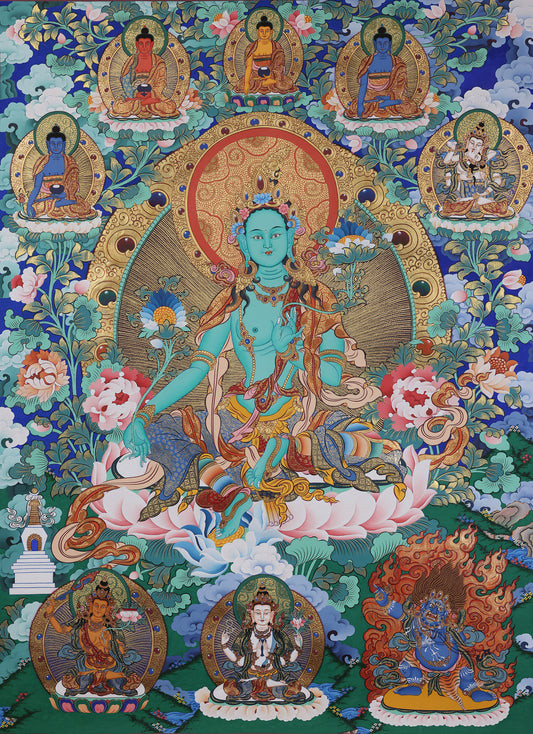
In the Nyingma tradition of Tibetan Buddhism, Guru Rinpoche (Padmasambhava) is revered as the founder of the lineage. His Refuge Mandala Thangka is not only an artistic creation but also the most iconic “visualized carrier of faith.” In Tibetan Buddhist context, a “Refuge Mandala” is not a portrait of a single deity but a comprehensive depiction of a lineage, including Buddhas of the past, present, and future, successive masters, the principal deity, dakas/dakinis, and dharmapalas. Its primary function is to allow practitioners, through visualization, to seamlessly connect body, speech, and mind with the lineage, thereby receiving collective blessings.
This theme is deeply rooted in Guru Rinpoche’s role as a founding figure. In the 8th century, upon his arrival in Tibet, he subdued indigenous Bon spirits and integrated exoteric and esoteric teachings, founding Samye Monastery and ordaining the “Seven Realized Masters.” By fusing Indian tantric practices with local Tibetan beliefs, he laid the foundation for Tibetan Buddhism. This Refuge Mandala visually expresses the Three Vajra Blessings (body, speech, mind) of Guru Rinpoche, making visualization equivalent to taking refuge in the Three Jewels, the Guru, the Yidam, dakas/dakinis, and protector deities, serving as a preparatory practice for Dzogchen, embodying the wisdom of “capturing all teachings in one mandala.”
2. Principal Deity: Iconography and Symbolic System of Guru Rinpoche
At the center is Guru Rinpoche, whose iconography strictly follows the Sutra of Measurements for Iconography and the Nyingma Guru Rinpoche rituals, with every detail being a symbolic translation of tantric teachings.
Body and Attire: The Integration of Wrathful and Peaceful Qualities
Guru Rinpoche wears the Ushnisha lotus hat, the lotus bud motif representing his name and enlightened mind arising from worldly defilements. Underneath, he wears crossed-collar monastic robes representing exoteric vows, while a red-brown and sapphire blue brocade cloak represents wrathful subjugation of obstacles and compassionate embrace, reflecting the dual application of wisdom and compassion in tantric practice. His skin is fair with a subtle reddish glow, eyebrows slightly furrowed but serene, portraying the integration of authority and compassion, demonstrating the method of subduing obstacles with wrath while embracing beings with compassion.
Ritual Implements and Mudras: Visual Language of Practice
-
Left Hand: Gabhara Bowl – Contains nectar of immortality and wisdom, engraved with vajra motifs symbolizing using emptiness wisdom to overcome attachment and stabilize bodhicitta.
-
Left Elbow: Kha-vajra Staff (Ka-zha-ga) – Composed of cross vajra, vase, three human heads, and flaming trident, representing the five elements, perfect nectar, elimination of the three poisons, unification of trikaya, and destruction of all obstacles.
-
Right Hand: Wish-Fulfilling Gesture – Palm outward, fingers slightly curved, symbolizing fulfilling all sentient beings’ aspirations, complementing the left-hand nectar bowl for dual enactment of wisdom and compassion.
Lotus Throne and Aura: Spatial Narrative of the Mandala
Guru Rinpoche sits in Royal Dance Posture (half-lotus) on a double-layer lotus throne:
-
Lower pink lotus symbolizes pure mind arising unsullied from defilements,
-
Upper white lotus represents attained purity of enlightenment.
The sun-moon base symbolizes dispelling ignorance with sunlight and extinguishing afflictions with moonlight. The halo and body aura use gold leaf and mineral pigments: the inner red flames burn away ignorance, the outer rainbow clouds symbolize celestial realms, and golden borders emphasize divinity.
3. Retinue Deities: Lineage and Faith Network
Surrounding deities form the lineage chain and protector network in Nyingma Refuge Mandala.
-
Top Deity: Usually Amitābha Buddha, representing the dharmakaya source, illustrating the teaching from dharmakaya to nirmanakaya.
-
Left Deity: Master Shing-mi (Jikpu), companion of Guru Rinpoche, symbolizing exoteric lineage transmission.
-
Right Deity: Yeshe Tsogyal, female consort and disciple, representing skillful means in tantric practice, and the source of terma (hidden treasure) lineage.
-
Bottom Deities: Dharmapalas and offerings, representing worldly and transcendental support; wrathful figures like Vajrakila protect the teachings and remove obstacles, ensuring uninterrupted practice.
4. Artistic Craftsmanship: Nevari-Mentorpa Fusion Hand-Painted Masterpiece
Canvas Preparation: Six-Step Ritual Process
Smooth white cotton canvas undergoes washing, stretching, cow-hide glue coating, white clay base, coarse and fine sanding, each step air-dried. Fine sanding is repeated 3–5 times to achieve a paper-like smoothness, reflecting the artist’s merit accumulation through labor, embodying the fusion of art and devotion.
Pigments: Eternal Power of Natural Minerals
Stone blue, stone green, cinnabar, and gold leaf are used:
-
Stone pigments from Tibetan lapis lazuli are purified to create delicate shades.
-
Cinnabar is wet-ground to remove impurities.
-
Gold leaf is processed into gold paste, mixed with adhesive and saffron for detailing, polished to radiance symbolizing eternal Buddhist light.
These pigments carry blessing power, transforming the Thangka into a spiritual conduit.
Technique: Iron-Line and Shading Harmony
-
Lines: Iron-line for primary forms, “floating lines” for clouds and flowers, crisp and continuous.
-
Shading: Dry and wet blending, creating smooth skin tones and vibrant clothing layers, enhancing solemnity and vitality.
-
Opening the Eyes: Ritual performed by the artist or lama with incense and prayers, giving the Thangka spiritual presence, elevating it from art to blessing field.
5. Cultural Value: A Living Canon of Faith and Art
This Thangka is more than painting; it is a visualized carrier of Nyingma lineage, practice rituals, and core teachings, a living cultural canon of Tibet. From an artistic perspective, its balanced composition, mineral colors with gold leaf, and line techniques exemplify Nevari-Mentorpa fusion. From a devotional perspective, it serves as a tool for practitioners to visualize Guru Rinpoche and receive blessings, embodying Tibetans’ pursuit of enlightenment and liberation.
In the modern context, this Thangka bears witness to cultural living heritage, preserving centuries-old iconographic rituals and craftsmanship, while visually conveying the core teachings of compassion and wisdom. It exemplifies the coexistence of faith, art, and culture.
#GuruRinpoche #Padmasambhava #TibetanThangka #HandPaintedThangka #NyingmaBuddhism #RefugeMandala #TibetanArt #SpiritualArt #BuddhistArt #MineralPigments #GoldLeafArt #BuddhistCulture #LineageVisualization #DzogchenPractice #FaithAndArt
Schlagwörter:
Vorherige
Hand-Painted Tibetan Thangka: The Spiritual Dimensions and Artistic Texture of Guru Padmasambhava’s Refuge Field
Nächste
Pure Hand-Painted Tibetan Thangka: The Faith Dimensions and Artistic Texture of Padmasambhava’s Refuge Field