Hand-Painted Tibetan Buddhist Thangka: Guru Rinpoche’s Refuge Realm – Faith Narrative and Artistic Code

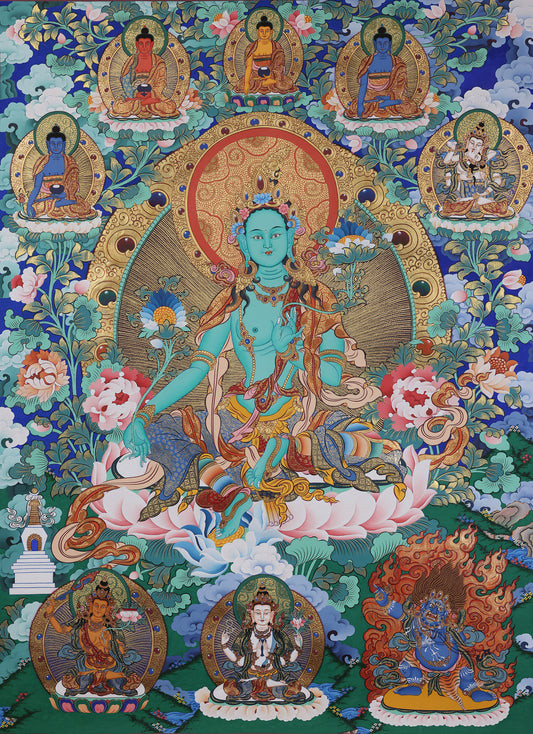
In the Tibetan Buddhist art system, thangkas serve not only as visual masterpieces but also as mediums of faith and spiritual practice. Among them, thangkas depicting Guru Rinpoche (Padmasambhava) in his refuge realm are particularly significant. They carry not only exquisite craftsmanship but also the profound traditions and spiritual wisdom of the Nyingma (Red) School. This article provides an in-depth analysis of a hand-painted thangka of Guru Rinpoche’s refuge realm, exploring its thematic core, iconography, attendant deities, painting techniques, and cultural value.
1. Theme: Visualizing the Nyingma School’s “Refuge of All Masters”
The central theme of this thangka is Guru Rinpoche’s refuge realm, the most emblematic “faith aggregation” image in the Nyingma tradition. In Tibetan Buddhism, a “refuge realm” is not a depiction of a single deity. Instead, it encompasses the three-time Buddhas, lineage masters, main deities, bodhisattvas, and protector deities within a single composition, forming a “field of merit” for practitioners to visualize and offer devotion. The essence of this composition is to concentrate all spiritual blessings and merits around Guru Rinpoche as the central figure, enabling devotees to spiritually connect their body, speech, and mind with the lineage.
This theme reflects Guru Rinpoche’s status as the “founder of Tibetan Buddhism.” In the 8th century, he subdued local spirits and integrated Indian tantric teachings with indigenous beliefs, establishing Samye Monastery and ordaining the “Seven Men of Realization.” For Nyingma practitioners, visualizing this refuge realm symbolizes simultaneous refuge in the Three Jewels, the guru, the deity, the dakini, and the protector deities, considered the most auspicious shortcut to spiritual attainment.
2. Main Deity: Iconography and Symbolism of Guru Rinpoche
The central figure is Guru Rinpoche, depicted according to the Sutra of Proportions for Sacred Images and Nyingma ritual specifications. Every detail conveys tantric teachings visually.
1. Physical Features and Attire
Guru Rinpoche wears the “Lotus Hat” (or Uzhangna Crown), symbolizing both “Buddha’s enlightenment” and “sovereign compassion for all beings.” He wears a cross-collared monastic robe representing Vinaya practice, over which is draped a red-and-blue brocade cloak—red symbolizing wrathful energy to subdue obstacles, blue representing compassion. His skin is fair with a reddish tint, eyebrows slightly furrowed yet face serene, showing the “wrathful-yet-compassionate” form, embodying his method of transforming obstacles through wrath and compassion.
2. Ritual Implements and Mudras
-
Left hand holding the Kapala (skull cup): Contains the “nectar of immortal wisdom,” representing the dissolution of attachment through wisdom of emptiness. The cup often bears vajra motifs, symbolizing the indestructible bodhicitta.
-
Left elbow holding the Khatvanga Staff: Guru Rinpoche’s primary ritual instrument, combining a vajra cross, vase, three skulls, and triple-pronged flames. The vajra cross represents the five elements (earth, water, fire, wind, space), the vase symbolizes perfected nectar, the three skulls (red, green, white) signify cutting through the three poisons and unifying the three bodies (Dharmakaya, Sambhogakaya, Nirmanakaya), and the triple flames represent destruction of all obstacles.
-
Right hand holding the five-pronged vajra: Performing the wrathful mudra pointing to the void; the five prongs correspond to the Five Wisdom Buddhas, symbolizing the dispelling of obstacles through enlightened wisdom.
3. Lotus Throne and Halo
Guru Rinpoche is seated in the “King’s Dance Posture” (semi-lotus) on a double-layered lotus throne: the lower deep-pink petals represent “purity untouched by the mud,” while the upper white petals symbolize “enlightened purity.” The base is adorned with the sun and moon cushion, symbolizing illumination of ignorance and cooling of afflictions. The halo and body aura are painted with gold leaf and mineral pigments: the inner red flames signify burning away afflictions, the outer rainbow clouds represent heavenly pure realms, and the golden frame accentuates divinity.
3. Attendant Deities: Lineage and Protective Network
Surrounding the main deity are attendant deities forming the Nyingma refuge realm’s lineage chain and protective network.
-
Upper Deity: Typically Amitabha Buddha, symbolizing the Dharmakaya source and ultimate enlightened essence. Guru Rinpoche is regarded as the emanation of Amitabha, Avalokiteshvara, and Shakyamuni’s body, speech, and mind.
-
Side Deities:
-
Left: Master Shikme (Jikhu), companion of Guru Rinpoche and one of the “Three Masters,” symbolizing exoteric transmission.
-
Right: White-robed Yeshe Tsogyal, consort and principal disciple, representing the “method path” of tantric practice and source of the dakini lineage.
-
-
Lower Deities: Protector deities and offerings below the lotus throne symbolize worldly and transcendental support. Wrathful forms, such as Vajrakila, represent the safeguarding of teachings and removal of obstacles.
4. Painting Techniques: Nepali Newar and Tibetan Menri Fusion
This thangka is a high-level fusion of the Nepali Newar and Tibetan Menri styles, exemplifying devotion and artistry.
1. Canvas Preparation
Six-step traditional process: washing, stretching, applying bone glue, white clay base, coarse and fine polishing. Each step involves drying to achieve a smooth, paper-like surface, providing ideal adhesion for pigments. This meticulous work also represents the artist’s devotional accumulation of merit.
2. Pigments
Mineral pigments: lapis lazuli, malachite, cinnabar, and gold leaf.
-
Lapis lazuli and malachite are refined through crushing, boiling, sedimentation, and triple purification for layered depth.
-
Cinnabar is ground wet for days.
-
Gold leaf is combined with gum and saffron to outline garments and implements, polished with gem brushes for lasting brilliance.
Natural minerals carry symbolic blessings, making the thangka a spiritual medium connecting the mundane with the sacred.
3. Techniques
-
Linework: Combination of iron-line and freehand fine line, rendering garments and implements with fluidity and precision.
-
Shading: Dry and wet layering creates natural skin tones and dynamic clothing, enhancing realism and solemnity.
-
Eye Opening: Final ritual by the artist or lama, invoking incense and reciting mantras before painting pupils, imbuing the deity with spiritual presence, transforming the thangka into a vessel of blessings.
5. Cultural Value: A “Tibetan Encyclopedia” of Faith and Art
This thangka is more than a painting; it is a visual representation of Tibetan Buddhist faith:
-
Records the Nyingma lineage, ritual practices, and core teachings, serving as a microcosm of Tibetan cultural heritage.
-
Artistically, its intricate composition, mineral pigments, gold leaf, and precise linework exemplify the fusion of Nepali and Menri schools.
-
Spiritually, it aids practitioners in visualizing Guru Rinpoche, receiving blessings, and pursuing enlightenment.
In contemporary context, the thangka serves as a living testimony of cultural transmission, preserving centuries-old rituals and artistic traditions while conveying the Nyingma teachings of “simultaneous wisdom and compassion” to the world.
Conclusion
The refuge realm thangka of Guru Rinpoche embodies the perfect synthesis of Tibetan Buddhist faith and artistic excellence. Whether for spiritual practice, cultural preservation, artistic appreciation, or sacred space decoration, it holds irreplaceable value. Viewing or venerating this thangka is not only a visual experience but a journey connecting faith, culture, and spiritual consciousness.
#GuruRinpoche #Padmasambhava #TibetanBuddhism #NyingmaSchool #ThangkaArt #HandPaintedThangka #RefugeRealm #TibetanSacredArt #TantricArt #NepaliNewarArt #MenriStyle #BuddhistLineage #SpiritualArt #TibetanCulture #BuddhistPractice
Schlagwörter:
Vorherige
Hand-Painted Tibetan Buddhist Thangka: Cultural and Artistic Analysis of the Refuge Field of Padmasambhava
Nächste
Hand-Painted Tibetan Thangka: The Spiritual Dimensions and Artistic Texture of Guru Padmasambhava’s Refuge Field