Amitabha Buddha in Tibetan Buddhism: Unlimited Light, Longevity, and Compassionate Guidance in Red Thangka Art

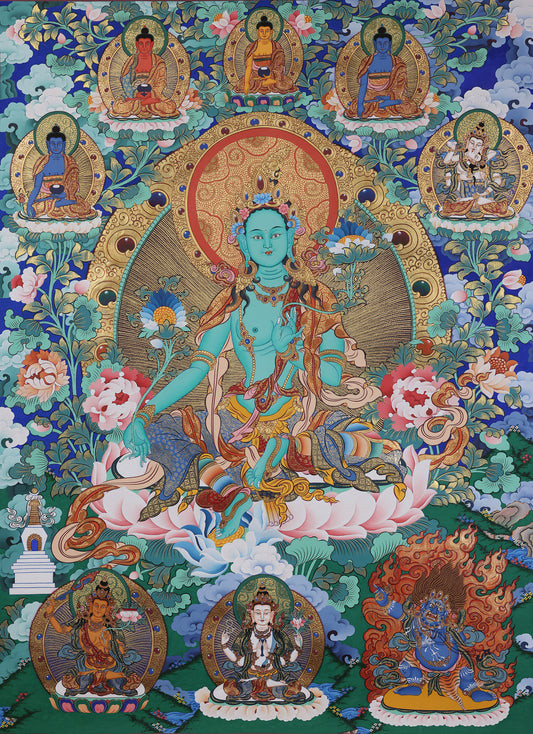
When the crimson of cinnabar intertwines with the brilliance of gold on Tibetan cloth, a Buddha of deep scarlet form sits atop a lotus pedestal—this is Amitabha Buddha in a Tibetan Red Thangka. It is not just an ornamental painting, but a "three-dimensional vessel" of Tibetan faith, Tantric wisdom, and traditional art: every inch of color, every mudra, holds the compassionate code of "Unlimited Light" and "Unlimited Longevity."
I. "Unlimited Light and Longevity" in Tibetan Buddhist Context: Amitabha Buddha’s Faith Coordinates
In the Tibetan Buddhist system, Amitabha Buddha is never an isolated "Buddha name," but a core symbol connecting "wisdom," "Pure Land," and "guidance."
His name itself holds the foundation of faith: in Sanskrit, Amitābha means "Unlimited Light," representing the Buddha’s radiance illuminating all directions, capable of dispelling the ignorance and darkness of sentient beings; Amitāyus means "Unlimited Longevity," symbolizing the Buddha’s endless lifespan, which grants sentient beings peace and lasting protection. In the Five Dhyani Buddhas system of Tibetan Tantra, Amitabha Buddha corresponds to the "Western Direction," with a scarlet form, representing "Discriminating Wisdom"—this wisdom can perceive the essence of all things, transforming sentient beings’ affliction of "greed," and is the key to liberation from the suffering of samsara (the Kalachakra Tantra’s "five colors matching five wisdoms" theory binds the Western Amitabha Buddha’s red color to Discriminating Wisdom).
Amitabha Buddha’s most well-known identity is the Lord of the Western Pure Land of Ultimate Bliss. This Pure Land, described as "free from all suffering, only enjoying all joys," is the ultimate place of peace in the hearts of Tibetan believers: scriptures state that as long as one recites his name with a pure mind and prays for rebirth, Amitabha Buddha will appear with Guanyin and Mahasthamaprapta at the time of death, guiding sentient beings to escape samsara and abide in Ultimate Bliss.
II. Symbolic Code of the Red Thangka Iconography: Every Detail is a "Language of Compassion"
Every design element of this Red Thangka Amitabha is not an artistic coincidence, but a Tibetan Buddhist "symbol system":
1. Scarlet Form: Visualization of Compassion and Wisdom
The main body of the icon is a rich cinnabar red—this is not a random color choice, but a "color norm for the Five Dhyani Buddhas" in Tibetan Tantra: the red color of the Western Amitabha Buddha symbolizes both "compassion blazing like a flame," corresponding to the compassionate nature of Guanyin Bodhisattva; it also represents "Discriminating Wisdom," which can dispel sentient beings’ attachment to "beautiful external forms."
As stated in Research on the Symbolic System of Thangka Colors: "The red color in Thangkas is not decoration, but a fervent expression of compassion—it spreads like nectar, implying that the vow to save sentient beings will never fade."
2. Dhyana Mudra and Alms Bowl: Dual Meanings of Abiding and Generosity
Amitabha Buddha’s hands form the Dhyana Mudra (hands folded in front of the abdomen), holding an alms bowl in the palm. This posture has two layers of meaning:
- The Dhyana Mudra represents "abiding in the pure original mind," an intuitive embodiment of the "undisturbed peace" of the Pure Land of Ultimate Bliss;
- The alms bowl contains "nectar," symbolizing Amitabha Buddha’s compassionate generosity of peace, nurturing the good roots of sentient beings, allowing them to encounter virtuous Dharma even in samsara.
3. Western Trinity: Unity of Compassion and Wisdom
The two attendants below the icon form the standard ensemble of the Tibetan "Western Trinity":
- Left Attendant (yellow form): Guanyin Bodhisattva—symbolizing "compassionate salvation," known as "Chenrezig" in Tibetan, famous for responding to the cries of the suffering, often with a small image of Amitabha Buddha atop his head, representing reverence for the Lord;
- Right Attendant (blue form): Mahasthamaprapta Bodhisattva—symbolizing "wisdom and power," known as "Jambhala" in Tibetan, dispelling confusion with the light of wisdom; his wrathful manifestation as Vajrapani Bodhisattva, one of the "Three Protectors" in Tibet, represents the power to subdue demons and remove obstacles.
The core of this ensemble is the unity of "compassion (Guanyin) + wisdom (Mahasthamaprapta)," corresponding to Amitabha Buddha’s dual attributes of "Discriminating Wisdom" and "compassionate guidance."
4. Lotus and Patterns: A "Three-Dimensional Manual" of the Pure Land
The icon sits on a layered lotus pedestal—the lotus symbolizes "purity and liberation" in Tibetan Buddhism, representing that although sentient beings are born in the "mud of samsara," they can transcend afflictions and be reborn in the Pure Land through Amitabha Buddha’s vows.
The gold patterns, auspicious clouds, and flowers on the Red Thangka are a "microcosm" of the Pure Land: gold represents sacred solemnity, auspicious clouds symbolize unobstructed peace, and flowers correspond to the description of the Pure Land as "constantly resounding with celestial music and showering with flower petals."
III. Red Thangka: "Scarlet Solemnity" in Tibetan Art
The carrier of this Amitabha icon—Red Thangka—is itself a "living fossil" of Tibetan art.
1. Definition of Red Thangka: Solemnity Crafted with Mineral Pigments
Red Thangka is a key category of Thangkas, characterized by a base color of "Tibetan red" mixed from natural mineral pigments such as cinnabar and ochre, with patterns drawn using precious materials like 24K gold powder, malachite, and lapis lazuli.
This craft has extremely high thresholds: cinnabar must be repeatedly ground and purified, Tibetan cloth must be specially treated with 酥油 (butter) and cowhide glue to prevent fading, and gold powder must be manually ground and mixed with glue to outline details stroke by stroke—for this reason, the colors of Red Thangkas can remain vibrant for centuries, making them "faith carriers that can be passed down through generations."
2. Red Thangka and Amitabha Buddha: Innate Compatibility
The "red color" and "gold ornaments" of Red Thangkas perfectly align with Amitabha Buddha’s faith attributes:
- Red corresponds to Amitabha Buddha’s "blazing compassion," a visual manifestation of his vow to guide sentient beings;
- Gold ornaments represent Amitabha Buddha’s "sacred solemnity," corresponding to the "unlimited treasures" of the Pure Land of Ultimate Bliss.
Therefore, Red Thangkas are often used to depict Amitabha Buddha, Guanyin, and other "compassionate principal deities," and are regarded by Tibetan believers as the artistic form that "best embodies peace and solemnity."
IV. Tibetan Pure Land Dharma: Daily Practice of Amitabha Buddha Faith
For Tibetan believers, Amitabha Buddha is not an "icon on the wall," but a spiritual reliance integrated into daily life—the practice of Tibetan Pure Land Dharma is far more concrete than imagined:
1. Recitation and Visualization: An "Anchor of Peace" Anytime, Anywhere
The most widespread practice is reciting Amitabha Buddha’s name or mantra:
- Name: "Namo Amitabha Buddha" (shared by Han and Tibetan Buddhism) or the Tibetan pronunciation "Tsepag Med" (Unlimited Longevity Buddha);
- Mantra: "Om Ami Dewa Hrih" (Tibetan pronunciation: "Ong A Mi De Wa She").
When reciting, believers will practice "visualization": imagining Amitabha Buddha’s scarlet form, Dhyana Mudra, and the ensemble of the Western Trinity, while visualizing that "their greed and afflictions are purified by the red Buddha light," gradually abiding in a pure state of mind.
2. Sutras and Rituals: Accumulating "Karmic Merit for Rebirth"
The most widely circulated Pure Land scripture in Tibet is the Prayer for Rebirth in the Pure Land, which believers recite at dawn and dusk, praying that "Amitabha Buddha will appear to guide them at the time of death."
Some believers also participate in "Pure Land Dharma Assemblies": during the assemblies, monks collectively visualize the Pure Land of Ultimate Bliss, offer butter lamps and pure water, to accumulate "karmic merit for rebirth"—this practice is essentially "connecting one’s virtuous karma with Amitabha Buddha’s vows," embodying the Tibetan Buddhist view of "unity of self-effort and other-power."
3. Birth Buddha Faith: Spiritual Sustenance Beyond Religion
In Tibetan folk culture, Amitabha Buddha is also regarded as the "birth Buddha of people born in the Year of the Dog or Pig"—believers will wear tsa-tsa (small clay icons) of Amitabha Buddha or enshrine Red Thangkas, praying for the protection of "Unlimited Longevity" and freedom from illness and disaster.
V. Timeless Compassion: The Contemporary Significance of This Icon
Today, this Red Thangka Amitabha has long transcended its identity as a "religious ritual object":
- For Tibetan culture, it is a dual carrier of "intangible cultural heritage + faith," witnessing the integration of Tibetan art and Buddhist wisdom;
- For modern people, it is a "symbol of spiritual peace": its meaning of "transforming greed" and "abiding in the original mind" just responds to the spiritual dilemma of modern people "being trapped by material desires"—even without understanding religion, one can feel the power of "letting go of afflictions and abiding in the present" from the scarlet form and tranquil Dhyana Mudra.
This is Amitabha Buddha in the Tibetan Red Thangka: it is a painting, a faith, and a set of "wisdom for spiritual peace"—when we gaze at this scarlet and gold, we see not just an icon, but the compassion of "Unlimited Light" dispelling darkness and "Unlimited Longevity" bearing peace itself.
#TibetanBuddhism #AmitabhaBuddha #RedThangka #WesternTrinity #PureLandDharma #BuddhistArt #FiveDhyaniBuddhas #ThangkaArt #MineralPigmentArt #WesternPureLand #SymbolismInBuddhistArt #TibetanBuddhistPractice #SacredArtOfTibet
Schlagwörter:
Vorherige
Kubera (Yellow God of Wealth): The Guardian of Prosperity and Wisdom in Tibetan Buddhism, Balancing Tangka Symbols with Modern Views on Wealth
Nächste
Padmasambhava: The "Second Buddha" of Tibetan Buddhism and the Founder of Himalayan Civilization