Tibetan Medicine Buddha Mandala Thangka: The Spiritual Dimensions of Healing, Order, and Craftsmanship

In the visual system of Tibetan Buddhism, Thangka paintings are far more than mere religious artworks. They serve as “spiritual containers,” highly condensed representations of cosmology, meditative practice, and real-world care. These paintings are “observable mandalas” and “contemplative universes” that guide practitioners from worldly stability toward ultimate liberation.
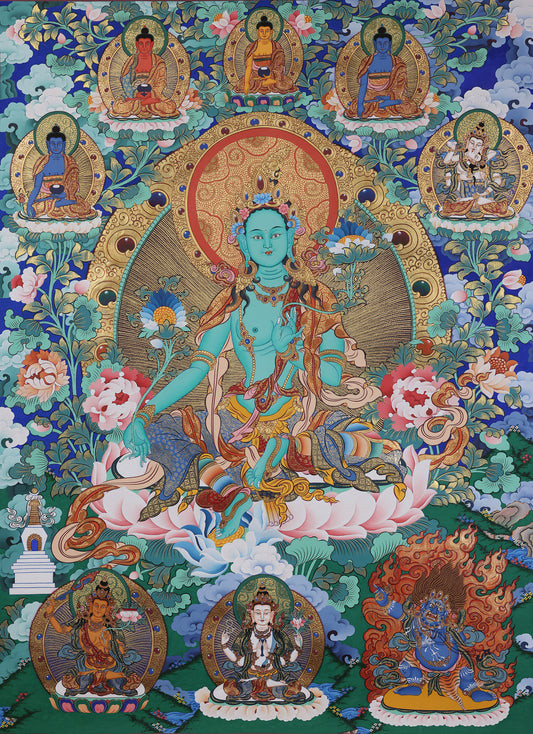
The Tibetan Medicine Buddha Mandala Thangka presented here is based on the Bhaisajyaguru Vows and Merits Sutra (Bhaisajyaguru Vaiduryaprabha). It strictly follows ritual guidelines for composition. Centered on the Medicine Buddha, it incorporates attendants, mandala structures, and exquisite mineral pigments to construct a faithful space for healing, purification, and worldly well-being, reflecting the Tibetan Buddhist value of balancing concern for the present life with the pursuit of ultimate liberation.
I. Central Theme: The Healing Cosmos of “Lapis Light”
In Tibetan Buddhism, the Medicine Buddha is revered as the “Buddha of Present-Life Healing.” Unlike Amitabha Buddha, who focuses on rebirth in the Pure Land after death, the Medicine Buddha’s twelve great vows emphasize physical and mental health, longevity, and elimination of misfortunes in the present life. This aligns with the practical needs of Tibetan communities living at high altitudes, where health and safety are vital concerns.
The painting depicts a “Lapis Pure Land” as the spiritual background. The “Lapis Light” represents not only clarity and purity but also a healing illumination capable of penetrating ignorance and relieving suffering. Tibetan Buddhist thought sees disease not just as a physical condition, but as a manifestation of imbalance and karmic obstacles. Therefore, the Medicine Buddha’s healing is both a practical remedy and a spiritual path from worldly suffering to liberation.
II. Main Deity: Ritual Symbols and the Manifestation of Healing Power
The central figure of the painting, the Medicine Buddha (Bhaisajyaguru), is depicted according to the canonical rules of the Sutra on Image Measurements, reflecting the “32 marks of a Buddha” and “80 auspicious signs.”
1. Body Color and Attire: Symbols of Healing and Purity
The Buddha’s body is rendered in Lapis Gold (orange-yellow tones), the signature color representing transparency, purity, and the ability to dispel darkness and suffering. The right-shoulder robe indicates renunciation and distinguishes the Buddha from bodhisattvas, highlighting his role as an enlightened healer using ultimate wisdom.
2. Mudra and Implements: Materializing Vows
The Medicine Buddha forms the Bhaisajya Mudra, holding a Lapis Medicine Bowl filled with amrita (divine nectar). This symbolizes healing, longevity, and purification of karmic obstacles. Practitioners often visualize this mudra for blessing during illness or adversity.
3. Lotus and Base: Structure of Order and Protection
The Buddha sits on a double-layer lotus pedestal. The lower tier is a thousand-petal lotus, symbolizing purity; the upper tier features snow lions, sacred guardian beasts that ward off disease and misfortune. The base’s blue and gold palette reinforces the imagery of a pure, healing environment.
III. Attendants: A Complete Healing System
The painting’s attendants are not decorative; they form a comprehensive healing system that embodies the Tibetan Buddhist principle of collective vow empowerment.
1. Upper Section: Seven Medicine Buddhas and Temporal Coverage
Seven Medicine Buddhas (including the central figure) occupy the upper section, corresponding to the seven days of the week. Each Buddha protects beings born on their specific day, providing healing coverage across time. The varied colors (green, red, blue, etc.) correspond to Tibetan medical principles of the five elements and organs, integrating Buddhist practice with traditional Tibetan medicine.
2. Lower Section: Bodhisattva Attendants and Lineage Masters
Sunlight and Moonlight Bodhisattvas flank the lower section, symbolizing light dispersing darkness and coolness alleviating mental agitation. Lineage masters, such as Je Tsongkhapa, are also depicted, emphasizing the Tibetan Buddhist principle of Guru-disciple unity, through which the Buddha’s healing power is transmitted.
This system forms a progressive contemplative path: lineage blessings → seven-Buddha vows → attendant assistance → central Buddha’s healing power.
IV. Painting Technique: Material as the Vessel of Healing Energy
1. Canvas and Preparation: From Ordinary to Sacred
High-altitude cotton canvas undergoes ritualized preparation: immersion in barley wine, seven layers of lime coating, and polishing with river stones. This process purifies the canvas and makes it spiritually fit to hold the Buddha’s healing power.
2. Mineral Pigments: Healing through Color
All pigments are natural minerals: gold leaf, realgar, malachite, turquoise, cinnabar, coral powder. These colors have inherent healing and protective properties in Tibetan culture. The pigments are refined via wet-milling and mixed with yak milk glue, ensuring durability and infusion with spiritual energy.
3. Ritualized Painting Process: Art as Practice
From sketching to layering to the final “opening of the eyes,” the painting is a meditative ritual, not mere artistic creation. The eye-opening ceremony, performed on an auspicious day by a qualified master, imparts spiritual efficacy and healing power to the Thangka.
Conclusion: Thangka as a Spiritual Container of Healing
This Tibetan Medicine Buddha Mandala Thangka is a vivid expression of concern for present-life well-being. Its theme embodies dual healing of body and mind, the main deity symbolizes healing vows, the attendants extend the healing system, and the craftsmanship materializes spiritual energy. Whether placed in a household shrine or a temple’s Medicine Buddha hall, it functions as both a prayer aid during illness and a contemplative tool for daily spiritual practice. Every mineral pigment and ritual line encodes the Tibetan ideal: healing suffering through faith, and abiding in purity and stability in this life.
#TibetanBuddhism #MedicineBuddhaThangka #HealingThangka #HandPaintedThangka #MineralPigments #BuddhistArt #MandalaThangka #TibetanCraftsmanship #SpiritualPractice #BuddhaDevotion #HealingBuddha #TibetanThangka #MandalaArt #BuddhistMandala #SpiritualArt
Tags:
Previous
Tibetan Buddhist Vajrasattva Black Background Gold Thangka: In-Depth Analysis of Theme, Deity, Retinue, and Craftsmanship
Next
Hand-Painted Tibetan Buddhist Four-Armed Avalokiteshvara Thangka: Decoding Theme, Deity, and Craftsmanship