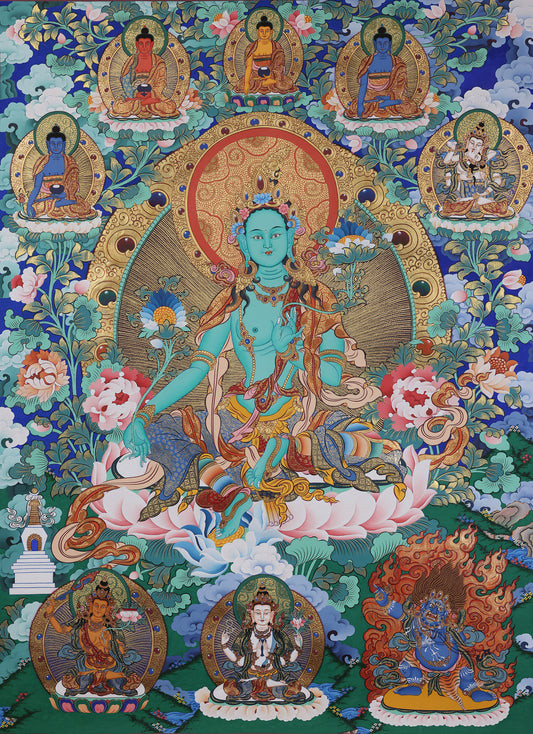
Tibetan Buddhist Vajrasattva Black Background Gold Thangka: In-Depth Analysis of Theme, Deity, Retinue, and Craftsmanship

In the lineage of Tibetan Buddhist art, Thangka paintings are not only tools for spiritual practice but also profound visual carriers of religious culture. Among them, black background gold Thangkas stand out as symbols of “purification and awakening.” The deep black background represents the darkness of afflictions, while the gold-painted deity symbolizes the illumination of wisdom.
This article focuses on a hand-painted black background gold Thangka with Vajrasattva (Dorje Sempa) as the central deity, exploring its theme, main deity, retinue, and intricate craftsmanship, revealing the spiritual wisdom and artistic value embedded within Tibetan Buddhism.
I. Theme: A Mirror for Purification and Awakening
The core theme of this Thangka is Vajrasattva’s purification and confession of negative karma. In Tibetan Buddhist context, Vajrasattva is regarded as the deity who purifies karmic obstacles, with the vow: “If beings recite my name and visualize my form, all their obstacles will be purified.”
Thus, this Thangka serves as a key visualization tool for practicing the Hundred Syllable Vajrasattva Mantra. Its thematic focus is clear: to eliminate afflictions with wisdom and return to purity through confession, facilitating purification and awakening in body, speech, and mind.
The black-and-gold style carries symbolic meaning:
-
Pure black background represents the ocean of ignorance and afflictions in sentient beings.
-
Gold-painted deity and patterns symbolize Vajrasattva’s wisdom piercing through darkness.
-
Colored lotus flowers and auspicious clouds signify the blossoming of the Bodhicitta after purification.
Functionally, this Thangka can be used both for individual meditation and collective confession ceremonies, with the core purpose of connecting with Vajrasattva to achieve purification and spiritual awakening.
II. Main Deity: Symbolism and Doctrinal Significance of Vajrasattva
At the center of the Thangka is Vajrasattva in a serene form, painted according to strict proportions described in the Iconometry Sutra. Every detail visually embodies the teaching of purification.
1. Physical Attributes and Symbolic Implements
-
One Face, Two Arms: “One face” symbolizes non-dual reality. Seated in vajra posture (meditation mudra), hands crossed at the abdomen, holding a Vajra and Bell.
-
Vajra: represents the power of wisdom to destroy afflictions.
-
Bell: represents compassion embracing all beings.
-
Together, they signify the unity of wisdom and compassion, the core force for karmic purification.
-
-
Body Color and Ornaments: White like moonlight, symbolizing innate purity; five Buddha crown representing wisdom from the five directions; adorned with necklaces and bracelets to manifest worldly and transcendent wisdom; hair interwoven with red (active compassion) and gold (unchanging wisdom).
-
Crown and Lotus Pedestal: On the top of the hair knot sits Samantabhadra Buddha, Vajrasattva’s Dharmakaya source, indicating that the power of purification comes from ultimate enlightenment. The deity sits on a double-layer lotus and moon disc pedestal, where the lower moon disc signifies cool detachment from afflictions and the upper lotus represents the Bodhicitta after purification. Together, they illustrate dwelling in purity and awakening.
2. Expression and Posture
The deity’s half-closed eyes and serene expression reflect the middle path, unattached to good or evil, free from self-condemnation. Confession here is not self-denial but a wisdom-based observation of the illusory nature of afflictions, returning to the innate purity of mind.
III. Retinue Deities: Functional Extension of the Purification System
In Tibetan Thangkas, the retinue is an extension of the main deity’s spiritual power, forming a functional network of purification, blessing, and protection.
1. Core Retinue
Above the main deity, Samantabhadra Buddha and Vajradhara are often depicted:
-
Samantabhadra: Dharmakaya, representing the ultimate source of purification.
-
Vajradhara: Sambhogakaya, conveying the purifying power through Vajrayana teachings.
-
Together with Vajrasattva, they form a Dharmakaya–Sambhogakaya–Nirmanakaya network, symbolizing triple blessings.
2. Auxiliary Retinue
On the sides, the Eight Great Bodhisattvas (e.g., Manjushri, Avalokiteshvara) provide wisdom support. Below, Vajra Guardians or Ksitigarbha appear:
-
Vajra Guardians: strong protection to destroy obstacles.
-
Ksitigarbha: compassionate vow to bear sentient beings’ karma.
-
Together, they enhance the efficacy of Vajrasattva’s purification.
3. Hidden Retinue
The golden vine patterns and lotus motifs symbolize hidden protectors:
-
Jewels in vine motifs represent blessings of Dakini spirits.
-
Colored lotuses represent protective deities of the lotus family.
Thus, the Thangka forms a three-dimensional purification field: main deity – visible retinue – symbolic hidden forces, bridging visual art and spiritual practice.
IV. Craftsmanship: Interpreting Purification through Black-and-Gold Painting
The hand-painted black background gold technique is one of the most challenging in Tibetan Thangka art, with each step imbued with spiritual symbolism.
1. Base Preparation and Black Background
-
Canvas Preparation: Thickened linen base layered with barley paste and lime water 7–10 times, polished to mirror-like smoothness, symbolizing polishing the mind to receive wisdom.
-
Black Background: Mineral ink (soot and stone powder) applied 5+ layers, representing the dark ocean of afflictions. Each layer corresponds to contemplating and accepting one’s afflictions.
2. Gold Painting and Line Drawing
-
Gold Application: 24K gold foil ground into fine powder, mixed with yak glue and saffron water, painted with wolf-hair brushes in 3–4 layers, while chanting the Vajrasattva mantra. Each stroke dissolves one affliction with wisdom-light.
-
Line Drawing: Deity outlines in Vajra Lines (strong, piercing), clothing in Flowing Cloud Lines (soft, compassionate), integrating wisdom and compassion. Gold edging enhances luminosity and sacred presence.
3. Coloring and Face Painting
-
Coloring: Minimal mineral pigments (lapis blue, malachite green, cinnabar red) used sparingly, lightly integrated into the black background, representing the Bodhicitta after purification, unattached to appearance.
-
Face Painting: Final step, after ritual purification and mantra recitation, with fine wolf-hair brush. The serene expression embodies the awakening power of Vajrasattva, transforming the Thangka from artwork into a spiritual practice tool.
V. Spiritual and Collectible Value
Vajrasattva black background gold Thangkas carry spiritual, cultural, and artistic significance:
-
Spiritual Value: Key tool for karmic purification and personal meditation.
-
Cultural Value: Each stroke embodies the Tibetan Buddhist principle of “using art to convey Dharma.”
-
Collectible Value: Extremely difficult to craft, hand-painted, durable, and suitable for high-end Thangka collections.
VI. Conclusion
This black background gold Thangka with Vajrasattva perfectly combines Tibetan Buddhist art and spiritual practice. From its thematic concept and retinue network to intricate iconography and handcraft techniques, it embodies the essence of purifying karma, returning to innate purity, and awakening wisdom.
Whether as a visualization tool for practitioners or a collectible of Tibetan culture, it provides purification of body, speech, and mind, inner peace, and spiritual awakening. This Thangka is more than a piece of art—it is a bridge to inner clarity and wisdom.
SEO Keywords: Tibetan Buddhist Thangka, Vajrasattva Thangka, Black Background Gold Thangka, Purification of Karma, Vajrayana Practice, Hundred Syllable Mantra Visualization, Hand-painted Thangka, Tibetan Buddhist Art
Tags: #Vajrasattva #Thangka #TibetanBuddhism #KarmicPurification #BlackBackgroundGold #HandpaintedThangka #BuddhistArt #SpiritualAwakening #MeditationTool #ThangkaCollection
Tags:
Previous
Tibetan Buddhist Culture: The Yellow Jambhala (Zhambhala) Wealth Protection System Thangka Meaning & Art
Next
Tibetan Medicine Buddha Mandala Thangka: The Spiritual Dimensions of Healing, Order, and Craftsmanship