Tibetan Buddhist White Tara Thangka: Spiritual Analysis of Theme, Iconography, and Craftsmanship

Thangka, as one of the most representative art forms of Tibetan Buddhism, is not only a visual aesthetic medium but also an important carrier of religious rituals and meditative practice. Among various Thangka subjects, White Tara Thangka is highly revered for its theme of longevity and wisdom, as well as its blessing of fulfillment. This article explores the spiritual significance and artistic value of White Tara Thangka from four aspects: theme, main deity iconography, attendant deities, and painting craftsmanship.
I. Theme: Compassion and Wisdom of the “Three Longevity Deities”
The central theme of this White Tara Thangka is “life-prolonging salvation” and “perfect merit and wisdom,” belonging to the classical “Three Longevity Deities” (Tibetan: tshogs gsum) in Tibetan Buddhist iconography. In the tantric ritual system of Tibetan Buddhism, White Tara is worshiped together with Amitayus (Buddha of Infinite Life) and Usnisavijaya (Victorious Goddess) as the “Three Longevity Deities.” Its spiritual significance can be divided into two layers: worldly benefit and ultimate liberation.
1. Worldly Benefit: Protection and Life Extension
White Tara, also known as the “Seven-Eyed Mother Buddha,” has seven eyes (three on her face, one on each hand and foot) symbolizing the ability to perceive the suffering of sentient beings in the six realms. Through meditative visualization of White Tara, practitioners may pray to remove illnesses, prevent premature death, and receive blessings such as healthy children, prosperity, and overall well-being. This aspect addresses the fundamental aspirations of Tibetan devotees for physical, mental, and family well-being.
2. Ultimate Liberation: Unity of Emptiness and Compassion
As an embodiment of Avalokiteshvara’s “left-eye tears of compassion,” White Tara’s theme conveys the tantric ideal of “the union of wisdom and compassion.” Her pure white body represents the emptiness of the dharmadhatu, while her seven eyes signify compassionate embrace and protection of all beings. Together, they illustrate the tantric principle of “base in emptiness, applied through compassion,” making longevity not only a matter of extending life but also an ultimate pursuit of liberation from cyclic existence and perfect wisdom.
II. Main Deity: Iconography and Symbolism of White Tara
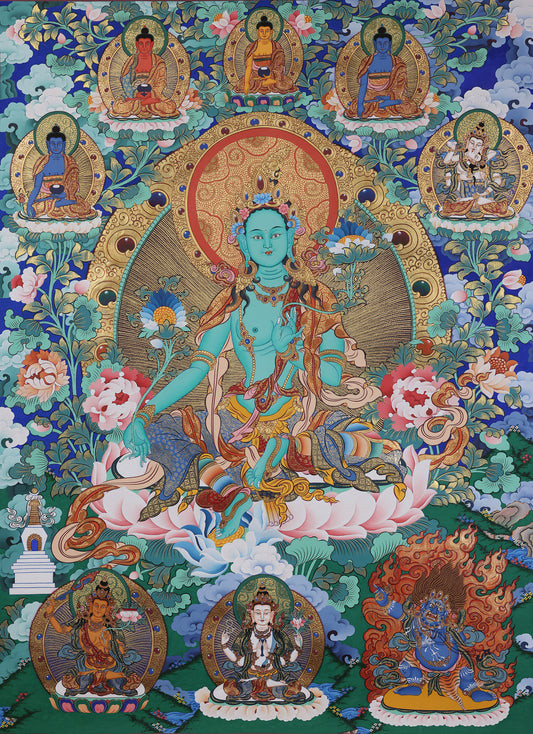
The central figure of this Thangka is White Tara in her serene form, strictly following the “Three Bends and Nine Folds” guidelines from the Sutra on Measurement of Images. Every detail embodies profound religious meaning.
1. Body Color and Facial Features
White Tara’s body is pure white like the full moon, corresponding to Amitabha Buddha of the Five Dhyani Buddhas, symbolizing purity, emptiness, and wisdom of longevity. Her face reflects the sixteen-year-old maiden form, with full lotus-shaped features, crescent-shaped eyebrows, and a gentle smile, representing feminine grace and the eternal compassion that transcends worldly age. This “maiden form” is not a secular aesthetic but a manifestation of the perfection of the Buddha’s Sambhogakaya.
2. Posture and Mudras
White Tara sits in vajra full-lotus posture atop a double-lotus seat, symbolizing freedom from afflictions without regression. Her right hand performs the gesture of granting wishes (Varada Mudra), palm outward, while her left hand forms the Three Jewels Mudra, holding a stem of the utpala lotus. The white lotus flowers in her hands appear in bud, half-open, and full bloom, representing the completeness of the Buddha, Dharma, and Sangha, while the curling lotus stems reach her ears, symbolizing the nourishment of sentient beings with the Dharma.
3. Adornments and Ritual Implements
She wears a five-Buddha crown, with Amitabha Buddha atop, representing the union of the Five Wisdoms. Her body is decorated with eight layers of tantric ornaments, including necklaces, jewelry, and armlets, while her ceremonial robes feature U-shaped folds typical of the Rebgong school, fulfilling the Sutra on Measurement of Images standards and reflecting the perfect virtues of the Buddha’s Sambhogakaya. The background contains jewels, banners, and other ritual implements, visually symbolizing abundant merit and wisdom.
III. Attendant Deities: Structured Protection and Offerings
The attendant deities in this White Tara Thangka follow the traditional “Three Longevity Deities” schema, forming a religious functional loop of “main deity – Dharmakaya – protector.”
1. Top Dharmakaya: Amitabha Buddha
Amitabha Buddha is usually depicted at the top of the Thangka, symbolizing that compassion originates from Buddhahood. As the core deity of longevity, Amitabha Buddha forms a sequential relationship with White Tara—Dharmakaya to Nirmanakaya—reinforcing the legitimacy of the longevity theme.
2. Flanking Deities: Usnisavijaya and Protectors
Flanking deities may include Usnisavijaya (three heads, eight arms), holding a nectar vase and dharmachakra, symbolizing purification of obstacles and life extension, complementing White Tara’s “longevity and wisdom.” Any blue wrathful deity present in the background is likely Vaiśravaṇa (Kubera), representing protective power over Dharma and wealth.
3. Offerings: Lotus and Natural Symbols
White Tara rests on a double-layered lotus seat—the lower lotus supporting, the upper lotus protecting—symbolizing freedom from worldly defilements. Background motifs such as peonies, auspicious clouds, and flowing water represent offerings in visual form: peonies signify wealth and completeness, clouds symbolize protection by deities, and water symbolizes compassionate nourishment. Together, these elements create a harmonious, serene environment.
IV. Painting Craftsmanship: Rebgong School Color Thangka Technique
This Thangka belongs to the Rebgong school of color Thangka painting, where craftsmanship is both an art and a meditative practice. The core process includes three levels:
1. Base Preparation: Purification from Canvas to Colored Ground
High-quality cotton canvas is stretched, coated with a mixture of yak glue and white chalk, and polished with shells until smooth. This process symbolizes purification from mundane distractions, providing a spiritually pure foundation for painting.
2. Color Techniques: Spiritual Significance of Mineral Pigments
White Tara’s body color is made from pearl powder and white chalk, producing a smooth, jade-like texture, representing her essence of emptiness. Background elements like peonies and clouds use a 32-color gradient technique, creating natural transitions with 3–5 layers, vivid yet harmonious, reflecting the Rebgong school’s style and the principle of all dharmas being equal.
3. Gold Lines and Detail: Ultimate Use of Pure Gold
Gold lines are drawn with 24K gold leaf ground into gold ink, applied with a fine cat-hair brush, creating a contrast of bright and dark gold. When light hits, the gold lines resemble Buddha light illuminating ignorance, embodying Rebgong artisans’ meticulous attention. The final step, opening the eyes, is performed after ritual recitation, imparting spiritual life to the Thangka—a practice emphasizing the union of painting and meditation.
V. Conclusion: Thangka as a “Living Ritual”
The White Tara color Thangka is not only a religious vehicle for life-prolonging salvation but also a masterpiece of devotion and craftsmanship. Its theme integrates worldly benefits and ultimate liberation, the iconography follows scriptural sanctity, and the colors and gold lines embody tantric philosophy: compassion arising from emptiness. For Tibetan devotees, this Thangka is not a static painting but a manifestation of the deity during visualization and a response of compassion during prayer, transforming abstract teachings into perceivable spiritual symbols, making longevity a path to perfect merit and wisdom.
#WhiteTara #TibetanBuddhism #TibetanThangka #RebgongThangka #BuddhistArt #MeditationArt #LongevityDeity #BodhisattvaThangka #TantricArt #SpiritualArt #BuddhistCraftsmanship #VisualizationPractice #CompassionAndWisdom #ThangkaCollectibles #SacredArt
Bring Tara Practice Into Your Sacred Space
Recommended pieces and collections
Tags:
Previous
Tibetan Buddhist Yab-Yum Thangka: The Visual Secret of Compassion and Wisdom — A Case Study of Vajrasattva in Union with His Consort
Next
Hand-Painted Tibetan Thangka Four-Faced Mahavairocana: A Cultural Decoding of Esoteric Wisdom, Sacred Iconography, and Traditional Craftsmanship