The Light of Enlightenment in Blue Thangka: The Symbols and Spirit of Shakyamuni Buddha in Tibetan Buddhism
wudimeng-Dec 17 2025-
0 comentarios
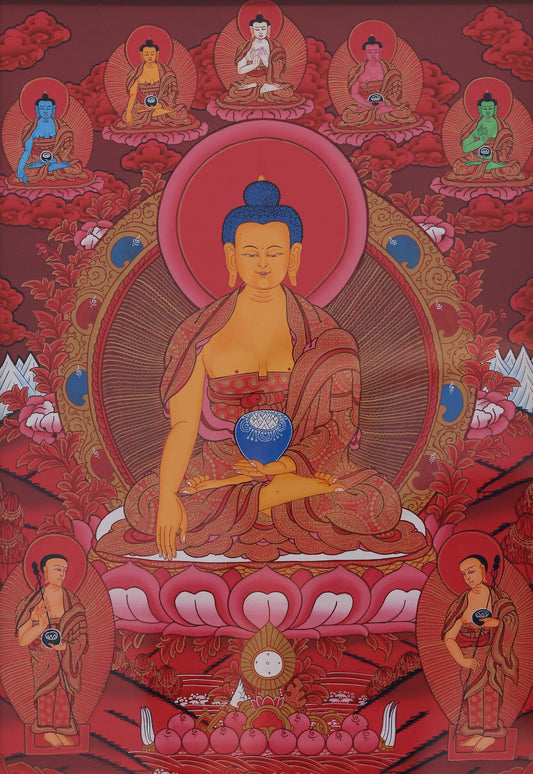
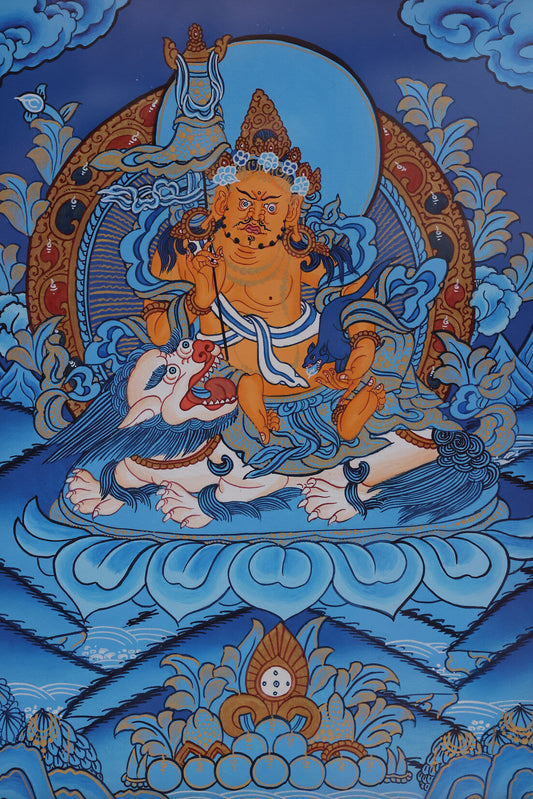
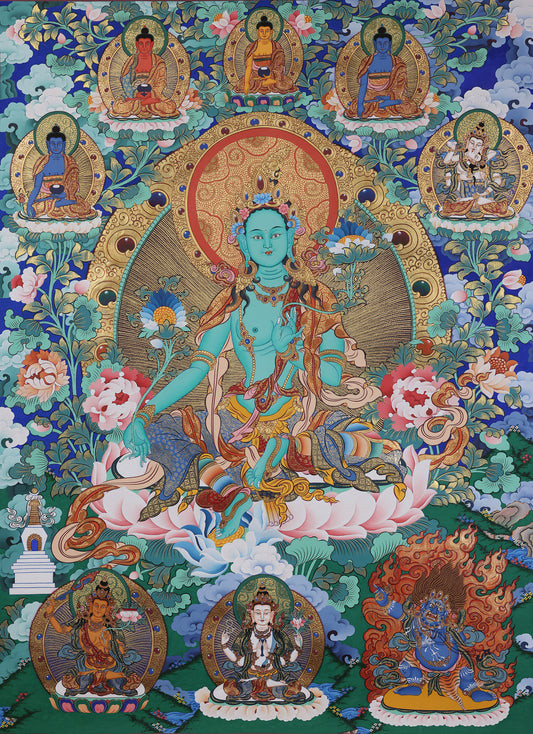
When a calm indigo blue spreads across the canvas, and gold-outlined lotus petals cradle the golden form—this Blue Thangka of Shakyamuni Buddha is both the pinnacle of Tibetan Buddhist art and a visual vessel for the Buddha’s spirit of enlightenment. In Tibetan monasteries and household altars, thangkas are never mere decorations; they are "mobile mandalas" connecting the mundane and the sacred. And the blue-background Shakyamuni thangka, with its profound color language, tells the life story of the Buddha from prince to enlightened one, as well as Tibetan Buddhism’s ultimate interpretation of "wisdom and compassion."
In the color system of Tibetan thangkas, blue is the "color of the Dharmadhatu" (the realm of all phenomena). Derived from mineral powders of lapis lazuli and turquoise—precious materials once transported along the Silk Road—artists grind them into fine particles (5-50μm) and layer them to create a sky-like depth (Master Lozang Rigje’s "thirty-two color gradient technique" allows blue thangkas to show 12 natural transitional shades). Against the blue background, Shakyamuni’s form is strictly shaped according to the Manual of Iconometric Proportions (Rig-pa’i Me-long):
-
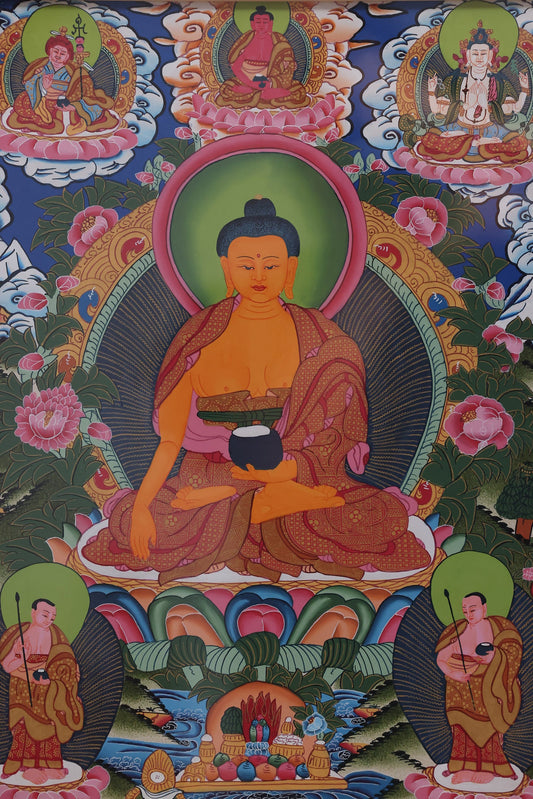
Golden Body: Symbolizes the Buddha’s "perfect, unstained Dharmakaya," like sunlight illuminating a golden mountain, corresponding to the Samadhi Raja Sutra’s description: "Body like pure gold, endowed with the thirty-two marks of a great man."
-
Ushnisha and Urna: The cranial protuberance (ushnisha) on the top of the head represents the perfection of wisdom; the cranial protuberance (urna) between the eyebrows is the symbol of the "third eye," which can perceive the nature of all sentient beings.
-
Long Earlobes: A mark of the Buddha’s renunciation of his princely status to become a monk; longer earlobes signify deeper resolve to "let go of attachments."
In this blue thangka, the Buddha sits in Vajra Cross-Legged Posture (Vajrasana) on a lotus pedestal—its petals unfold like blooming utpala lotuses, symbolizing "purity unsoiled by the mud of samsara." The sun disc and moon disc beneath the lotus pedestal represent "wisdom that realizes emptiness" and "bodhicitta (enlightenment mind) that benefits all beings," respectively—the core of Tibetan Buddhism’s "union of compassion and wisdom."
Every detail of a thangka is a "code of doctrine," and Shakyamuni’s Earth-Touching Mudra (Bhumisparsha Mudra) and Nectar Bowl embody the moment of his enlightenment:
-
Right Hand in Earth-Touching Mudra: The fingertips gently touch the lotus pedestal—this is the posture the Buddha held while attaining enlightenment under the Bodhi Tree. When the demon Mara disturbed him with beauty and weapons, the Buddha touched the earth to invoke the Earth Goddess as a witness to his "good karma across three lifetimes"; the earth trembled, and Mara’s army dispersed. In Tibetan Buddhism, this mudra symbolizes "subduing the inner demon," reminding practitioners that "afflictions are like demons, and only wisdom can overcome them."
-
Left Hand Holding the Nectar Bowl: The bowl filled with nectar symbolizes both the Buddha’s alms-seeking after renunciation and the "nectar of liberation." In Tibetan rituals, bowls are often associated with "Medicine Buddha’s healing," but Shakyamuni’s bowl emphasizes "letting go of material attachments and taking the Dharma as sustenance."
The Eight Auspicious Symbols (Ashtamangala) (e.g., the treasure vase, the Dharma wheel) surrounding the Buddha in the blue thangka are offerings from deities like Brahma and Indra: the Dharma wheel symbolizes "the Dharma turning ceaselessly," the treasure vase represents "the perfection of merit," and the interwoven lotus patterns fuse Han Chinese aesthetics with Tibetan symbols—a testament to Sino-Tibetan cultural exchange.
Tibetan Buddhism summarizes Shakyamuni’s life as the "Twelve Deeds of Enlightenment," and high-quality thangkas condense these stories into a "three-world, five-direction" composition:
-
Descending from Tushita Heaven: The Buddha, in his bodhisattva form, resided in Tushita Heaven, observed that sentient beings were ready, and entered Queen Maya’s womb riding a six-tusked white elephant.
-
Birth Under the Sal Tree: At Lumbini Garden, under the Ashoka tree, the prince was born from his mother’s right side, pointing one finger to the sky and one to the earth, declaring, "Above heaven and below earth, I alone am the honored one"—not a claim of egoistic supremacy, but a metaphor that "all sentient beings have Buddha-nature and can become enlightened."
-
Touring the Four Gates: The prince saw an old man, a sick man, a dead man, and a monk, realized the impermanence of life, and resolved to renounce the world.
-
Subduing Mara’s Army: Corresponding to the Earth-Touching Mudra, this is the key moment of "breaking delusion and attaining enlightenment."
-
Passing into Nirvana at Kushinagara: At the age of 80, the Buddha entered nirvana between two sal trees, leaving the final instruction, "Take the precepts as your teacher"—the foundation of "upholding precepts in practice" in Tibetan Buddhism.
Though centered on the "enlightenment form," the blue thangka’s background clouds and divine beasts (e.g., the Garuda) allude to the "Twelve Deeds." Thus, the thangka becomes a "mobile biography of the Buddha," allowing illiterate believers to understand the Dharma through visuals.
In Tibetan Buddhist practice, thangkas are not "artworks" but "aids to visualization": practitioners focus on the Buddha’s form, merging it with their own mindstream, ultimately achieving the state of "visualizing the Buddha is visualizing oneself." The deep color of the blue thangka further helps practitioners quickly enter "the tranquility of meditation"—as The Gradual Path of Enlightenment (Zhi-wei Lhun-grub) states: "Visualizing the Buddha in a blue thangka is like visualizing the void; it allows the mind to settle from distractions."
For modern viewers, the value of blue thangkas extends beyond religion: they are a "microcosm of Tibetan cosmology"—the upper clouds represent the heavenly realm, the middle Buddha represents the human realm, and the lower lotus pedestal represents the earth realm; this "three-world" composition reflects Tibetans’ perception of the universe. They are also "living heritage": artists in the Rebkong (Repkong) region still use mineral pigments and pure gold powder to paint by hand, with each blue thangka taking months to years to complete. The scarcity of materials like lapis lazuli makes these works "cultural living fossils."
Today, blue thangkas of Shakyamuni are not only found in monasteries but also in modern spaces—they are seen as symbols of "calm," helping urbanites regain inner order amid busyness. However, the "sacredness" of thangkas has never faded: in Tibet, thangkas are blessed by monks before painting, and buyers should understand their cultural background to avoid reducing sacred objects to mere "commodities."
As a Rebkong artist puts it: "Every brushstroke in a blue thangka is a recitation." This Shakyamuni thangka is both a witness to the Buddha’s enlightenment and a mirror for every viewer to "seek their inner Buddha-nature." When we gaze at the calm indigo and golden form, we may see not a "god," but the "innate wisdom and compassion" within ourselves.
#TibetanBuddhistArt #ShakyamuniBuddhaThangka #BlueThangka #ThangkaSymbols #TibetanBuddhistCulture #EnlightenmentInBuddhism #ShakyamuniTeachings #TraditionalTibetanArt #SpiritualArt