Hand-Painted Tibetan Buddhist “Amitabha Buddha Pure Land” Thangka: In-Depth Analysis of Theme, Deities, and Craftsmanship

1. Theme: The “Meritorious Splendor” of the Western Pure Land and Nyingma Tradition Expression
Tibetan Buddhist thangkas, as a unique form of religious art, not only embody aesthetic value but also serve as a visual representation of faith. Among them, the “Amitabha Buddha Pure Land” thangka focuses on the Pure Land belief system, depicting Sukhavati, the Western Pure Land ruled by Amitabha Buddha. This sacred realm symbolizes liberation from samsara and the swift attainment of enlightenment.
In Tibetan Buddhist culture, the Pure Land is not merely a “heavenly fantasy,” but a concrete manifestation of the Buddha’s self-realized state. According to classic texts such as the Amitabha Sutra and Infinite Life Sutra, Sukhavati is adorned with Seven Precious Pools, Eight Merit Waters, jeweled trees, and heavenly music, creating a spiritually supportive environment for practitioners to eliminate afflictions and accelerate their path to Buddhahood.
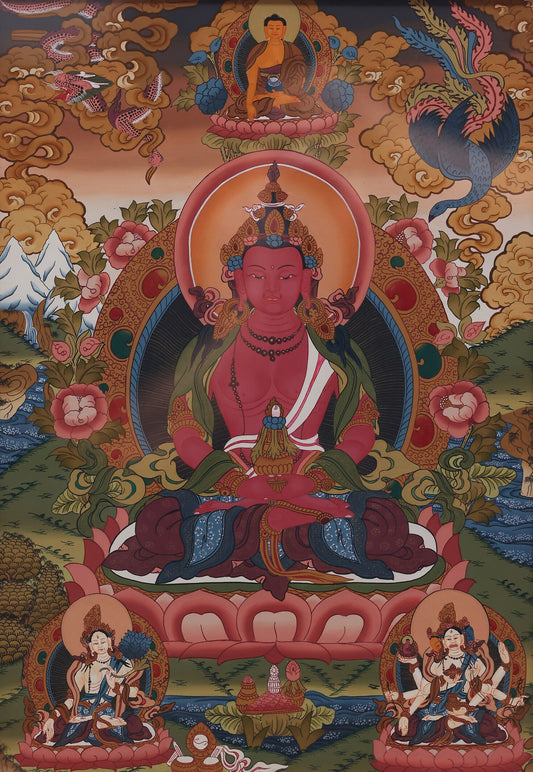
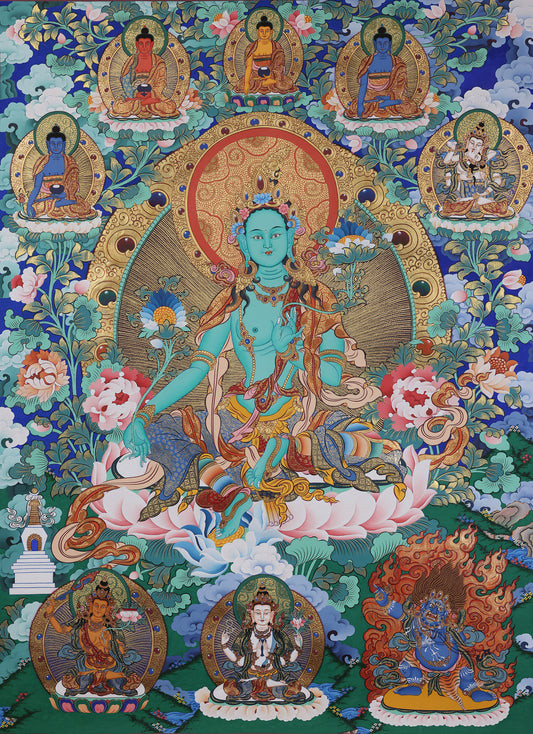
This thangka uniquely integrates the Nyingma “Three Bodies in One” (Trikaya) concept. The central Amitabha Buddha represents the Dharmakaya, the attendant Avalokiteshvara Bodhisattva symbolizes the Sambhogakaya, and Padmasambhava seated in the lotus pond signifies the Nirmanakaya. According to Nyingma teachings, rebirth in Padmasambhava’s Pure Land is equivalent to rebirth in Amitabha’s Pure Land. This design combines Pure Land devotion with Padmasambhava lineage practices, reflecting the doctrinal synthesis within Tibetan Buddhism.
2. Central Deity: Amitabha Buddha’s Iconography and Symbolism
The central figure of the thangka is Amitabha Buddha (Tibetan: Tsemo), meticulously depicted according to the 37:25 golden ratio from the Canon of Buddha Proportions. Every detail carries profound religious symbolism.
2.1 Posture and Facial Expression
Amitabha’s cranial protuberance (ushnisha) signifies perfected wisdom, while elongated earlobes represent renunciation of royal life and the cultivation of compassion. The serene facial expression, with half-closed eyes and gentle lips, conveys the Pure Land qualities of tranquility and liberation from suffering. The orange-red body color aligns with traditional Tibetan iconography, symbolizing the transformation of afflictions into wisdom and compassion.
2.2 Mudra and Ritual Implements
The Buddha’s hands are in the meditation (dhyana) mudra, holding a begging bowl. This not only reflects the monastic practice of receiving alms but also metaphorically nourishes sentient beings with the “taste of Dharma,” embodying both compassion and emptiness.
2.3 Lotus Throne and Halo
Seated on a thousand-petal lotus, Amitabha embodies the purity of rising above worldly defilements. The double halo—inner green for purity, outer gold for the omnipresence of Dharma—features curling floral motifs, exemplifying the Tibetan tradition of expressing merit and virtue through intricate patterns.
3. Attendant Deities: The Hierarchical Network of the Pure Land
The thangka arranges the attendant deities around the central Buddha according to the Three Realms and Five Directions cosmology, forming a layered and symbolic network.
3.1 Bodhisattva Attendants
On either side of Amitabha are Avalokiteshvara (left) and Mahasthamaprapta (right), the attendants of the Western Trinity. Avalokiteshvara holds a vase of nectar, symbolizing blessings for all beings; Mahasthamaprapta holds a lotus, guiding beings to the Pure Land. Their elaborate attire, with jewels and flowing garments, represents the Sambhogakaya’s dignity and their role in aiding Amitabha in receiving sentient beings.
3.2 Deities Above the Central Buddha
Above Amitabha are three seated Buddhas from the Five Dhyani Buddhas: Akshobhya (East), Ratnasambhava (South), and Amoghasiddhi (North), representing the five wisdoms of Buddhahood. Depicting three rather than five Buddhas follows the Tibetan artistic convention of “partial representation reflecting the whole,” symbolizing that the Pure Land encompasses all Buddhas’ merit and virtues.
3.3 Deities Below and Around
Near Amitabha are Ānanda and Kāśyapa, representing the exemplary disciples of the Buddha. In the lotus pond, Padmasambhava holds a vajra, reflecting the Nyingma lineage, accompanied by Four-Armed Avalokiteshvara, emphasizing the Trikaya doctrine. Peripheral figures include the Eight Classes of Protectors, offering goddesses, and worldly benevolent deities, who collectively create a vision where sacred and mundane coexist, sharing the merit of the Pure Land.
These attendants are more than decorative—they visually represent levels of spiritual attainment, guiding practitioners from ordinary beings to advanced stages of realization.
4. Craftsmanship: Material and Spiritual Practice in Tibetan Thangka Painting
This thangka is a hand-painted Menri-style work, renowned for its rich colors and precise lines. Its creation is both an artistic and spiritual practice, demonstrating the unity of sacredness and technical skill.
4.1 Canvas Preparation
The base is pure cotton cloth, soaked thrice in animal glue, stretched, dried, and finely polished, ensuring centuries-long preservation. Tibetan painters consider this process a preliminary spiritual purification.
4.2 Pigment Preparation
All pigments are natural: cinnabar for red, malachite for green, lapis lazuli for blue, and 24K gold for highlights. Minerals are ground to 5–20 microns and mixed with glue in a 3:1 ratio. This guarantees long-lasting colors and symbolizes the eternal nature of the Dharma.
4.3 Painting Techniques
-
Line Drawing: Using wolf-hair brushes, outlines are drawn with hair-fine precision, following the central brushstroke principle, embodying the Menri style philosophy: “line as skeleton.”
-
Layered Coloring: Colors are applied from dark to light in 3–5 layers, e.g., Amitabha’s orange-red body is built over cinnabar and layered with yellow and soft red to create depth and vitality.
-
Eye Opening Ceremony: Painting the Buddha’s eyes is highly ritualized, performed after purification and incense, controlling the radius with the pinky finger, conveying compassionate gaze.
4.4 Compositional Logic
The composition uses non-realistic perspective centered on the Buddha, with figures diminishing in size toward the background. This creates a sense of vast cosmic space and aligns with religious understanding: Amitabha as the central axis of the Pure Land. Influenced by 16th-century Tibetan “grid-style” layouts and Han Chinese garment realism, this work exemplifies multi-style integration in Tibetan thangka art.
5. Conclusion: Thangka as a Living Vehicle of Dharma
The “Amitabha Buddha Pure Land” thangka is not merely an artwork but a mobile Buddhist temple. Its theme visually manifests Pure Land devotion; its central and attendant deities represent hierarchical stages of spiritual practice; its craftsmanship embodies the principle of “realizing Dharma through skillful artistry.”
In Tibetan culture, thangkas are used for meditation, veneration, and merit accumulation rather than mere display. Every brushstroke and line embodies the aspiration to bring liberation and joy to all sentient beings, reflecting the core Tibetan Buddhist principle of unity of form and spirit, method and meaning.
Through this thangka, devotees not only appreciate exquisite Tibetan artistry but also engage in spiritual practice, experiencing the majesty and serenity of the Pure Land while cultivating inner peace and spiritual elevation.
#TibetanBuddhism #Thangka #AmitabhaBuddha #PureLand #PureLandFaith #HandPaintedThangka #MenriStyle #BuddhistArt #TibetanBuddhistCulture #BuddhistPractice #VisualizationPractice #ReligiousArt #DharmaVessel #TibetanArt #BuddhistCollectibles
Etiquetas:
Anterior
Vaiśravaṇa in Tibetan Buddhism: The God of Wealth and Protection Seen Through Blue Thangkas
Próximo
Tibetan Hand-Painted Thangka “Shakyamuni Buddha Teaching”: Decoding Faith Symbols, Deity Hierarchy, and Craftsmanship