Tibetan Hand-Painted Thangka “Shakyamuni Buddha Teaching”: Decoding Faith Symbols, Deity Hierarchy, and Craftsmanship

Tibetan Buddhist thangkas are more than just exquisite works of art; they are profound carriers of religious culture. Every thangka narrates the Buddha’s life, religious teachings, and the wisdom of spiritual practice. The thangka “Shakyamuni Buddha Teaching” perfectly combines the grand narrative of the Buddha’s enlightenment and first turning of the Dharma wheel with the doctrinal principles of the Gelug tradition, presenting a three-dimensional cultural value through faith symbols, deity hierarchy, and exquisite craftsmanship. This article explores the cultural significance of this thangka from four perspectives: thematic meaning, main deity iconography, attendant deities, and painting craftsmanship.
I. Thematic Interpretation: Faith Narrative of “Shakyamuni Buddha’s First Teaching” and Gelug Doctrine
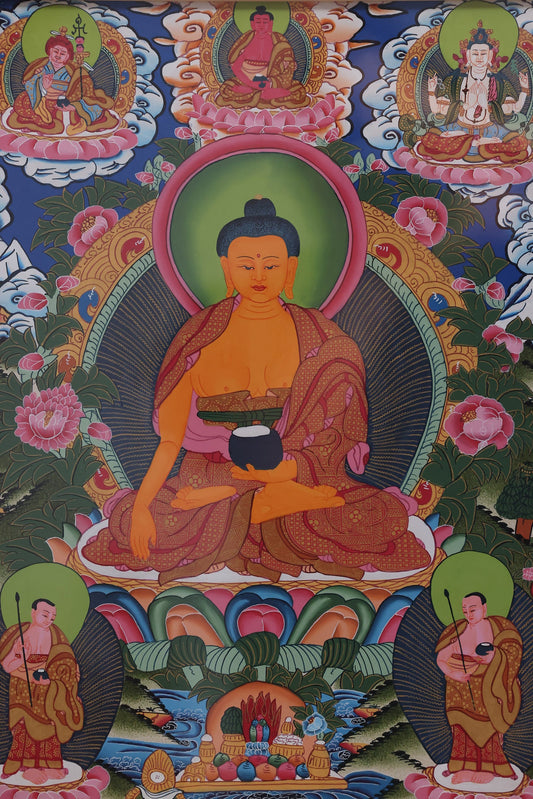
The core theme of the “Shakyamuni Buddha Teaching” thangka is the Buddha’s first turning of the Dharma wheel at Sarnath after attaining enlightenment. This event is not merely a historical account; in Tibetan Buddhism, it symbolizes the Buddha demonstrating the path “from ordinary being to Buddha” and opening the gate of liberation for all sentient beings. According to the Dharmacakra Pravartana Sutra, after enlightenment, the Buddha taught the Four Noble Truths—suffering, origin, cessation, and path—to the five monks, marking the formal establishment of Buddhism in the world and the beginning of sentient beings’ liberation.
The Gelug tradition emphasizes systematic transmission of exoteric teachings, with scriptures and step-by-step practice at its core. This thangka reflects that doctrinal principle: the preaching Buddha sits at the center, surrounded by attendant deities arranged hierarchically. Through visual representation, abstract Buddhist teachings are transformed into tangible symbols suitable for contemplation and veneration, allowing practitioners to directly experience the Buddha’s compassion and wisdom.
II. Main Deity Iconography: Symbolism and Hidden Meanings of Shakyamuni Buddha’s Teaching Form
The central figure is Shakyamuni Buddha (Sanskrit: Siddhartha Gautama). The iconography strictly follows the Canonical Measurements of Buddha Images, incorporating 32 physical characteristics and 80 auspicious marks, each detail embodying Buddhist philosophical symbolism.
1. Physical Features
The Buddha’s cranial bump forms a dark blue spiral ushnisha, symbolizing complete wisdom and transcendence of the mundane. His elongated earlobes reaching the shoulders represent the accumulation of merit and detachment from desires. The face exhibits a serene expression, with half-closed eyes and a subtle smile, conveying compassion for sentient beings and the wisdom of teaching the Dharma. The golden body color, characteristic of Shakyamuni Buddha in Tibetan thangkas, represents purity, untarnished by worldly defilements, and the illumination of Dharma across all directions.
2. Hand Gestures and Ritual Objects
The Buddha’s hands form the Dharmachakra Mudra, with thumbs and index fingers touching to form a circle at chest level. In his palms rests the Dharma wheel decorated with the Eight Auspicious Symbols. The wheel symbolizes the perpetuity of the Dharma, while the eight symbols—such as the treasure vase representing universal blessings and the conch shell representing the far-reaching sound of the Dharma—convey both the doctrinal and merit aspects of Buddhist teachings.
3. Lotus Seat and Halo
The Buddha sits in full lotus on a thousand-petal red lotus seat, symbolizing purity emerging unstained from the worldly defilements. Behind him, a dual-layer halo is depicted: an inner red body halo representing the Buddha’s compassionate warmth, and an outer golden Dharma wheel halo representing the omnipresence of the Dharma and the removal of ignorance. The halo’s edge is adorned with curling vine patterns, symbolizing the continuity of the Dharma lineage.
III. Attendant Deities: Sacred Assembly and Functional Hierarchy of the First Turning of the Dharma Wheel
Attendant deities surround the Buddha according to hierarchical arrangement, recreating the sacred scene of the first Dharma wheel turning at Sarnath.
1. Upper Deities: The Five Dhyani Buddhas
Above the main Buddha are five Dhyani Buddhas: Vairocana at the center, Akshobhya in the east, Ratnasambhava in the south, Amitabha in the west, and Amoghasiddhi in the north. They represent the five wisdoms of the Buddha—e.g., Vairocana embodies the Dharmadhatu wisdom, Akshobhya the Mirror-like wisdom. Their inclusion signifies that Shakyamuni Buddha’s teaching embodies universal wisdom.
2. Lateral Disciples: The Five Monks
On both sides of the Buddha are the foremost disciples Kaundinya (left) and Ashvajit (right). Kaundinya, the first to attain enlightenment, signifies that Dharma practice liberates sentient beings; Ashvajit holding the sutra represents the transmission and continuation of the Buddha’s teachings. Together, they embody the starting point of the Śrāvakayāna path, resonating with the theme of teaching ordinary beings.
3. Lower Assembly and Offerings
Beneath the lotus seat, the Dharma wheel flanked by two deer symbolizes sentient beings receiving the Dharma, free from suffering. Surrounding treasures such as seven precious items (golden wheel, white elephant, blue horse, etc.) indicate the Dharma bringing worldly peace and abundance. The lotus and treasure vase symbolize purity and the elixir of Dharma. These are not mere decorative elements—they visually deconstruct the first turning of the Dharma wheel, from Buddha wisdom to disciple realization, from Dharma principles to sentient benefit, forming a coherent narrative of Buddha teaching — beings attaining liberation.
IV. Painting Craftsmanship: Integration of Artistry and Devotion
This thangka is a purely hand-painted work of the Khyentse school, one of the three major Tibetan thangka traditions, noted for bold colors and rich composition. Its craftsmanship is not only artistic but also a devotional practice, reflecting the painter’s spiritual commitment.
1. Canvas Preparation
The base is coarse linen, soaked four times in animal glue, stretched over a wooden frame, and polished with stone pestle for 15 days. Tibetan artists regard this as preparatory spiritual practice, purifying the mind. Glue is slowly boiled for three hours to achieve balanced adhesion and durability.
2. Pigment Preparation
Natural mineral and plant pigments are used: cinnabar for red, 24K gold leaf for gold (pounded with animal glue to under 10μm), lapis lazuli for blue, turquoise for green. The pigment ratio of mineral powder to glue is 4:1, ensuring durability for centuries and symbolizing the eternal nature of the Dharma.
3. Painting Techniques
-
Line Drawing: Fine purple brushes outline figures; lines alternate side and center strokes, embodying Khyentse’s principle of “line as force.”
-
Color Application: Flat and gradient layers (2–3) create depth. For the golden body, a base of ochre is overlaid with gold powder and light yellow glaze.
-
Facial Features: The final stage, performed after three days of fasting, uses wolf-hair brushes to render the eyes and eyebrows, capturing serenity, authority, and compassion.
4. Compositional Logic
The thangka follows central symmetry and layered mandala-style layout. The Buddha sits at the core, with attendants extending outward, reflecting the centrality of Dharma. The red and gold palette symbolizes compassion and wisdom, resonating perfectly with the theme of Buddha teaching.
V. The Thangka as a Living Dharma Wheel
The “Shakyamuni Buddha First Turning of the Dharma Wheel” thangka embodies both art and mobile sanctuary. Its theme conveys the presence of Dharma in the world, the central deity and attendants form a symbolic system of transmission, and the craftsmanship represents a devotional practice of upholding the Dharma. In Tibet, such thangkas are not mere decorative pieces; they are tools for meditative visualization, remembrance of teachings, and accumulation of merit. Every mineral pigment stroke and line carries the aspiration “May the Dharma endure, and sentient beings attain liberation”, embodying the Tibetan thangka’s cultural essence of form, spirit, and practical purpose in unity.
#TibetanThangka #ShakyamuniBuddha #BuddhaTeaching #HandPaintedThangka #BuddhismArt #GelugSchool #DharmaWheel #MeditationArt #SpiritualArt #KhyentseSchool #SacredArt #BuddhistIconography #BuddhistSymbols #ArtCollectors #MindfulnessArt #TibetanCulture #ReligiousArt #BuddhistPractice #ThangkaPainting #CulturalHeritage
Etiquetas:
Anterior
Hand-Painted Tibetan Buddhist “Amitabha Buddha Pure Land” Thangka: In-Depth Analysis of Theme, Deities, and Craftsmanship
Próximo
Hand-Painted Tibetan Thangka of Akshobhya Buddha’s Eastern Abhirati Pure Land: In-Depth Analysis of Symbolism, Deities, and Artistic Craftsmanship