The Great Aspiration in Red Thangka: Samantabhadra Bodhisattva in Tibetan Buddhism – Symbolism and Spiritual Wisdom
wudimeng-Dec 19 2025-
0 comentarios
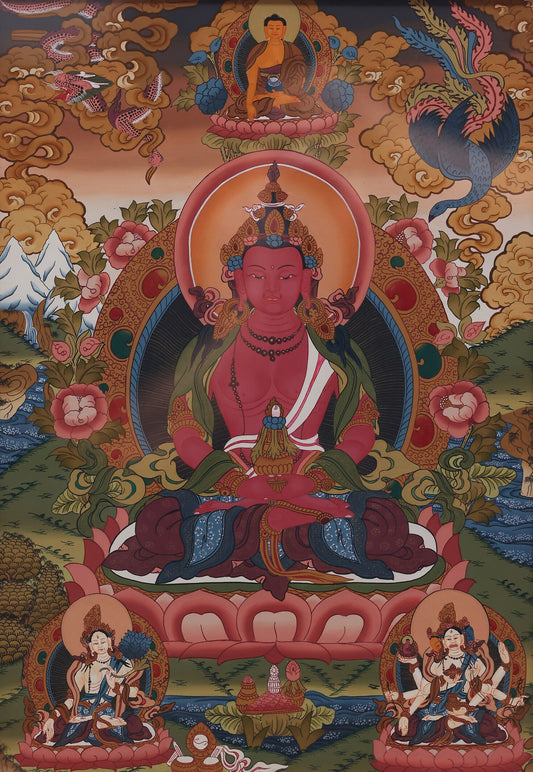
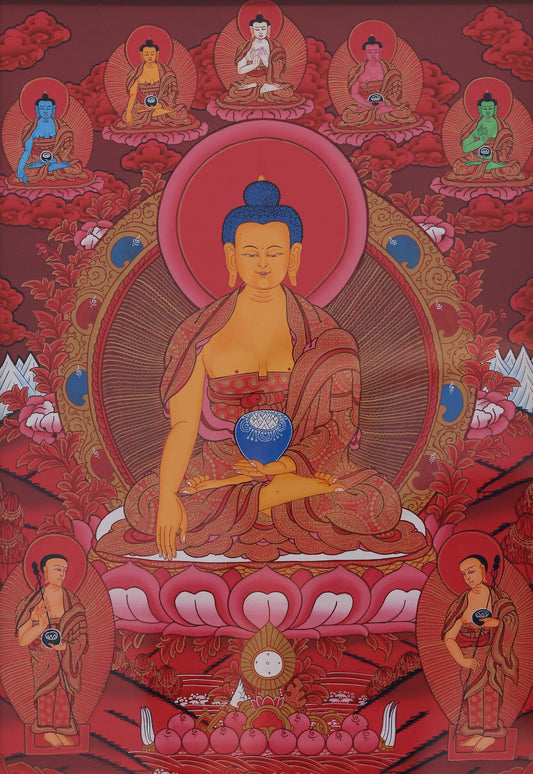
When you gaze at this Red Thangka of Samantabhadra Bodhisattva, the crimson background glows like the intense sunlight of the Tibetan Plateau. The gilded lines outline a six-tusked white elephant resting on a lotus throne; the Bodhisattva holds a wish-fulfilling vase, his 眉宇 radiating the solemnity and compassion unique to the snowy land’s Buddhist realm. This is not merely a work of art, but a tangible expression of "great aspiration and action" in Tibetan Buddhism. In Han Chinese Buddhism, Samantabhadra is paired with Manjushri as the "Two Sages of the Avatamsaka Sutra"; in the cosmology of Tibetan Buddhism, however, he is both one of the Eight Close Attendant Bodhisattvas (alongside Avalokiteshvara, Manjushri, Vajrapani, etc.) and the "Lord of Aspiration" who is inseparable from Vajrasattva.
In the Bodhisattva system of Tibetan Buddhism, Samantabhadra (known as Kun-tu Bzang-po in Tibetan) is not ranked among the "Four Great Bodhisattvas" as in Han Buddhism, but is classified among the Eight Close Attendant Bodhisattvas. Yet his trait of "great action" is endowed with deeper esoteric connotations.
Tibetan Buddhism holds that Samantabhadra is the synthesis of all Buddhas’ virtuous qualities of principle, concentration, and action:
-
Principle virtue: Corresponding to the Avatamsaka Sutra’s concept of "all-pervading nature is pu (universal)," it symbolizes the equality of the Dharma realm;
-
Concentration virtue: Embodied in his stable seated posture, representing unshakable wisdom in meditation;
-
Action virtue: His core trait – practicing the Bodhisattva path guided by the "Ten Great Vows."
More uniquely, Tibetan esotericism identifies Samantabhadra and Vajrasattva as one entity with different names: In the Womb Realm Mandala, Samantabhadra often appears as "Well-Tamed Vajra" or "True Suchness Vajra," holding a five-pronged vajra, representing the "unity of aspiration and emptiness." This fusion of identities reflects Tibetan Buddhism’s "harmony of exoteric and esoteric teachings" – Samantabhadra’s "aspirations" are ultimately fulfilled through Vajrasattva’s "esoteric actions."
In this Red Thangka, the most striking elements are the six-tusked white elephant and the wish-fulfilling vase held by the Bodhisattva; every detail embodies the "symbolic teaching" wisdom of Tibetan Buddhism.
Samantabhadra’s image riding a six-tusked white elephant follows a strict symbolic system in Tibetan Buddhism:
-
Six tusks: Correspond to the "Six Perfections" (generosity, morality, patience, diligence, concentration, wisdom) – the foundation of the Bodhisattva path;
-
White elephant: Symbolizes "great power" and "purity" – like an elephant king, it can bear sentient beings’ suffering; like white jade, it is free from defilement;
-
Elephant on the lotus throne: The white elephant rests on a red lotus, representing "aspiration (the elephant) arising from Bodhicitta (the lotus)."
Tibet also has the saying that "the appearance of a white elephant signals the flourishing of the Dharma." Historically, Lha Thothori Nyantsen, the 27th Tibetan king, was believed to be an incarnation of Samantabhadra riding a white elephant, marking the beginning of Buddhism’s introduction to Tibet.
The vase held by the Bodhisattva in the Thangka is called a "mani vase" in Tibetan esotericism:
- It often contains nectar, symbolizing "the ability to fulfill all sentient beings’ wishes";
- A peacock feather or lotus is inserted into the mouth, representing "saving sentient beings with skillful means."
In Samantabhadra’s rituals, the vase is also an important offering implement – visualizing infinite offerings flowing from the vase is a core practice of the "Samantabhadra Offering Cloud."
Tibetan Buddhism regards the "Ten Great Vows" from the Samantabhadra’s Aspiration and Practice Sutra as the general outline of the Bodhisattva path, even equating it to the "Seven-Limbed Offering" (prostration, praise, offering, etc.). Its practice methods permeate daily religious life in Tibet.
-
Worshipping All Buddhas: Tibetan believers practice this through kora (circumambulation) and full prostrations – each bow is a reverence for the truth that "all sentient beings possess Buddha-nature";
-
Praising the Tathagatas: This is not just chanting Buddha names, but also "hiding others’ faults and praising their virtues," as the Tibetan proverb goes: "Not speaking of others’ shortcomings is the best praise for the Buddha";
-
Making Vast Offerings: In the "Samantabhadra Water Offering Ceremony" at Changchub Ling Monastery, believers offer stream water, visualizing it transforming into infinite nectar – a practice of the "Samantabhadra Offering Cloud";
-
Repenting Karmic Obstacles: In Tibetan esotericism, Samantabhadra’s vows are often used as confession texts, paired with Vajrasattva’s Hundred-Syllable Mantra to visualize karmic obstacles being washed away like dust by aspiration;
-
Rejoicing in Merit: Tibet’s custom of dundrup (merit piles) embodies rejoicing in others’ good deeds;
-
Requesting the Turning of the Dharma Wheel: This corresponds to the Tibetan tradition of "inviting lamas to teach the Dharma";
-
Requesting Buddhas to Remain in the World: The "Longevity Offering" is performed to pray for lamas and spiritual mentors to live long;
-
Always Following the Buddha’s Teachings: The process of relying on a lama and engaging in study, reflection, and practice is "following Samantabhadra’s actions";
-
Constantly Adapting to Sentient Beings: The Tibetan herders’ lifestyle of "prioritizing others’ well-being" is a practical manifestation of this vow;
-
Dedicating All Merit Universally: Concluding any good deed with "may this merit be dedicated to all sentient beings" is standard in Tibetan spiritual practice.
Tibetan Buddhism holds that practicing the Ten Great Vows leads to "rebirth in the Pure Land" – as the Samantabhadra’s Aspiration and Practice Sutra states: "Whoever hears, writes, or expounds these vows will be reborn in Amitabha’s Western Pure Land." This has deeply integrated Samantabhadra’s faith with Pure Land teachings in Tibet.
This Thangka belongs to Red Thangka (one of the three major Thangka types, with a red background), and its artistic characteristics themselves carry Samantabhadra’s spirit:
-
Crimson background: Symbolizes "the fervor of aspiration," as intense and enduring as Samantabhadra’s Ten Great Vows;
-
Gilded lines: Represent "the light of wisdom," implying that aspiration must be guided by wisdom;
-
Dense composition: The surrounding clouds and flowers visualize the "Samantabhadra Offering Cloud" – in visualization, these decorations transform into infinite offerings filling the universe.
Red Thangkas are often used as "spiritual aids" in Tibet; when believers visualize Samantabhadra in the Thangka, they can "recall his vows and align their minds with the Bodhisattva’s" – a reflection of Tibetan Buddhism’s tradition of "conveying the Dharma through images."
In today’s fast-paced society, Samantabhadra’s spirit of "great action" still offers inspiration:
-
From "aspiration" to "action": We often make vows but struggle to act; the core of Samantabhadra’s Ten Great Vows is "action" – like Tibetan believers, we can embody our vows in small daily acts, such as "bowing once or speaking a kind word";
-
Adaptation and tolerance: "Constantly adapting to sentient beings" is not unprincipled compromise, but accepting differences with compassion and saving others with skillful means, as Samantabhadra does;
-
The wisdom of dedication: Dedicating personal achievements "to all sentient beings" breaks the limits of the self and brings a broader sense of life’s meaning.
When we look at this Red Thangka again, Samantabhadra’s smile is no longer a distant religious symbol, but a promise that "aspiration can accomplish all things" – as the Tibetan proverb says: "Samantabhadra’s vows are the path beneath your feet; the white elephant’s steps are the forward movement."
#SamantabhadraInTibetanBuddhism
#RedThangkaSymbolism
#TenGreatVowsPractice
#SixTuskedWhiteElephantMeaning
#TibetanBuddhistBodhisattvas
#SamantabhadraVows
#BuddhistThangkaArt
#TibetanSpiritualPractice
#AspirationAndActionInBuddhism
#SamantabhadraBodhisattvaTeachings
#TibetanBuddhism