When the cool matte of silver meets the emerald-hued embodiment of compassion, a sacred scroll of Tibetan Buddhism unfolds in the gradations of mineral pigments—this is the hand-painted Tibetan silver thangka of Green Tara, both a visual expression of faith and a living inheritance of Tibet’s millennial craftsmanship.
I. Theme: Green Tara’s "Virtue of Salvation," the Compassionate Mandala of Tibetan Esotericism
In the spiritual system of Tibetan Buddhism, Green Tara is the embodied compassion of Avalokiteshvara (according to The Origin of Tara, she emerged from Avalokiteshvara’s tears). She presides over "swift salvation" and "relieving calamities to fulfill wishes," making her one of the most beloved female buddhas among Tibetan believers.
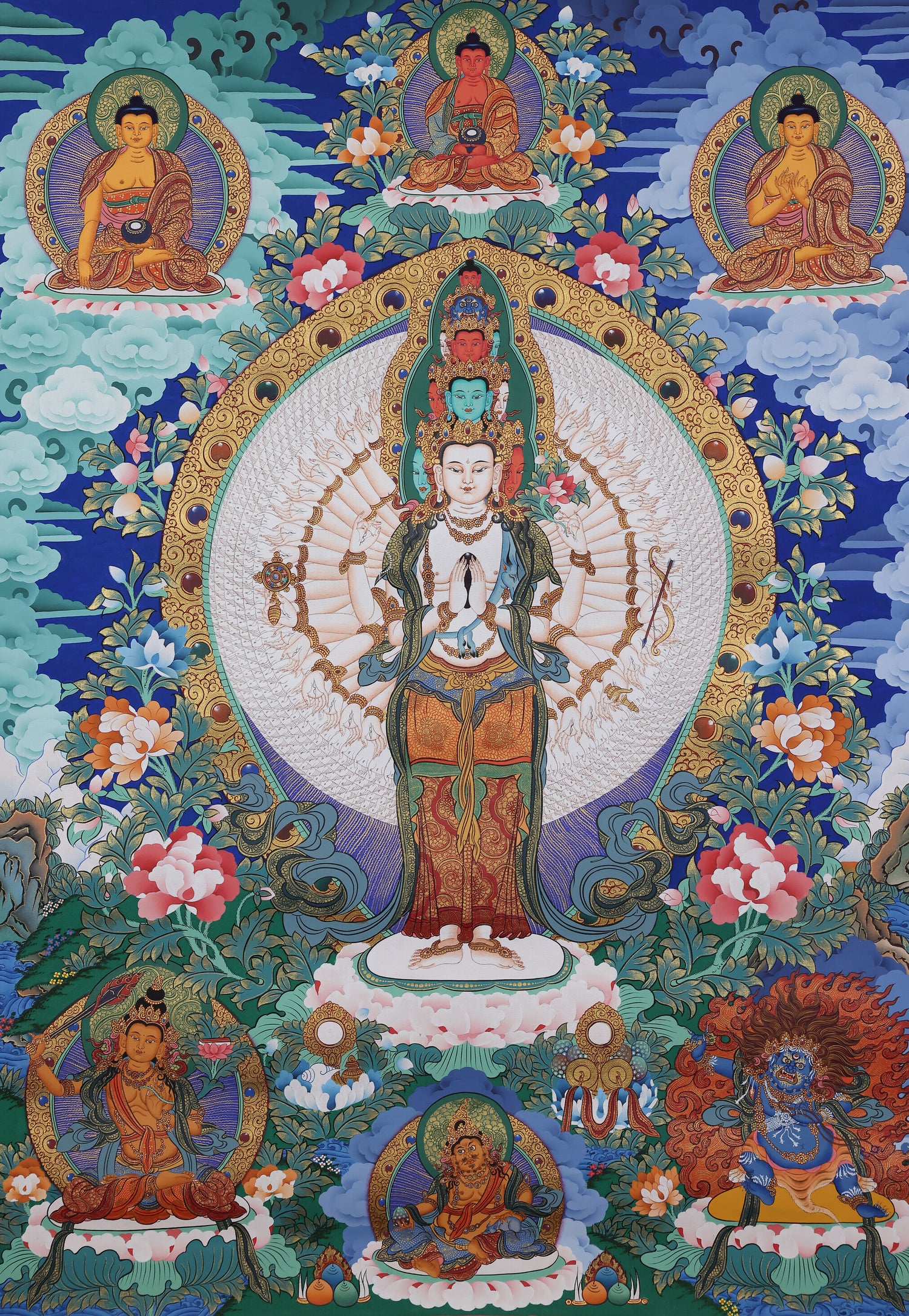
This 70×100cm silver thangka constructs a complete "mandala space" centered on Green Tara: the main deity occupies the core, attendant deities flank her, and offering elements below echo the theme. The cool texture of the silver base aligns perfectly with Green Tara’s virtue of "purifying afflictions," creating a natural resonance between vision and spirit.
II. The Main Deity: Ritual Details, Every Element a Symbol of Compassion
The iconography of Green Tara at the center strictly follows the Tara Ritual Sutra, with each detail holding cultural meaning:
-
Body Color & Posture: Clad in emerald green (in Tibetan esotericism, green symbolizes "vitality and purification"), she sits in the "lax posture" (left leg crossed, right leg slightly bent resting on a lotus)—a symbol of Tara’s "accommodating sentient beings," distinct from the "ultimate solemnity" of the Buddha’s full lotus position.
-
Mudras & Implements: Her right hand forms the varada mudra (palm outward), promising to "fulfill sentient beings’ wishes"; her left hand holds an utpala (blue lotus), its stem extending to her shoulders. The bud, blooming flower, and fruit represent the "past-present-future" of salvation, embodying the path of "transforming afflictions into bodhi."
-
Ornaments: The five-flower crown, eight external adornments (necklaces, armlets, etc.), and flowing silk ribbons adhere to the "bodhisattva attire" ritual, while their intricate lines illustrate the buddha-mother’s dual nature of "solemnity and compassion."
III. Attendant Deities: The Protection of the Five Dhyani Buddhas, the Esoteric "Wisdom-Compassion System"
The five buddhas above the main deity are the Tibetan esoteric "Five Dhyani Buddhas," forming Green Tara’s attendant protection system. Their layout and symbolism align with the core of the Vajradhatu Mandala:
-
Vairocana (Central Great Sun Buddha): White body + dharmachakra mudra, presiding over the "dharmadhatu wisdom"—the "dharmic source" of Green Tara’s compassion;
-
Akshobhya (Eastern Buddha): Cyan-blue body + bhumisparsha mudra, presiding over the "mirror-like wisdom," corresponding to Tara’s power to "subdue anger";
-
Ratnasambhava (Southern Buddha): Golden body + varada mudra, presiding over the "equality wisdom," bearing the wish to "increase blessings";
-
Amitabha (Western Buddha): Vermilion body + dhyana mudra, presiding over the "discriminating wisdom," linked to the compassion of "guiding rebirth in pure lands";
-
Amoghasiddhi (Northern Buddha): Dark green body + abhaya mudra, presiding over the "all-accomplishing wisdom," blessing the fulfillment of "karmic endeavors."
Arranged to "flank the main deity," these five buddhas reflect the principle that "the buddha-mother relies on the buddhas," while their distinct colors and mudras cover the cultivation dimensions of "wisdom, compassion, and action."
IV. Craftsmanship: The Texture of Silver Thangkas, Tibet’s Millennial Artisanal Devotion
As a "high-grade thangka category," this silver thangka embodies the craftsman’s piety:
-
Base: Silver powder (or foil) is applied to a cotton base and polished to a matte finish—its cool texture distinguishes it from the opulence of gold thangkas, echoing Green Tara’s "serenity";
-
Pigments: A blend of minerals (lapis lazuli, malachite, cinnabar), plants (saffron), and metal (silver base), ground and mixed with glue by hand. This ensures long-lasting color (250-year-old thangkas in Tashilhunpo Monastery remain vibrant) while balancing richness and transparency;
-
Techniques: Iron-wire line outlines robes (firm and fluid), orchid-leaf line shades flowers (soft and delicate), and "flat application + light gradation" creates natural color transitions for the main deity’s body. These techniques require years of training, embodying the fusion of "craft and faith."
V. Style: The Legacy of the Tsangpa School, Balancing Grace and Solemnity
In terms of iconographic proportions and color logic, this thangka belongs to the "Tsangpa School (Zhiwa Gangba lineage)":
-
Iconography: Slender figure, delicate waist, and facial features (high nose, deep eyes, slight smile) blend Nepalese grace with Tibetan solemnity;
-
Color Palette: Cool silver base paired with mineral hues like malachite and lapis lazuli creates an "elegant yet rich" tone, distinct from the vivid contrasts of the Lhasa school;
-
Composition: Central radial layout, with a detailed main deity and simplified background, adhering to the mandala’s "center-four directions" structure while using density contrast to highlight the subject.
A silver thangka of Green Tara is both a "visual text of Tibetan Buddhist compassion" and a "living heritage of Tibetan craftsmanship." When the coolness of silver meets the warmth of mineral pigments, faith and art complete a millennial dialogue within a single frame.
#TibetanSilverGreenTaraThangka
#TibetanBuddhistThangkaAnalysis
#GreenTaraIconographicRituals
#FiveDhyaniBuddhaMandalaLayout
#TsangpaSchoolThangkaStyle
#TraditionalTibetanThangkaCraft
#MineralPigmentThangka
#SilverThangkaMaterialAnalysis
#TibetanEsotericDeityArt
#ThangkaArtAndFaith