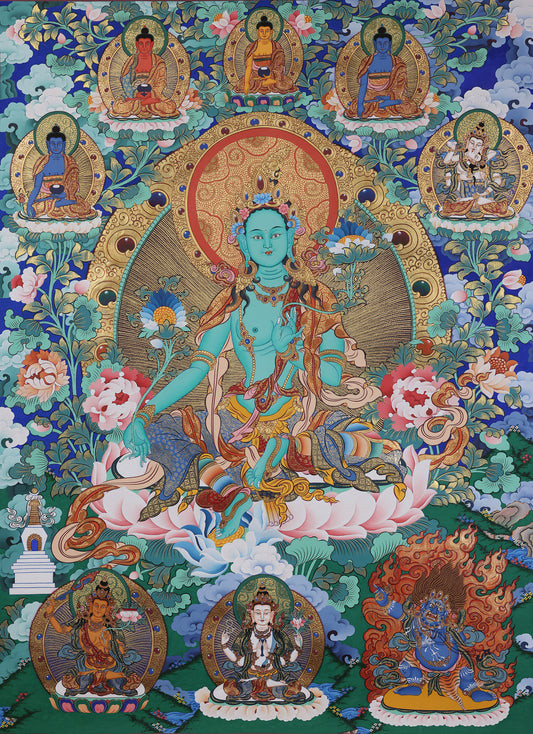
When a 45×62cm Tibetan black-gold Manjushri thangka unfolds, what you see is not just a composition of ink and gold lines—it is a visual ritual of millennia-old Tibetan faith, an artistic 秘境 forged by mineral pigments and handcrafted techniques.
In the tantric system of Tibetan Buddhism, the black-gold thangka itself is a metaphor for "wisdom dispelling ignorance": the black background corresponds to the primal ignorance of the universe, while the gilded lines represent the light of the Buddha’s teachings. Centered on the Yellow Manjushri Bodhisattva, this work embeds the religious meaning of "Prajna wisdom" into every gold line and mineral hue.
I. Theme: A Wisdom Ritual Emerging from Darkness
The "black-white dualism" of Tibetan Bon religion laid the cultural foundation for black-gold thangkas. This 45×62cm piece is not a decorative painting, but a "visualization tool" for practitioners: gazing at the golden Manjushri on the black background is the process of visualizing "wisdom’s fire burning away afflictions"—this is the tantric logic of "connecting to the divine through sight."
For Tibetan believers, Manjushri is the "Teacher of All Buddhas," representing Prajna wisdom that transcends all ignorance. The black-gold form perfectly translates this spiritual journey "from ignorance to awakening" into a tangible visual vessel.
II. Main Deity: The Symbolic Code in Iconographic Proportions
The Yellow Manjushri Bodhisattva at the center strictly adheres to the Iconographic Proportions of Buddhist Images, with every detail a precise expression of religious symbolism:
-
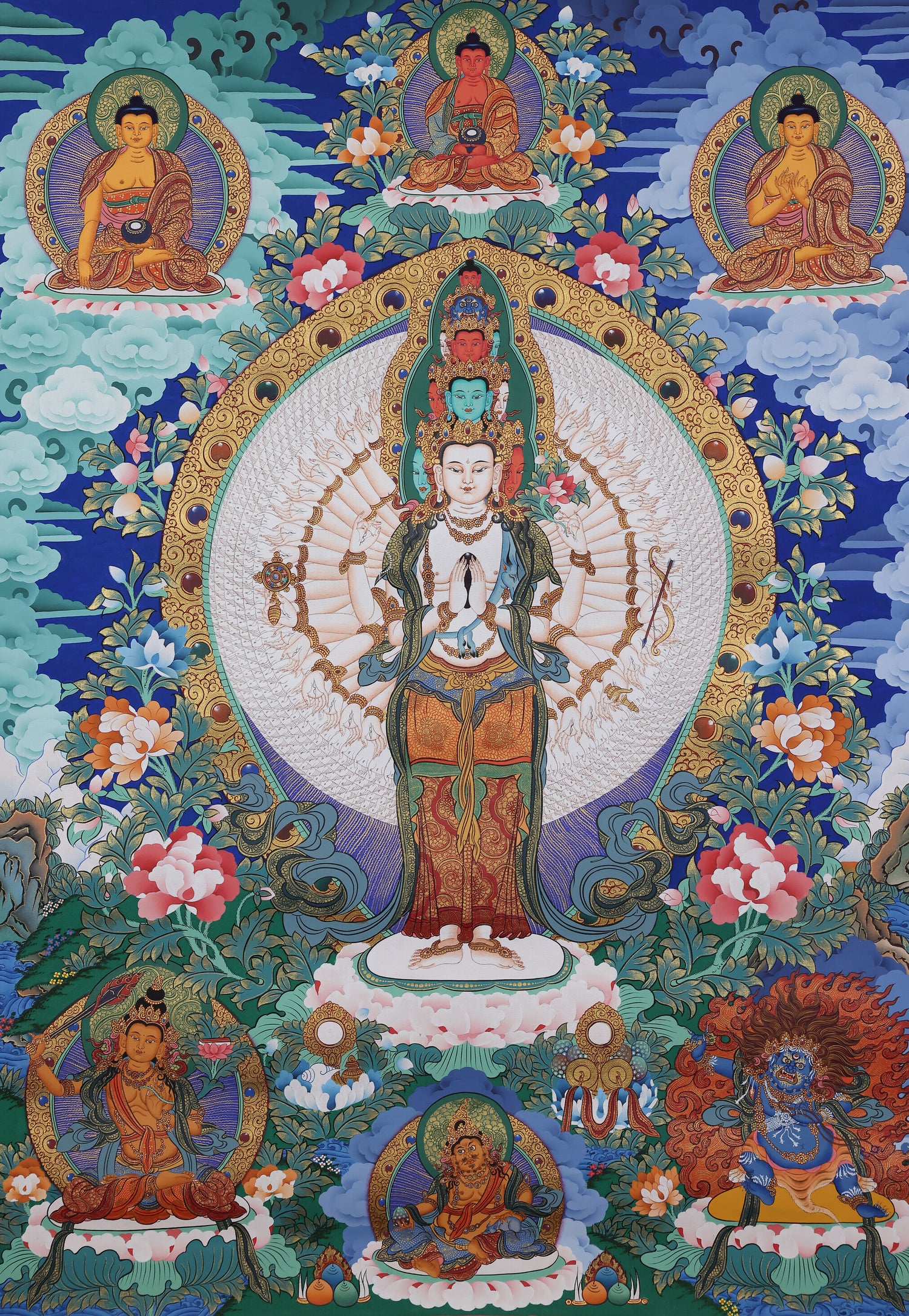
Body Color & Posture: The bright yellow corresponds to the "Ratnasambhava Buddha Family," symbolizing the enhancement of wisdom and merit; seated cross-legged on a lotus 须弥座 (Mount Meru throne), the left hand holds a sutra scroll (representing Prajna scriptures), and the right hand raises a wisdom sword (cutting through ignorance and afflictions)—this is Manjushri’s core symbol of "dispelling ignorance with Dharma truth."
-
Attire & Aura: The shoulder-bared sanghati (monastic robe), the lotus-patterned nimbus, and the outer flame halo not only conform to the solemnity of "bodhisattva attire" but also reinforce the tantric meaning of "wisdom burning away afflictions" through the black-gold contrast.
III. Attendant Deities: Building a Faith Circle of Wisdom
The attendant deities in the thangka are not randomly arranged, but form a "wisdom protector system" centered on Manjushri:
-
Three Buddhas Above: In the top center is Amitayus (pink body, in meditation mudra), flanked by Shakyamuni Buddha (golden body) and Medicine Buddha—these three represent the "past-present-future" time dimensions, implying that Manjushri’s wisdom permeates the teachings of all Buddhas across epochs.
-
Attendants Below: On either side of the main deity’s lotus throne are the "Yellow Manjushri Incarnate Child" (left, holding a sutra scroll, representing the worldly manifestation of Manjushri’s wisdom, e.g., enhanced academic performance and eloquence) and the "Blue-Bodied Protector" (right, an wrathful emanation of Manjushri, using fierce power to dispel obstacles to practice)—this embodies the tantric logic of "compassion + ferocity."
-
Environmental Symbols: The Dharma wheel (center, representing the spread of the Dharma) and lotus ponds (sides, representing a pure cultivation ground) at the bottom, along with the cloud and landscape backgrounds, are typical expressions of "the fusion of worldly and transcendental realms" in Tibetan mandala-style compositions.
IV. Craft: The Apex of Mineral Pigments and Black-Gold Techniques
The craftsmanship of this thangka embodies the Tibetan tradition of "materials as faith":
-
Base & Background: The canvas is made of Tibetan linen + cowhide glue coating; the black background is mixed from natural graphite (5-10μm particles) + deer antler ash, applied in 50 layers—each layer is only 0.02mm thick, resulting in a warm ink luster with lightfastness of over 100 years.
-
Mineral Pigments: Following the Tibetan thangka tradition of "treasures in painting":
- Gold: 24K pure gold powder (0.12μm thickness) is used, with 18K gold powder mixed in some areas to create light and shadow layers (24K leans red, 18K leans yellow);
- Colored sections: Blue comes from lapis lazuli (Afghanistan-sourced, lightfastness >100 years), green from malachite, and red from cinnabar—these pigments undergo 3 years of aging and 18 processing steps, serving both as color carriers and symbols of "blessings from precious materials."
-
Linework & Gilding: The gold lines, outlined with wolf-hair fine brushes, are only 0.1mm thick with a break rate of less than 0.3%; the attire patterns use the "raised gold technique," stacking gold powder to create a relief texture—this alone takes the painter over 300 hours, with a gold loss of 8.5g per square meter, a signature technique of Rebkong master Dekyi.
Conclusion: A Symbiosis of Faith and Art
This 45×62cm black-gold Manjushri thangka is both a living sample of Tibetan Buddhist wisdom faith and the pinnacle of traditional craftsmanship. Every gold line and pigment layer embodies the Tibetan cultural logic of "art as a vessel for faith"—it is both a practitioner’s visualization tool and a treasure in art history.
#Tibetan Black-Gold Manjushri Thangka #Rebkong Thangka Craft #Mineral Pigment Thangka #Tibetan Tantric Manjushri Iconography #Thangka Attendant Deities #45×62cm Thangka #Tibetan Faith Art #Black-Gold Thangka Analysis #Manjushri Bodhisattva Thangka #Traditional Thangka Techniques