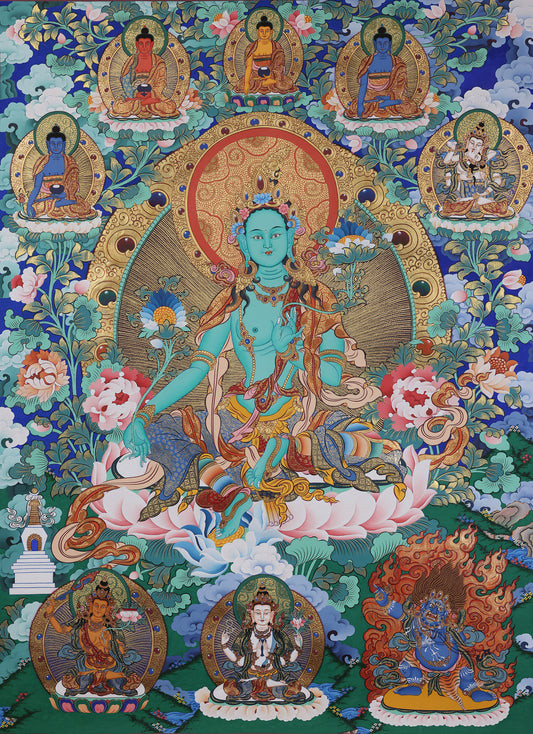
In the Himalayan cultural sphere, a thangka is never "just a painting"—it is a visual vessel for faith, a symbiosis of craftsmanship and ritual. Today, we explore a 45×65cm hand-painted Nepalese Vaishravana thangka: a product of Tibetan Buddhist culture and Newari artistic 精髓,with mineral pigments as its "bones" and the belief in the Wealth Protector Deity as its "soul, condensing the doctrinal logic of Tibetan Buddhism and the aesthetic code of Himalayan art within its compact frame.
In Tibetan Buddhism, the belief in Vaishravana (Sanskrit: Vaishravana; Tibetan: Namthö Sé) balances "renunciate practice" and "worldly needs": he is both the Northern Dharma Protector among the Four Heavenly Kings, guarding the northern realm of Mount Meru and the transmission of the Dharma; and an emanation of Ratnasambhava Buddha (the Southern Buddha), commanding the Eight Horse-faced Wealth Gods to oversee worldly prosperity.
The core theme of this thangka is a precise visualization of this "dual divinity":
-
Dharma Protector Dimension: The main deity’s majestic, semi-wrathful visage and the victory banner (dhvaja) in his right hand symbolize the protection of the Dharma and subjugation of obstacles;
-
Wealth Deity Dimension: The treasure-spitting mongoose (marici) in his left hand and the treasure-bearing iconography of his retinue reflect Tibetan believers’ spiritual desire to "use worldly resources to support spiritual practice."
This "divine symbiosis" embodies Tibetan Buddhism’s pragmatic logic: "embrace worldly needs, yet return to transcendental liberation"—and Nepalese thangkas are the ideal medium for translating this logic into visual language.
The central Vaishravana iconography adheres strictly to the Iconometric Canon ( Pratimālakṣaṇa ) while bearing distinct marks of the Nepalese Newari school:
The main deity has a yellow body (corresponding to Ratnasambhava Buddha’s "precious hue") and sits in lalita asana (half-lotus pose) astride a white lion:
- Yellow body: Symbolizes wealth and radiance, a direct visual marker of his "Wealth God" attribute;
- Lalita asana: Unlike the full lotus pose of Buddhas, this posture reflects the divine trait of "guarding the Dharma with majesty while accommodating sentient beings’ needs";
- White lion mount: The lion symbolizes "subjugating afflictions." In the Newari style, the white lion’s flowing mane softens its ferocity, emphasizing its "protective" warmth.
-
Victory Banner (Dhvaja): Adorned with a jewel at the top, it symbolizes both "the accumulation of wealth" and "protective shelter"—in Tibetan Buddhism, the victory banner is often a sign of the Dharma’s flourishing;
-
Treasure-Spitting Mongoose (Marici): The mongoose spitting a continuous stream of jewels is the iconic implement of Vaishravana’s "wealth-overseeing" role, and the core focus of Tibetan believers’ devotion to this deity.
Unlike the "flat ornamentation" of Tibetan thangkas, this main deity carries unique Newari artistic traits:
- Visage: Squarish and rounded, with prominent brow ridges and wide-open eyes (not 狰狞,but "semi-wrathful"), aligning with Nepalese folk aesthetics of a "benevolent protector";
- Adornment: Jeweled five-Buddha crown, pearl necklaces, and flowing green silk sashes—intricate but not cluttered. The Newari school excels at using ornate adornment to highlight divine "dignity," while dynamic lines avoid a sense of heaviness.
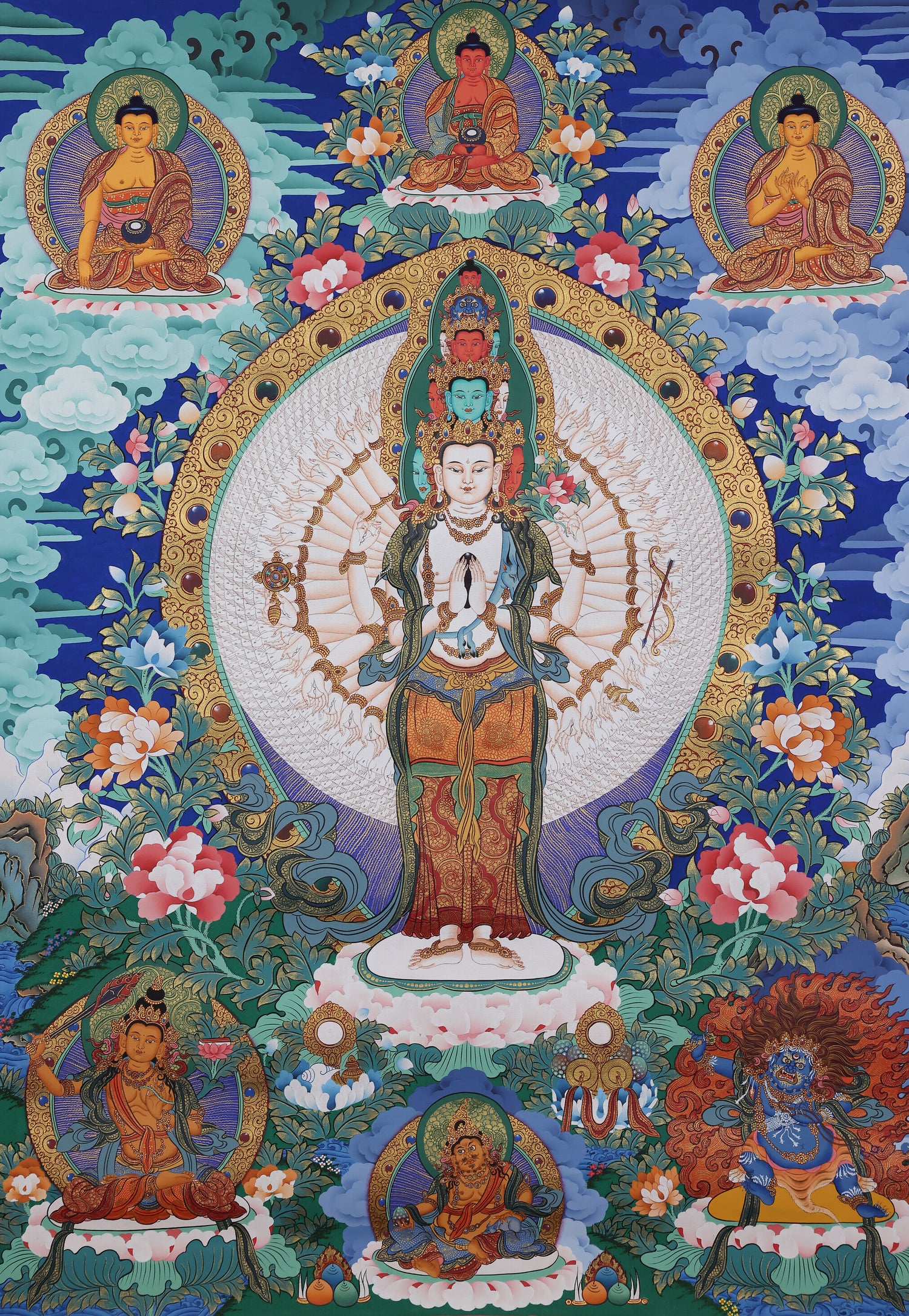
This thangka uses a mandala-style symmetrical layout, with the retinue deities surrounding the main figure to form a complete "wealth protection network":
- Central upper Buddha: Typically Ratnasambhava Buddha (or Shakyamuni Buddha), seated in full lotus pose on a lotus throne—this clarifies that "Vaishravana is an emanation of the Buddha, and his divinity originates from the Dharma itself";
- Flanking Bodhisattvas: Often White Tara and Green Tara (or Manjushri and Avalokiteshvara), representing "compassion" and "wisdom," echoing Vaishravana’s vow to "alleviate sentient beings’ suffering through wealth."
The eight retinue figures surrounding the main deity are the "Eight Horse-Faced Wealth Gods":
- Iconographic traits: Each holds a treasure-spitting mongoose, with distinct body colors and implements (e.g., the Eastern Wealth God holds a jewel, the Western one a wish-fulfilling gem), and most ride horses (hence the "Eight Horse-Faced" name);
- Cultural significance: Arranged to correspond to the "eight directions," they symbolize "wealth permeating the world"—the primary focus of Tibetan believers’ prayers for "abundant fortune." In the Newari style, these deities feature more ornate attire and dynamic poses, exuding a sense of "prosperity."
The wrathful figures at the bottom (often Black Wealth God or Yaksha protectors) hold implements in fierce poses—their role is to "eliminate obstacles to wealth and practice," complementing the main deity’s semi-wrathful visage to form a complete system of "protecting the good Dharma and dispelling evil obstacles."
Painted with natural mineral and earth pigments, this thangka epitomizes traditional Nepalese craftsmanship and Tibetan Buddhism’s principle that "material is faith":
Pigments include natural minerals such as cinnabar (red), lapis lazuli (blue), malachite (green), and orpiment (yellow), plus plant pigments like saffron and rhubarb:
- Material significance: The lightfastness and durability of mineral pigments symbolize "the eternity of the Dharma"—a high-quality mineral-pigment thangka can retain its colors for centuries;
- Color symbolism: Lapis lazuli blue corresponds to "sky and tranquility," cinnabar red to "majesty and vitality," and orpiment yellow to "radiance and wealth"—each hue is a "symbolic language" of Tibetan Buddhism.
Painting a Nepalese thangka is itself a "spiritual practice":
-
Base Preparation: Cotton fabric is coated with layers of chalk and animal glue, sanded repeatedly until "smooth as a mirror" (a 45×65cm thangka takes 2–3 days for this step);
-
Outlining: Using charcoal, the design is sketched per the Iconometric Canon with a margin of error under 1mm—"precision" is an act of reverence for the deity;
-
Coloring and Gradation: Base colors are applied first, followed by multiple layers of blending (the Newari school’s "gradient shading" differs from Tibetan thangkas’ "flat application"), and finally outlined in gold thread to enhance opulence;
-
Consecration: After completion, a high lama writes the seed syllables "Om Ah Hum" on the back, endowing the thangka with the religious attribute of a "spiritual aid."
This 45×65cm Vaishravana thangka is a prime example of "small but exquisite": it is both a ritual object suitable for temple display and a collectible Himalayan art masterpiece. From iconographic symbols to mineral pigments, from thematic logic to craft details, it tells a truth—thangkas are never "decorations," but a vivid practice of Tibetan Buddhist culture: "carrying faith through art, and integrating faith into life."
#NepaleseThangka #VaishravanaThangka #TibetanBuddhistThangka #NewariArtSchool #MineralPigmentThangka #HandPaintedThangkaAnalysis #TibetanBuddhistWealthDeity #HimalayanArt #ThangkaIconography #BuddhistProtectorThangka