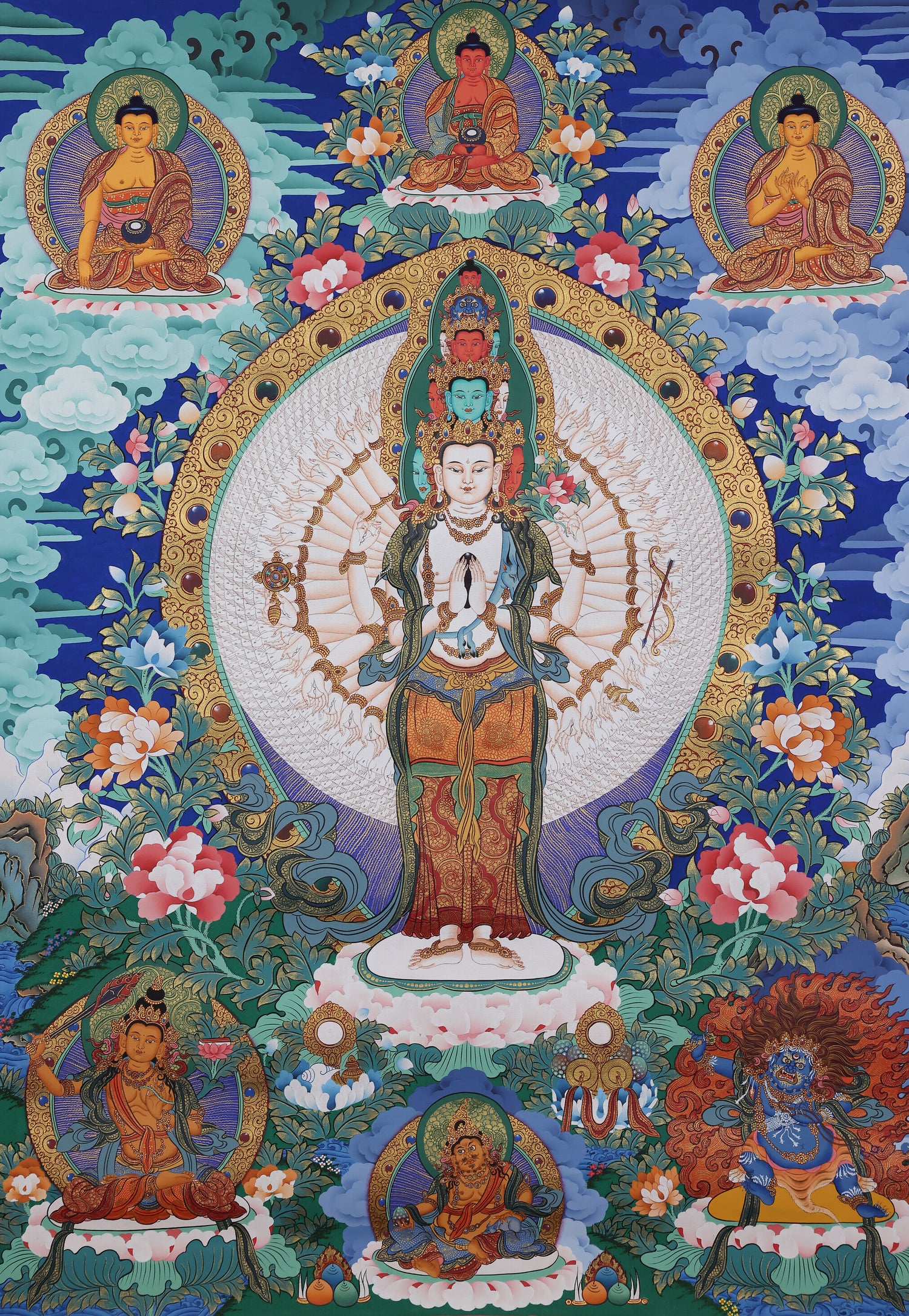
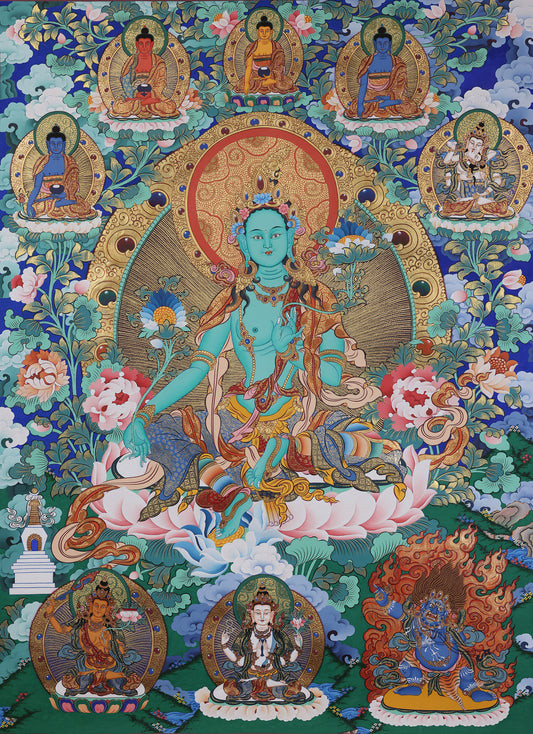
When the crimson of cinnabar and the blue of lapis lazuli—rendered in the warm texture of mineral pigments—blend on a 45×64cm cotton canvas to form lotus thrones and divine figures, this hand-painted Nepalese thangka transcends the label of "decorative art." It is a ritual vessel for "extending life and dispelling obstacles" in Tibetan esoteric Buddhism, a living inheritance of Newari school craftsmanship, and a symbiosis of faith and aesthetics in the Himalayan cultural sphere.
In Tibetan Buddhism, the triad of the Longevity Buddha, White Tara, and Ushnisha Vijaya is never a mere "blessing symbol" but a sophisticated spiritual system: the Longevity Buddha governs "mastery over life span," White Tara embodies "compassionate salvation," and Ushnisha Vijaya oversees "purification of karmic obstacles." The theme of this thangka is the materialization of this triple perfection—it responds to believers’ wishes for worldly longevity and good fortune, while also pointing to the ultimate liberation of "passing into the Pure Land of Infinite Merit at death."
This theme traces its roots to the fusion of post-renaissance Tibetan esotericism and Bonpo "life worship": the Longevity Buddha is the sambhogakaya manifestation of Amitabha, White Tara is the embodied compassion of Avalokiteshvara, and Ushnisha Vijaya draws her wisdom of obstacle removal from the Ushnisha Vijaya Dhāraṇī Sūtra. For Tibetan and Nepalese believers, enshrining this thangka is to participate in an esoteric ritual of "visualizing the main deity merging with oneself."
Central Deity: The Sambhogakaya Dignity of the Longevity Buddha
The cinnabar-red figure at the center is the standard sambhogakaya form of the Longevity Buddha (Amitayus): the Five Buddha Crown symbolizes the wisdom blessings of the Five Dhyani Buddhas; the bare torso and pearl ornaments align with the
Iconometric Canon’s "thirty-two marks of a sambhogakaya Buddha"; the hands form the meditative mudra, holding a longevity vase (the nectar inside represents the merit of immortality), and the double lotus throne—pink petals for worldly longevity, green petals for liberation from samsara.
Upper Deity: The Lineage of the Root Buddha
The pale yellow small Buddha on the lotus throne above the main deity is an incarnation of Shakyamuni (or Bhaisajyaguru)—its teaching mudra implies that the Longevity Buddha manifested when Shakyamuni preached the
Sutra of Infinite Life, embodying the lineage between the "root Buddha and manifested Buddha."
Lower Attendants: Wings of Compassion and Obstacle Removal
-
White Tara (Left): Her seven eyes (one on the forehead to observe the heavens, one on each palm and sole to observe the six realms) watch over sentient suffering; the white lotus symbolizes pure compassion, and the wish-fulfilling mudra conveys the power to alleviate illness—she is the embodied compassion of Avalokiteshvara.
-
Ushnisha Vijaya (Right): Her three faces (white for pacifying, red for magnetizing, blue for subjugating) and eight arms (with the vajra and lasso representing obstacle subjugation) are accompanied by a sun-moon lotus throne (sun for light, moon for tranquility), rooted in the Ushnisha Vijaya Dhāraṇī Sūtra.
Background Auspicious Beasts: A Note on Cultural Fusion
The green-scaled, red-clawed dragon (left) and blue-feathered, pink-tailed phoenix (right) reflect the Nepalese thangka’s absorption of Han Chinese culture—the dragon governs good fortune and vitality, the phoenix symbolizes auspiciousness and harmony, infusing the sacred space with worldly warmth.
Mineral Pigments: Sacred Texture Forged by Time
The thangka uses natural mineral and earth pigments: cinnabar’s "first-grade powder" ensures deep hue; lapis lazuli is divided into "first-grade" and "second-grade" for layered depth; 24K gold leaf is ground and mixed with bone glue for gilding. These pigments require 15 days of grinding, settling, and glue mixing—their colors remain stable and grow warmer with time, a testament to the Newari school’s commitment to "sacred materials."
Painting Process: Reverence in Nine Steps
From "gluing and polishing the canvas" to "opening the eyes on an auspicious day," Nepalese thangkas follow a strict nine-step process: charcoal for proportioning divine figures, wolf-hair brushes for ink outlines, layered gradient coloring, fine gold-line detailing, and finally "opening the eyes" to breathe soul into the thangka. Each step is both craft and reverence for faith.
Stylistic Traits: Balance Between Ritual and Aesthetics
Unlike the bold, iron-like lines of Tibetan thangkas, the Newari school favors soft, fluid strokes; the landscape and auspicious beasts in the background break the pure religious space; warm-toned gradients give mineral pigments greater depth. This "rigorous ritual, softened aesthetics" style is the unique hallmark of Nepalese thangkas, which reconcile Tibetan esoteric norms with local taste.
This 45×64cm Longevity Buddha Thangka is a spiritual text of Tibetan esotericism, a living sample of Newari craftsmanship, and a testament to the Himalayan cultural sphere’s pluralistic fusion. It shows us: faith takes root through art, and art endures through faith.
#Nepalese Thangka #Longevity Buddha Thangka#Tibetan Buddhist Thangka #Newari School Thangka#Mineral Pigment Thangka#Three Longevity Deities#Hand-Painted Thangka#Tibetan Esoteric Ritual Thangka#Himalayan Art #Thangka Cultural Analysis