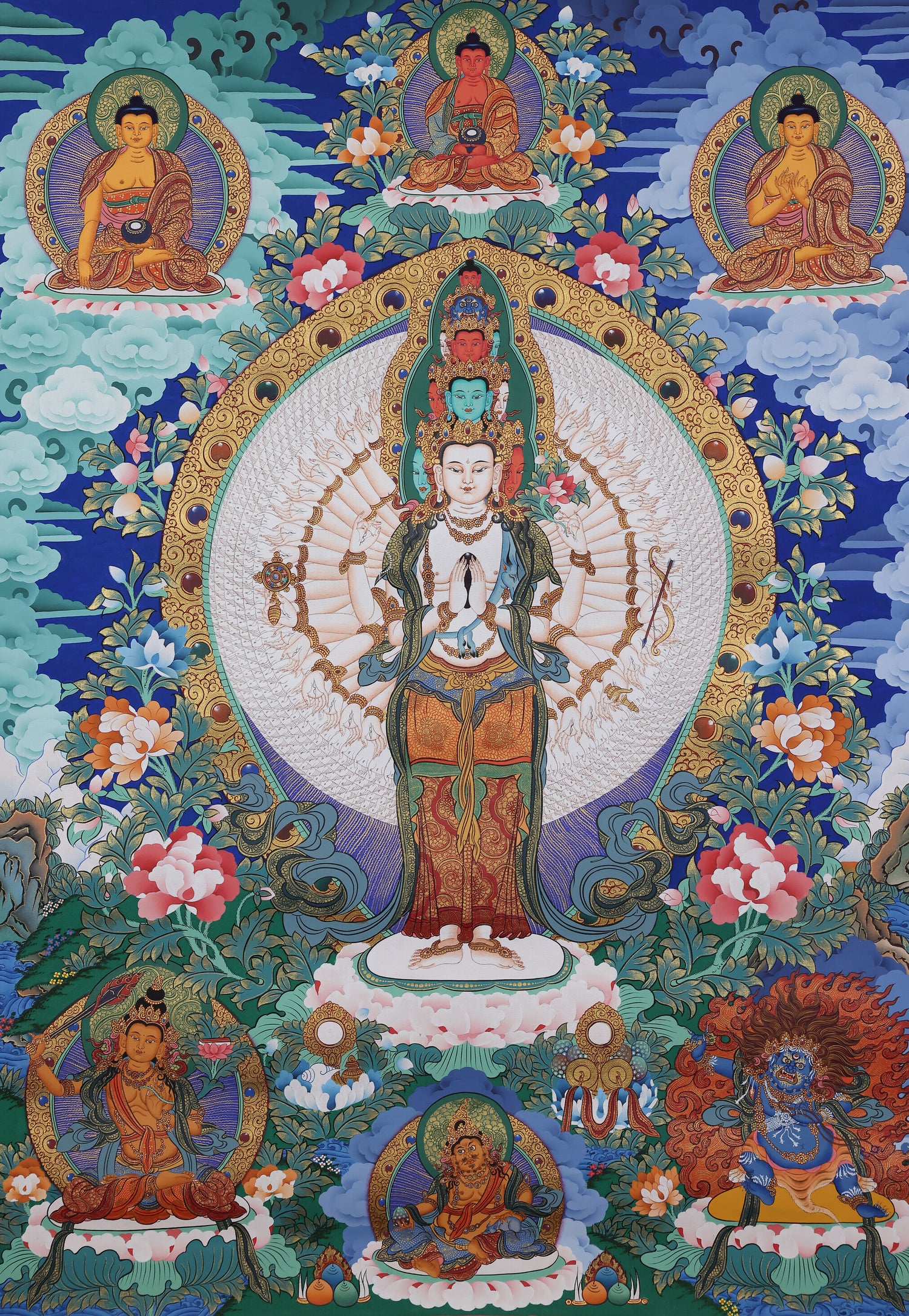
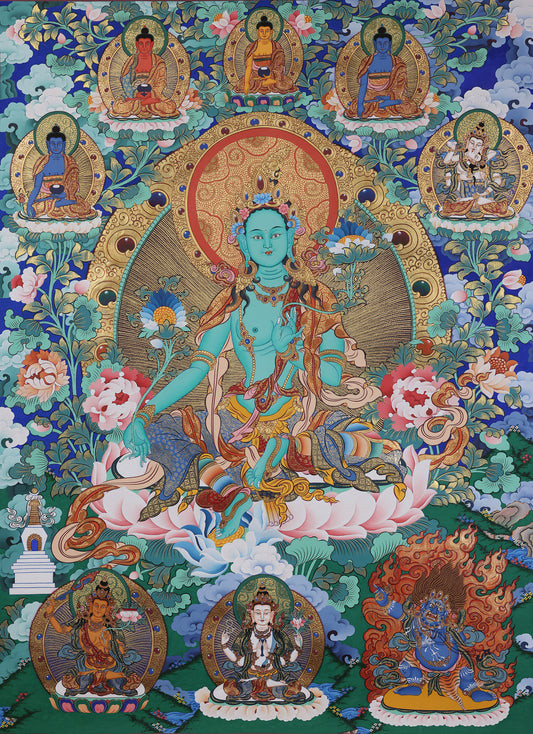
When a 46×65cm hand-painted Nepalese color thangka unfurls, what you see is not just a canvas of layered colors, but a tangible embodiment of Tibetan Buddhism’s cosmology and spiritual practice. As a "portable mural" in Himalayan art, this thangka centered on Shakyamuni Buddha is a product of deep fusion between Nepal’s Newari painting school and Tibetan Buddhist ritual traditions. Every line, color, and icon holds the belief logic of Tibetan Buddhism.
In Tibetan Buddhism, Shakyamuni Buddha is the "Worldly Buddha"—representing the ultimate spiritual goal of transcending suffering to achieve perfection. However, this thangka’s theme is not an isolated image of the Buddha; instead, it constructs a complete "sacred field" through a composition of "main deity at the center, crest deities above, attendants below":
- Shakyamuni (the main deity) symbolizes "present enlightenment"—the core of a practitioner’s visualization, signifying that "ordinary beings can attain bodhi through practice";
- The three Buddhas above represent the "Three-Age Buddhas"—connecting the temporal dimensions of past, present, and future, embodying Buddhism’s worldview of "continuous cause and effect";
- The disciples below serve as "bridges of the Dharma"—transmitters from the Buddha to worldly believers, implying that "enlightenment is not for self-benefit alone, but for universal salvation."
This composition is not an artistic whim but a requirement of Tibetan Buddhist ritual: the thangka is a tool for practitioners to "enter samadhi through visualization," and the position of each deity corresponds to the spiritual order of that visualization.
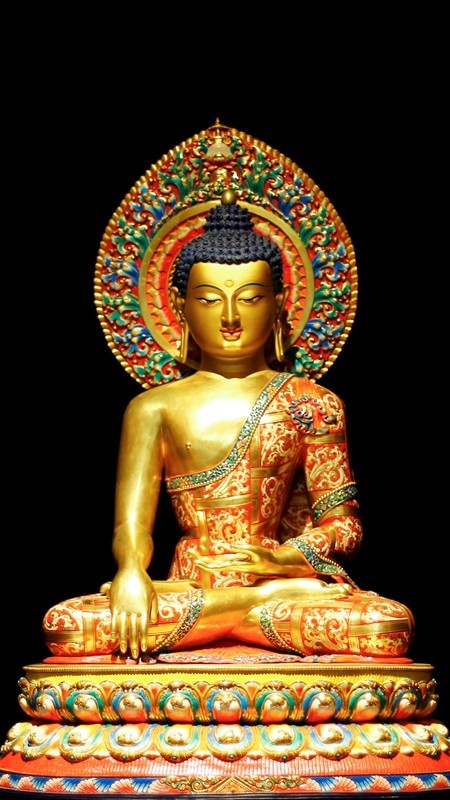
Shakyamuni at the center of the painting follows the Iconometric Canon of Tibetan Buddhism in his "Enlightenment Form":
-
Body Color and Head Adornments: The warm yellow body symbolizes "the Middle Way and compassion"; the spiral curls and the cranial protuberance (ushnisha) are markers of the "Thirty-Two Marks of a Buddha"—the former represents the Buddha’s transcendence of mundane impurity, while the latter symbolizes wisdom that dispels ignorance;
-
Mudra and Ritual Implements: The left hand holds a alms bowl (signifying "nourishing sentient beings with the Dharma"), and the right hand performs the Bhumisparsha Mudra (Earth-Touching Mudra)—the iconic gesture of the Buddha’s enlightenment, meaning "subduing inner and outer demons to attain ultimate awakening";
-
Lotus Throne and Robes: The double lotus throne (with closed and blooming petals) corresponds to "the unity of worldly afflictions and transcendental enlightenment"; the "field-pattern" on the red kasaya (monastic robe) is a visual metaphor that "offering to the Buddha accumulates karmic merit (merit fields)."
The main deity’s multi-layered auras hold further details: the inner pink nimbus represents compassion, while the outer golden mandorla (body aura) adorned with scrollwork symbolizes "perfect wholeness." Tibetan Buddhism uses color to distinguish the sacred from the profane, and the depth of the auras and their patterns form the visual boundary of "sacredness."
The "attendants" in the thangka are not decorations, but extensions of the belief system:
-
Crest Deities (Three Buddhas Above): The Temporal Dimension of the Three-Age Buddhas
The three Buddhas above the main deity’s head are the "Three-Age Buddhas" of Tibetan Buddhism:
- The central red-bodied Buddha (Amitabha): The Future Buddha/Enjoyment Body Buddha, symbolizing guidance to the Pure Land;
- The left yellow-bodied Buddha (Dipamkara): The Past Buddha/Dharma Body Buddha, the prognostic teacher of Shakyamuni;
- The right blue-bodied Buddha (Bhaisajyaguru): The Worldly Buddha/Manifestation Body Buddha, signifying worldly merit of healing and dispelling disasters.
These three Buddhas ensure that "worldly enlightenment" is not isolated—it is a continuation of past Dharma and the starting point of future liberation.
-
Retinue Disciples (Two Below): The Materialization of Dharma Transmission
Ananda and Mahakasyapa, flanking the main deity, are representatives of the Buddha’s Ten Great Disciples:
- Mahakasyapa (holding a khakkhara, "foremost in asceticism"): Symbolizes "ascetic practice and precepts," the foundation of spiritual cultivation;
- Ananda (holding an alms bowl, "foremost in hearing"): Symbolizes "listening to the Dharma and memory," the transmitter of the teachings.
Together, their "practice" and "learning" align with Tibetan Buddhism’s principle of "balancing understanding and practice."
The "hand-painted" nature and "mineral pigments" of this thangka are the secrets to Himalayan art’s "enduring vitality," while its style epitomizes Sino-Nepalese Buddhist art exchange.
All pigments are natural minerals and earth materials from the Kathmandu Valley in Nepal:
- Red comes from cinnabar, yellow from realgar, blue from lapis lazuli (which requires 3–5 days of grinding to separate shades), and white from Rinpoche white earth;
- Pigments are mixed with cowhide glue and applied in layers (e.g., 3–5 layers for skin tones), gradually integrating with the cotton fabric—centuries later, the colors become richer and more mellow, which is why thangkas can serve as "transmissible ritual objects."
Every brushstroke of color is not "decoration" but "the materialization of belief": the "eternity" of minerals corresponds to Buddhism’s philosophy of "the permanence of all dharmas."
This thangka is a classic work of Nepal’s Newari school, incorporating elements of Tibetan ritual traditions:
-
Composition: The "symmetrical order" of Tibetan thangkas + the "balanced density" of the Newari school—the main deity occupies 60% of the space, attendants are placed above and below, and the background is filled with pink peonies (symbolizing perfection) and clouds, avoiding the "crowded fullness" of Tibetan thangkas;
-
Form: Icons follow the Iconometric Canon, but faces feature the Newari school’s "infant-like softness," while robes inherit the "lightness" of Indian Pala art, differing from the "solemn heaviness" of Tibetan thangkas;
-
Color: Warm tones (red, yellow) reflect the Newari school’s "warm opulence," while cool accents (blue, green) correspond to Tibetan Buddhism’s symbolic system of "five colors matching the Five Dhyani Buddhas."
This 46×65cm Nepalese color thangka unites the roles of religious ritual object and artistic work: it carries belief through the eternity of mineral pigments, continues Sino-Nepalese art exchange through Newari school style, and constructs the sacred space of Tibetan Buddhism through the "main deity-attendant" composition.
For Tibetan Buddhist believers, it is a tool for visualization; for art enthusiasts, it is a living fossil of Himalayan culture—every line and color is a concrete expression of Tibetan Buddhism’s "enlightenment" and "transmission."
#NepaleseThangka #TibetanBuddhistArt #ShakyamuniThangka #NewariPaintingSchool #MineralPigmentThangka