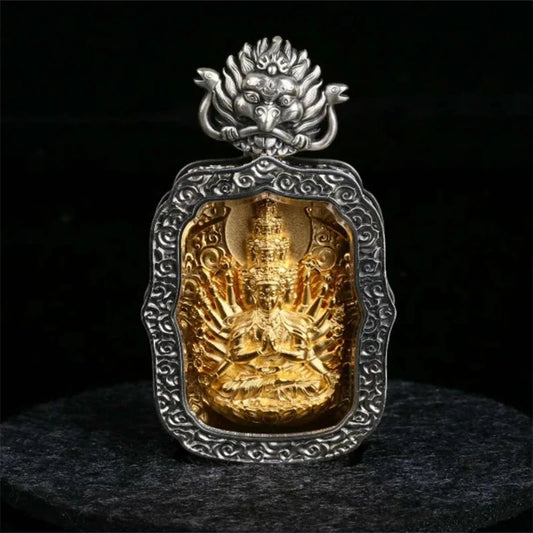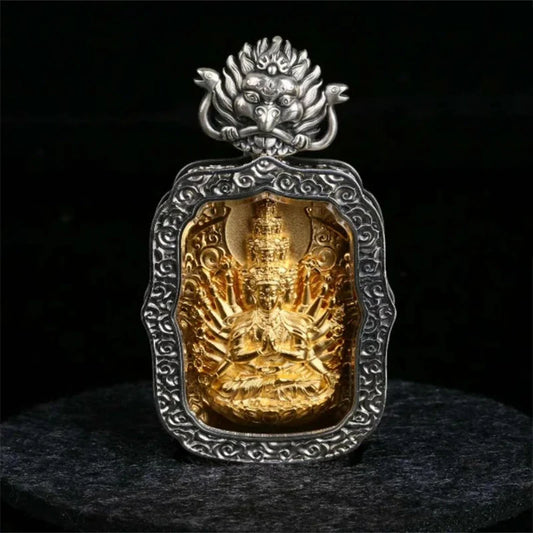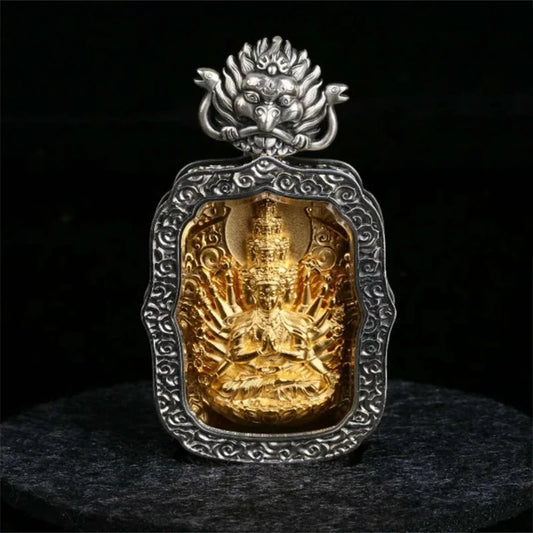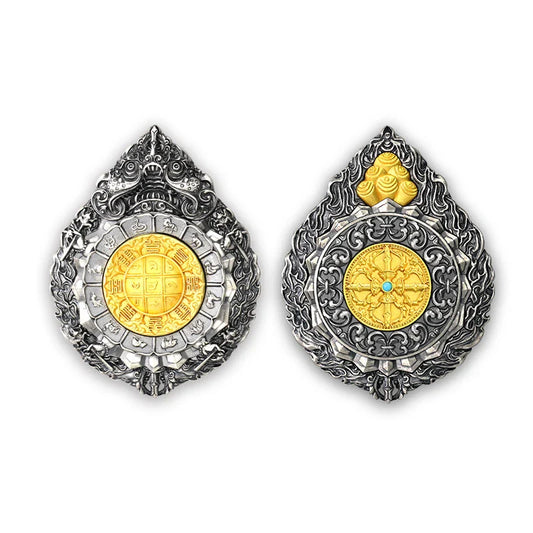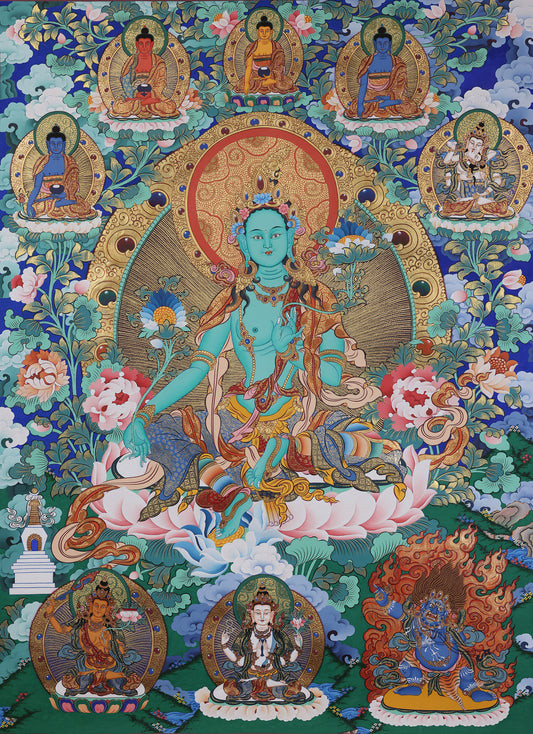
Tibetan Buddhist Amitayus Buddha Black and Gold Thangka: A Visual Sacred Text Connecting Lifespan and Eternal Wisdom

Introduction: When Prayers for Longevity Meet Ultimate Care
In contemporary society, with increasing life expectancy and advancements in medical technology, humanity has achieved unprecedented "length of life." Yet, the inquiry into "quality of life" and the "meaning of existence" has grown even more profound. This Tibetan Buddhist Amitayus Buddha Black and Gold Thangka acts precisely as a bridge spanning time and space, perfectly connecting ancient Eastern life wisdom with the spiritual needs of modern people. It is not merely a medium for praying for longevity; it is, more importantly, a visual textbook on how to "use lifespan wisely, dwell in the present, and transcend life and death."
Chapter One: The Mandala — The Energy Topology of the Pure Land
1.1 From Prayer to Practice
This thangka centers on Amitayus Buddha (i.e., Amitabha Buddha), constructing a "Pure Land Longevity Mandala." It is worth noting that "mandala," called "Kyilkor" in Tibetan, originally means "center and periphery." It is essentially a geometric expression of cosmic structure and spiritual order. The design of this mandala follows a precise symbolic logic: the principal deity resides at the center, representing the "fundamental vow power"; the surrounding space, though simplified here, contains a complete retinue system, symbolizing "the perfect provision of supporting conditions."
For modern people, this structure holds special enlightening significance: Longevity is not merely a "result" to be bestowed but also a "process" that requires support from various conditions. It reminds us that health and longevity require the combined achievement of multiple factors such as physical and mental harmony, a suitable environment, and spiritual fulfillment.
1.2 The Wisdom of Continuity Between This Life and the Next
The Amitayus Buddha faith in Tibetan Buddhism skillfully balances the relationship between the "mundane" and the "transcendent." For devotees consecrating this thangka, the psychological motivation encompasses three levels:
-
Primary Prayer: Praying for the extension of lifespan and for health and happiness in this life.
-
Intermediate Practice: Using longevity as a foundation to practice the Dharma more diligently.
-
Ultimate Concern: Through practice in this life, establishing the auspicious causes and conditions for rebirth in the Pure Land.
This belief system addresses a common spiritual dilemma for modern people: How can one cherish the present moment while not fearing the end of life? The answer lies within the wisdom carried by this thangka—achieving eternal transcendence by dwelling fully in each present moment.
Chapter Two: Amitayus Buddha — Decoding the Symbol System of Eternal Life
2.1 The Life Code of Red
The "Auspicious Red" that suffuses Amitayus Buddha's entire body holds multiple layers of meaning within Tibetan Buddhist semiotics:
| Dimension of Symbolism | Specific Interpretation | Modern Significance |
|---|---|---|
| Physical Attribute | Corresponds to the red light of the "Western Pure Land" | Warm, vibrant sensory experience |
| Psychological Effect | Dissolves the fear of death | Psychological suggestion for alleviating death anxiety |
| Energy Metaphor | Continuation of life energy | Visual trigger for stimulating inner vitality |
| Wisdom Symbol | Persistence of compassionate vow-power | Guides sublimation from "self-benefit" to "benefiting others" |
2.2 The Synergistic Effect of the Dhyana Mudra and the Longevity Vase
The principal deity's hands forming the "Dhyana Mudra" (meditation gesture) holding up the Longevity Vase constitutes a perfect system of dynamic balance:
The Dhyana Mudra represents the dimension of "Stillness":
-
Inner stability and concentration
-
Acceptance and transcendence of the impermanence of life and death
-
Coalescence and preservation of spiritual energy
The Longevity Vase represents the dimension of "Movement":
-
The continuous flow of life energy
-
The ongoing accumulation of merit and resources
-
The outward radiation of compassionate wisdom
This combination of stillness and movement, of receiving and giving, reveals a profound principle of life: True longevity requires not only maintenance (stillness) but also the creation of value (movement).
2.3 The Cosmological Significance of the Lotus Posture
Amitayus Buddha's "lotus posture" (padmasana) is not a simple sitting position but a complete energetic structure:
-
Lotus Base: Symbolizes growing from the "mud" of cyclic existence (samsara) yet remaining uncontaminated.
-
Moon Disc Cushion: Represents cooling wisdom capable of pacifying the "fevers and distress" of life.
-
Overall Posture: Forms a stable energetic triangle, an ideal posture for prolonged meditation.
Modern biomechanics research has found that this sitting posture minimizes energy consumption while maintaining the natural curvature of the spine—it is an "energy-saving mode" that conforms to ergonomics. Ancient wisdom and scientific principle converge here.
Chapter Three: The Retinue System — Constructing a Complete Longevity Ecosystem
3.1 The Functional Division of the Three Holy Beings of the West
Within a complete mandala system, the Bodhisattvas Avalokiteshvara (Guanyin) and Mahasthamaprapta (Dashizhi) flanking Amitayus Buddha constitute complementary protective powers:
Avalokiteshvara Bodhisattva (Compassion Side)
-
Represents unconditional great love.
-
Corresponds to emotional support and psychological comfort.
-
Modern societal meaning: Mental health, harmonious interpersonal relationships.
Mahasthamaprapta Bodhisattva (Wisdom Side)
-
Represents insightful wisdom.
-
Corresponds to rational choices and correct direction.
-
Modern societal meaning: Wisdom for living, decision-making ability.
Together, they form the perfect combination of "compassion protecting life, wisdom guiding direction," reminding us: Longevity requires dual nourishment from both emotional warmth and rational wisdom.
3.2 A Modern Interpretation of the Eight Classes of Protectors
The Eight Classes of Protectors (deva, naga, etc.) hidden within the background patterns can be understood as various support systems throughout the life process:
-
Family Support: Nourishment from intimate relationships.
-
Social Network: Support from community belonging.
-
Medical Safeguards: Protection from modern medicine.
-
Environmental Factors: Assurance of a healthy living environment.
These elements work together to form an "ecological niche" conducive to longevity.
Chapter Four: Black and Gold Craftsmanship — The Alchemy of Matter Bearing Spirit
4.1 The Energetic Semantics of Color
The color combination used in this thangka constitutes a precise language of energy:
Black Base (Wisdom of the Dharmadhatu's Essence):
-
Visual Function: Provides a deep background, enhancing the prominence of the subject.
-
Symbolic Meaning: The cosmic emptiness that contains everything.
-
Psychological Effect: Guides the viewer into a state of tranquility and focus.
Cinnabar Red (Amitayus Buddha's Body Color):
-
Physical Attribute: Natural mineral pigment, colors are permanent.
-
Cultural Significance: A calming medicinal substance in traditional Chinese medicine.
-
Visual Impact: Stimulates a sense of vitality and passion for life.
24K Gold (Ornamentation of Dignity):
-
Material Property: Chemically stable, symbolizing eternity.
-
Craftsmanship Difficulty: Requires extremely high skill and patience.
-
Aesthetic Effect: Creates a sacred sense of light against the black background.
4.2 The Spiritual Transformation of the Production Process
Each stage of traditional thangka creation is an act of spiritual practice:
The Artist's Observance of Precepts:
-
Maintaining a vegetarian diet during creation.
-
Upholding basic precepts like non-harming.
-
Beginning work each day with a pure mind.
Practice at the Brush Tip:
-
Each stroke accompanied by mantra recitation.
-
Infusing concentration into the lines.
-
Making the artwork a "vessel of spirit."
Modern Significance: In an era that pursues efficiency, this creative method of "slow work yields fine products" is itself an interpretation of life quality—true value is often born from focus and patience.
Chapter Five: From Devotion to Application — Modern Practice with the Amitayus Buddha Thangka
5.1 As a Tool for Life Education
This thangka can serve as a visual teaching aid for "life education" in homes or educational institutions:
Educational Focus for Different Age Groups:
-
Children and Adolescents: Recognizing the preciousness of life, cultivating awareness of cherishing time.
-
Middle-aged and Young Adults: Learning to balance work and health, planning life's meaning.
-
Seniors: Facing life stages with equanimity, living out the value of later years.
5.2 As an Aid for Mindfulness Practice
Three-Minute Daily Visualization Method:
-
Preparation: Sit quietly, relax body and mind.
-
Gazing: Focus on viewing Amitayus Buddha's red body.
-
Inhalation: Imagine inhaling red life energy.
-
Exhalation: Exhale black fatigue and stress.
-
Integration: Feel the entire body enveloped in golden light.
Research Support: Studies have shown that regular mindfulness practice can lower stress hormone levels and improve immune function, highly consistent with the effect of "extending lifespan."
5.3 As a Regulator of Spatial Energy Fields
According to principles of modern environmental psychology, placing this thangka in different spaces has varying effects:
Family Living Room:
-
Suggested Position: Directly opposite the main activity area.
-
Expected Effect: Creates a warm, stable family atmosphere.
-
Especially Suitable For: Multi-generational families.
Work Study:
-
Suggested Position: Wall behind or to the side.
-
Expected Effect: Provides endurance support for sustained work.
-
Especially Suitable For: Professions requiring long-term concentration.
Healing Space:
-
Suggested Position: Natural line of sight for patients.
-
Expected Effect: Assists in alleviating anxiety about illness.
-
Especially Suitable For: Nursing homes, rehabilitation centers.
Chapter Six: The Blending of Cultural Depth and Contemporary Significance
6.1 Supplementing Modern Views of Life
In an era dominated by science, the traditional wisdom represented by the Amitayus Buddha Thangka offers a valuable supplementary perspective:
Supplement to the Medical Model:
-
Western Medicine: Focuses on treating disease.
-
Thangka Wisdom: Focuses on nurturing life.
-
Ideal Integration: An integrated health view prioritizing prevention, with treatment as secondary.
Expanding the Definition of Success:
-
Modern Mainstream: Wealth, status, achievement.
-
Traditional Wisdom: Health, longevity, a good death.
-
Integrated Perspective: Balanced development, holistic success.
6.2 Wisdom Resources for Addressing an Aging Society
As global population aging intensifies, the wisdom carried by this thangka becomes especially precious:
Inspiration for Active Aging:
-
Longevity is not passive "existing."
-
It is active "value creation."
-
Each age stage holds unique potential for growth.
Spiritual Resources for End-of-Life Care:
-
Facing the end of life with equanimity.
-
Maintaining dignity and peace.
-
Leaving a positive spiritual legacy.
Conclusion: A Thangka, A Treasure Trove of Life Wisdom
This Amitayus Buddha Black and Gold Thangka is like a silent yet wise teacher, traversing millennia, imparting profound wisdom about time, existence, and eternity to every modern person facing the questions of life.
It tells us: The true meaning of longevity lies not in simply extending the length of life, but in expanding its breadth, deepening its thickness, and elevating its height. When we learn to cherish every present moment, treat life with compassion, illuminate the path ahead with wisdom, and face impermanence with tranquility, then our lives are already moving towards a certain sense of "eternity."
In the symphony of red, black, and gold within the thangka, may every viewer find the colors of their own life—possessing both the passion and vitality of red, the depth and acceptance of black, and the wisdom and transcendence of gold. For ultimately, what this thangka depicts is not only the Buddha's Pure Land but also the perfect state of life inherently present within each person's heart.
Schlagwörter:
Vorherige
Tibetan Buddhist Medicine Buddha Black and Gold Thangka: An Artistic Sanctuary Carrying Millennia of Healing Wisdom
Nächste
Black-Gold Ākāśagarbha Bodhisattva Thangka in Tibetan Buddhism