The Blessing Code in Tibetan Colored Thangka: An Analysis of the Yellow Jambhala & Five-Direction Wealth Deity System in Tibetan Buddhism

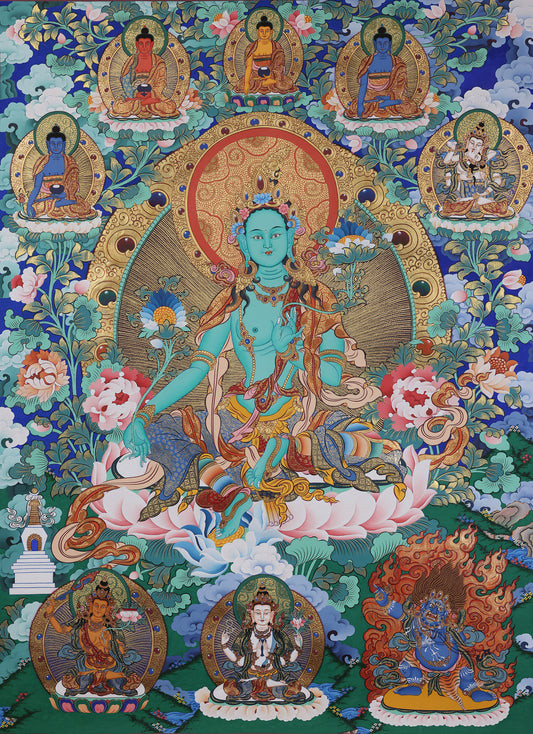
When you gaze at this vividly colored Tibetan thangka, your eyes are first drawn to the golden-hued central deity: a portly figure with a bare chest, right hand holding a glowing Cintāmaṇi (wish-fulfilling jewel), left hand cradling a treasure-spitting rat, and right foot resting on a white conch, seated serenely on a lotus throne. This is Yellow Jambhala, the "chief of all wealth deities" in Tibetan Buddhism. The four 护法 (dharma protectors) in red, green, white, and black, nestled in the swirling clouds around him, are the other members of the Five-Direction Wealth Deity system. This thangka is far more than decorative art—it is a complete Tibetan Buddhist interpretation of "wealth": every hue and every ritual object is a millennium-old cipher of blessing.
I. Yellow Jambhala: From Dharma Protector to Core of the Five-Direction Wealth Deities
In Tibetan, Yellow Jambhala is called "Zangla Serpo," also known as "Vaiśravaṇa Vajra." His evolving identity mirrors the cultural integration of Tibetan Buddhism.
1. Origin: Protector of Vulture Peak & Incarnation of Vaiśravaṇa
Buddhist scriptures record that when Shakyamuni Buddha preached the Mahāprajñāpāramitā Sūtra at Vulture Peak in central India, demonic obstacles suddenly arose, causing mountains to crumble and the earth to split, endangering all bhikkhus. At this moment, Yellow Jambhala manifested as a protector, using his divine power to stabilize the mountains and dispel evil, allowing the dharma assembly to continue. Grateful for his merit, the Buddha instructed him to take refuge in the Dharma and "benefit all impoverished sentient beings," thus establishing Yellow Jambhala as a great Buddhist dharma protector.
His prototype traces back to Kubera, the wealth deity of ancient Brahmanism, and is also an incarnation of Vaiśravaṇa (one of the Four Heavenly Kings) in Buddhism. Tibetan esotericism extracted and deified Vaiśravaṇa’s "wealth-governing function," eventually forming the Yellow Jambhala we know today. In 13th-century murals at the Alxa Grottoes, Yellow Jambhala first appeared as a central deity, with attendant figures even replaced by patrons from Genghis Khan’s clan—testament to his evolution from a religious protector to a "guardian of ethnic prosperity" through localization.
2. Thangka Imagery: Every Detail is a Symbol of Blessing
Yellow Jambhala in this thangka strictly follows the Iconometric Canon:
- Golden hue: Corresponding to the "earth" element in the five elements, it symbolizes wealth as broad and stable as the earth, and aligns with the energy center of the human central channel;
- Treasure-spitting rat & Cintāmaṇi: The rat in his left hand spits jewels, signifying "wealth flows rather than accumulates"; the Cintāmaṇi in his right hand represents "fulfilling reasonable wishes," encompassing both material wealth and spiritual merit;
- Right foot on conch: The conch is a metaphor for "pure wealth," symbolizing Yellow Jambhala’s ability to "retrieve treasures from the sea"—to grasp the laws of wealth through wisdom;
- Portly figure: This is not a sign of gluttony, but a reflection of compassionate tolerance for impoverished sentient beings, echoing the life wisdom that "a broad heart attracts good fortune."
II. The Five-Direction Wealth Deities: Yellow Jambhala’s Five-Colored Blessing Protectors
Yellow Jambhala is not an isolated "wealth deity"—he is the core of the Five-Direction (Five-Color) Wealth Deity system. Centered on Yellow Jambhala, White, Red, Green, and Black Jambhalas are positioned in the east, south, west, and north, corresponding to the five directions and five elements, forming a "complete blessing network."
1. White Jambhala: Compassionate Incarnation of Avalokiteśvara
Tibetan name "Zangla Karpo," he is the manifestation of a tear from Avalokiteśvara’s right eye. Legend has it that when Atisha (a renowned Indian Buddhist master) encountered a destitute beggar but could not help him, Avalokiteśvara wept out of compassion; the right tear transformed into White Jambhala, who immediately saved the beggar with treasures.
White Jambhala’s pure white hue governs "alleviating poverty and enhancing good karma": he not only improves material deprivation but also dispels psychological barriers caused by poverty, making him a "supreme method for the poor to begin practice." Practitioners must root their practice in Avalokiteśvara’s great compassion and perform selfless generosity to align with White Jambhala.
2. Red Jambhala: "Harmony & Wealth" Protector of the Sakya School
A core wealth deity of the Sakya School, Red Jambhala is an incarnation of Amitābha Buddha. His crimson hue governs "gathering connections and attracting virtuous wealth." In ancient times, kings and nobles often practiced his dharma, as it attracts social networks and collaborative opportunities. However, Tibetan esotericism emphasizes that practicing with a self-serving intention will only breed affliction; only with an altruistic original mind can one attain the fruit of "increased connections and wealth paths."
3. Green Jambhala: Activity Protector of Akshobhya Buddha
An incarnation of the Eastern Akshobhya Buddha, Green Jambhala’s verdant hue governs "successful undertakings and steady wealth growth." Legend tells of a Tibetan farming tribe suffering years of poor harvests; after worshipping Green Jambhala, villagers dreamed of his guidance to new water sources and improved seeds, eventually reaping bountiful crops. Thus, Green Jambhala is also revered as a protector of "stable right livelihood" (e.g., farming, industry), dispelling obstacles to undertakings and ensuring their success.
4. Black Jambhala: "Obstacle-Clearing Wealth Deity" of Vajrasattva
Tibetan name "Zangla Nagpo," he is an incarnation of the Eastern Vajrasattva (Vajra Akshobhya) to liberate the underprivileged, and is called the "King of Wealth Deities." His function is "dispelling disasters and turning danger into safety," especially suitable for resolving karmic obstacles to wealth (e.g., financial leakage, losses). However, his practice has the highest threshold: it requires a premise of "non-greed and non-stinginess," and ordinary people (especially the lower class) with good intentions are most likely to align with Black Jambhala.
III. Beyond the Thangka: The Spiritual Core of Tibetan Wealth Deity Belief
Modern people often view Yellow Jambhala thangkas as "luck charms for wealth," but they overlook the core doctrine: the essence of Tibetan wealth deity belief is "using wealth as a path to enlightenment," not "treating wealth as the path itself."
Tibetan esotericism explicitly stipulates that practicing Yellow Jambhala’s dharma must be premised on "generating the supreme Bodhicitta"—vowing to help others with wealth and practice generosity widely, "never becoming greedy or stingy." Seeking the deity’s blessing with a greedy mind not only fails to bring merit but also creates negative karma due to attachment. As Longchenpa, a Nyingma master, stated: "Gold is the light of the mind; giving wealth is the seed of Bodhi." Wealth is the result of good karma, not the goal; the purpose of accumulating wealth is to "pursue enlightenment without financial worry," ultimately using wealth to propagate the Dharma and benefit sentient beings.
17th-century practice manuals from Kumbum Monastery in Qinghai show that the complete Yellow Jambhala ritual includes 108 visualization steps: when practitioners visualize the treasure-spitting rat, they must imagine "giving treasures to sentient beings in all directions"; when visualizing the Cintāmaṇi, they must imagine "may all sentient beings attain both material and spiritual abundance." This is not "seeking wealth"—it is a spiritual practice to break the "ignorance of wealth."
IV. Modern Insights: From Thangka to a Life-Centered Wealth View
As Wall Street fund managers begin practicing Yellow Jambhala mantras and Silicon Valley elites study wealth deity dharma in meditation centers, the contemporary value of this ancient belief emerges: it is a "spiritual remedy" for the predicament of materialism.
The Yellow Jambhala in this thangka offers modern people far more than "attracting wealth":
- Wisdom of the treasure-spitting rat: The essence of wealth is flow—sharing, not hoarding, is the source of sustainable wealth;
- Metaphor of the portly figure: Tolerate hardships and let go of greed; the breadth of one’s heart is the container for wealth;
- Complementarity of the Five-Direction Wealth Deities: Wealth is not just money—it is the sum of health (White Jambhala), connections (Red Jambhala), career (Green Jambhala), and stability (Black Jambhala).
The gold powder on this thangka will eventually fade, but the wisdom carried by Yellow Jambhala endures: true abundance is never the number in a bank account, but the balance of "nurturing virtue with wealth and accumulating wealth with virtue," and the compassion and wisdom in one’s heart.
#YellowJambhala #FiveDirectionWealthDeities #TibetanBuddhismThangka #WealthWisdomInTibetanBuddhism #TibetanEsotericWealthPractice #ThangkaSymbolismExplained #TibetanColoredThangka
#SpiritualWealthVsMaterialWealth
Schlagwörter:
Vorherige
The Wealth Code in Tibetan Thangkas: The Belief and Spiritual Core of Jambhala (Yellow Wealth Deity) and the Five Directions Wealth Deities in Tibetan Buddhism
Nächste
Yellow Jambhala & the Five Jambhalas in Tibetan Buddhism: Wealth Symbols and Spiritual Core in Color Thangka