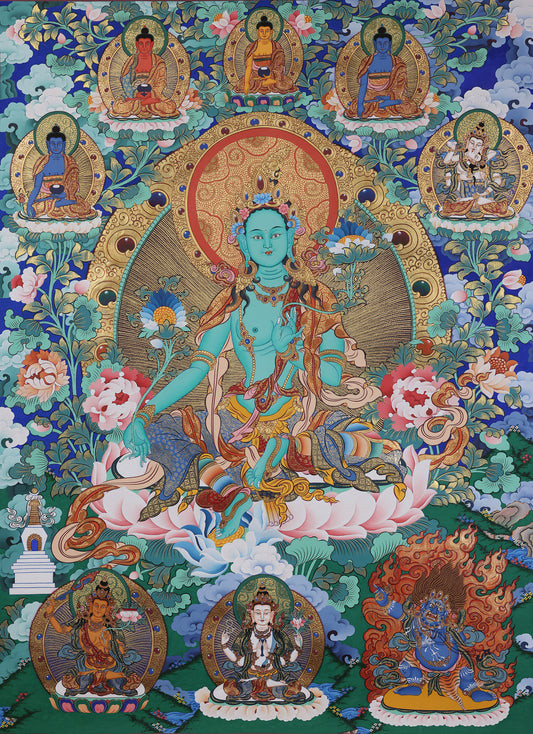
Green Tara in Tibetan Buddhism: Compassion and Vitality in Red Thangka Iconography

When the vermilion background spreads like a plateau sunset, the emerald figure unfolds amid gilded patterns—this is Green Tara in red thangka art: one of the warmest symbols of compassion in Tibetan Buddhism. The frame of red thangka before you, with its background blended from cinnabar and ochre steeped in millennia of faith, and its lotus petals and cloud patterns outlined in gold wrapped in sacred rituals, holds the all-green Tara, whose half-lotus posture weaves the imagery of compassion into every fold of color.
For Tibetan Buddhism, Green Tara has never been a "distant deity": she is the courage of plateau herders at snowy mountain passes, the solace beneath butter lamps in prayer halls, and the faith 凝固 in red thangka pigments—she is a "compassionate actor," transforming abstract sanctity into tangible protection with her gentle feminine texture.
I. Green Tara's Identity: The Embodied Agent of Guanyin's Compassion
In the canonical system of Tibetan Buddhism, Green Tara's origin is always tied to the "materialization of compassion."
According to The Origins of Tara, when Bodhisattva Guanyin looked down on the saṃsāra world and saw sentient beings' sufferings stretching like endless snow-capped mountains, two tears fell from his eyes: one incarnated as White Tara (symbolizing longevity and peace), and the other became Green Tara. As the principal deity among the Twenty-One Taras, Green Tara was entrusted with the mission of "swift salvation" from her birth: she is the "executor" of Guanyin's compassion, unlike the Buddha who manifests "perfect enlightenment" or the Vajra deities who stand with "majestic demon-subduing power." Instead, she transforms "saving the suffering" into perceptible gentle protection through her soft feminine traits.
In Tibetan Buddhism, each of the Twenty-One Taras has a specific role: some oversee wealth, others protect travelers, but Green Tara is the "all-round savior"—her vows cover the "Eight Great Perils" (perils of lions, elephants, fire, water, imprisonment, thieves, non-human beings, and demons), and even extend to modern life's troubles: academic anxiety, workplace exhaustion, physical and mental illness, all are included in her protective scope by believers.
This "all-roundness" is precisely the core reason Green Tara is more widely popular in Tibet than other deities: she is not a "lofty saint" but a "companion who responds at any time"—as Tibetans often say: "Chanting Green Tara's mantra (Om Tare Tuttare Ture Soha) feels like holding a mother's hand."
II. Green Tara in Red Thangkas: Every Detail Is a Code of Symbolism
The Green Tara in this red thangka is a typical example of Tibetan Buddhism's "conveying doctrine through imagery": every color and posture is a visual language of the belief system.
1. The Emerald Form: Metaphor of Vitality and Healing
In Tibetan Buddhism, color is never mere decoration—green corresponds to the Eastern Pure Land of Vairocana (the Pure Land of Medicine Buddha), symbolizing vitality, healing, and the extension of compassion.
Green Tara's emerald form is just like plateau grass breaking through snow to grow: in Tibet's long winter, green is the embodiment of "hope"; spiritually, this green is the "antidote to afflictions"—believers believe that Green Tara's form can purify negative emotions and heal physical and mental sufferings, just as glazed light penetrates darkness, her emerald hue can reveal vitality amid suffering.
2. Half-Lotus Posture: The Gesture of Spontaneous Salvation
Unlike the Buddha's full-lotus posture (symbolizing perfect enlightenment), Green Tara adopts the "half-lotus posture": one foot rests on the lotus (symbolizing abiding in the sacred realm), and the other hangs down (symbolizing being ready to descend to the world for salvation). This posture is called "lila asana"—not "playfulness," but "unimpeded ease": she is not bound by the "sacred realm" and can respond to sentient beings' calls in the most flexible way.
Look at the Tara in this red thangka: her hanging toe lightly touches the lotus petal, as if she will rise to walk toward the suffering at the next moment—this is the wisdom of Tibetan Buddhism: sanctity is never isolated from the secular; compassion is "acting among sentient beings."
3. Red Thangka Background: The Warmth and Durability of Faith
Red thangka is an important branch of Tibetan thangkas, with a base of mineral pigments such as cinnabar and ochre—these pigments do not fade after long exposure to plateau sunlight, just as Green Tara's compassion remains vivid through the years.
The blend of bright cinnabar and deep ochre avoids the harshness of pure cinnabar while retaining the solemnity of faith: in the dim prayer hall, the vermilion background glows warmly under butter lamps, making Green Tara's form more prominent—this is not an aesthetic coincidence, but a design to "make compassion visible": amid the crowd in the prayer hall, believers can spot that emerald hue at a glance and receive that protection.
The lotus petals, cloud patterns, and decorations outlined in gold powder are the "externalization of sanctity": gold symbolizes "unchanging truth" in Tibetan Buddhism, and every gold line is a note on the "eternity" of Green Tara's vows.
III. Red Thangkas and Green Tara: The Symbiosis of Faith and Art
Red thangkas are not "ordinary paintings" but "carriers of faith"; Green Tara's choice of red thangkas as a common iconographic form is inevitable for Tibetan culture's "form serving spirit."
1. Red Thangka Craftsmanship: Creation Within Rituals
Creating a red thangka is itself a practice:
- Canvas preparation: Stretch cotton over a frame, polish repeatedly with a base material mixed from gypsum and latex until the canvas is as smooth as a mirror—this is the process of "removing distractions";
- Background mixing: Blend cinnabar and ochre in strict proportions, chanting Green Tara's mantra with each stir—vows are steeped in the pigments;
- Gold line outlining: Grind gold leaf into fine powder, mix with bone glue to make gold ink, and complete it in one go with a wolf-hair brush—bone glue cannot be modified once dry, so the painter must create in a "distraction-free" state, making the gold lines an extension of the sacred.
For Tibetan painters, creating a red thangka of Green Tara is not "work" but "accumulating merit": every stroke is an offering to Green Tara, and every work is a "stopping point" of compassion.
2. The Adaptation of Red Thangkas and Green Tara: Spirit in Color
The contrast between vermilion and emerald is the essence of Tibetan aesthetics:
- Vermilion is the "warmth of faith": corresponding to Tibetans' reverence for the land and sun;
- Emerald is the "foundation of compassion": corresponding to the longing for life and hope.
Their interweaving precisely interprets Green Tara's essence: "fervent faith" wraps "gentle compassion," making sanctity both powerful and warm.
IV. Contemporary Perspective: Green Tara Is More Than a Religious Symbol
Today, Green Tara has transcended religious boundaries to become a representative of Tibetan culture and a symbol of spiritual healing.
1. A Business Card for Cultural Communication
At international art exhibitions, Green Tara in red thangkas is often the core of Tibetan culture exhibitions: Western audiences may not understand The Origins of Tara, but they can read "hope amid suffering" from the collision of vermilion and emerald; in Tibetan homestays and cultural and creative stores, Green Tara in red thangkas is the most popular collection—it is no longer just an offering on the altar, but a "visual business card" of Tibetan spirit.
2. Spiritual Solace in Modern Life
For urbanites, Green Tara's meaning has long exceeded "rescuing from the Eight Perils": when you chant her mantra late at night while working overtime, that emerald hue becomes a "habitat" for the tired soul; when you fall into anxiety, her unimpeded posture reminds you to "treat yourself with compassion"—this spiritual healing has nothing to do with religion, but everything to do with "the eternal human need for compassion."
As a Tibetan scholar said: "Green Tara's vitality lies in the fact that she is never an 'outdated faith' but 'humanity's eternal need for compassion.'"
Conclusion: The Compassion in Red Thangkas Never Fades
As the vermilion hue of this red thangka settles over time, Green Tara's emerald form remains vivid—she is Guanyin's tear, the plateau's spring, and the faith 凝固 in red thangka pigments.
For Tibetan Buddhism, she is the "deity of swift salvation"; for art, she is the ultimate expression of red thangka aesthetics; for contemporary people, she is a symbol of "gentle compassion"—whether you believe in Tibetan Buddhism or not, you can read a simple truth from the interweaving of vermilion and emerald: compassion is the warmest power in the world.
Would you like me to put together a concise list of Green Tara's core symbolic elements to help you quickly recap the key points of this article?
#GreenTaraInTibetanBuddhism #RedThangkaArt #GreenTaraSymbolism #TibetanBuddhistDeities #RedThangkaGreenTaraIconography #GreenTaraMantra #TwentyOneTarainTibetanBuddhism #TibetanRedThangkaCraft #TibetanBuddhistArt #TibetanCulturalSymbols #SpiritualHealingInBuddhism #ThangkaPigmentTechnique #PlateauFaithCulture #CompassionSymbolInBuddhism #SacredArtOfTibet
Schlagwörter:
Vorherige
Tibetan Buddhist Gold Leaf Green Tara Thangka A Deep Analysis of Spiritual Symbolism, Deity Iconography, and Gilded Craftsmanship
Nächste
Yellow Jambhala in Tibetan Buddhism: More Than Wealth Attraction – The Wisdom of Blessings in Symbolism, Worship, and Practice