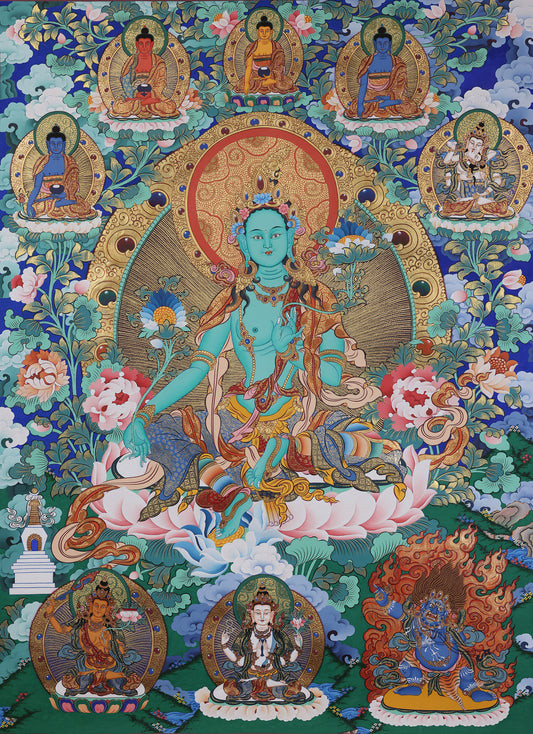
Four-Armed Avalokiteshvara Thangka: This Hand-Painted Turquoise & Gilded Thangka Hides a Compassionate Rescue Field "Embracing the World"
wudimeng-Nov 28 2025-
0 Kommentare
When a hand-painted thangka—centered on a "white-bodied, four-armed figure clutching a wish-fulfilling gem," woven with turquoise and gilded details—unfurls before you, you’re not just seeing the opulence of Tibetan art: you’re stepping into the rescue universe of "compassion embracing all, delivering all beings" in Tibetan Buddhism. Today, we break down this Four-Armed Avalokiteshvara Thangka: from the symbolism of its four arms to its turquoise base, why is it the "compassion choice" in thangka collections?
You may have seen two-armed Avalokiteshvara, but the four-armed Avalokiteshvara form is the core of "compassion made tangible" in Tibetan Buddhism:
-
White Body Meaning: Its pure, milky-white form symbolizes "untainted compassion"—to Tibetan believers, the Four-Armed Avalokiteshvara is inherently the rescue bodhisattva who "fulfills all good wishes and dissolves all suffering";
-
The Compassionate Division of Four Arms:
Middle arms clasped around a wish-fulfilling gem: The gem is a "vessel for all beings’ good wishes," and the clasped posture represents a gentle "connection to all beings’ hearts";
Right hand holding a prayer bead mala: Each turn of the mala signifies "transforming affliction into enlightenment," embodying the compassion of "gradual rescue";
Left hand holding a blue lotus: The blue lotus rises unsoiled from mud, corresponding to "Avalokiteshvara’s compassion—pure and untainted, capable of delivering beings from the mire of affliction";
Every gesture of its arms is a visual language of "compassion in action."
Even the gilded patterns on the Five-Buddha Crown and the turquoise interwoven ornaments are layered stroke by stroke by the artist using natural mineral pigments (malachite powder, gold leaf)—every turquoise fold carries the warmth of "handmade compassion."
The base colors and patterns of this thangka hold the spatial philosophy of "compassion embracing all":
-
Turquoise Dominant Hue: Turquoise isn’t just a color—it’s a metaphor for "vitality and omnipresence"—like grass covering the earth, Avalokiteshvara’s compassion wraps around every corner of the world where suffering exists;
-
Gilding & Florals: Gilded cloud patterns represent "the light of compassion," while interwoven peonies and blue lotuses symbolize "the fragrance of compassion"—the black-gold base makes the turquoise glow vividly, visualizing "compassion blooming like light in the darkness of affliction";
-
Multi-Layered Lotus Throne: The bodhisattva sits atop a lotus throne with overlapping petals—symbolizing both "purity beyond worldly affliction" and "Avalokiteshvara’s compassion, which can carry beings across the sea of suffering."
More people are hanging Four-Armed Avalokiteshvara thangkas in living rooms or meditation spaces, and the core lies in its "dual value":
-
Cultural Value: This is a hand-painted work in the traditional Tibetan "Menri-Sa school" style, with natural mineral pigments (malachite, gold leaf) that resist fading for centuries—making it a "compassionate art asset to pass down through generations";
-
Spiritual Value: The four arms of Avalokiteshvara (representing "wishes, action, purity, and deliverance") turn this thangka into a "portable rescue symbol": Greeting the gem-clasping Avalokiteshvara in the morning brings comfort that "all good wishes will be fulfilled today"; Glancing at it during worry, the mala and blue lotus offer reassurance that "afflictions can be transformed, and suffering can be overcome."
There are many imitations on the market—here are the clear "hand-painted markers" of this piece:
-
Layered Turquoise: The turquoise from natural malachite powder has gradient blending, not the stiff blocks of industrial pigments;
-
Handmade Mala Beads: Each bead varies slightly in size (machine replicas are perfectly uniform);
-
Lotus Petal Folds: The edges of the petals have natural brushstroke undulations, not the rigid lines of mold-pressed designs.
If you want to bring "world-embracing compassion" into your life, this Four-Armed Avalokiteshvara Thangka is a dual haven of aesthetics and spirit—after all, objects that encapsulate "gentle rescue" in art are rare.