Emerald Compassion: The Belief in Green Tara in Tibetan Buddhism and the Art of Color Thangka

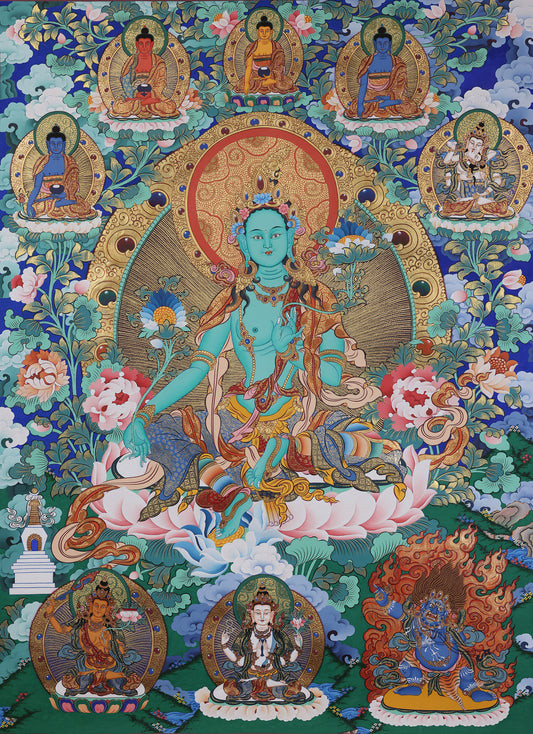
When the eye falls on this color Thangka, the emerald-hued form first seizes the gaze—it is not ordinary green, but the vitality of plateau grass breaking through soil, the turquoise glow of snow-region lakes, and the embodiment of "the color of activity" in Tibetan Buddhism: this is Green Tara, the "Mother of All Buddhas" who emanated from Avalokiteshvara’s tears of compassion and vowed in female form to deliver all sentient beings.
I. Emanated from Tears: The Origin and Identity of Green Tara
In Tibetan Buddhist scriptures, Green Tara’s birth is the ultimate expression of compassion. The Origin of Tara records: Avalokiteshvara, gazing upon the six realms with his wisdom eye, saw sentient beings still drowning in the sea of suffering; sorrow welled up, and a tear from his right eye transformed into a lotus. When the lotus bloomed, Green Tara appeared in the form of a young maiden, palms pressed together, saying to Avalokiteshvara: "Do not grieve, Bodhisattva—I vow to deliver all beings trapped in samsara."
She is the "compassionate emanation" of Avalokiteshvara and the "leader of the Twenty-One Taras"—the different forms of the Twenty-One Taras are in fact Green Tara’s "activity manifestations" for rescuing beings from various afflictions. In Tibetan historical narratives, Princess Wencheng is regarded as Green Tara’s human incarnation: before Songtsen Gampo’s passing, he placed his left hand on Princess Wencheng’s head; she transformed into a sixteen-petaled emerald lotus, and Green Tara’s dharma form appeared in the lotus heart. This legend binds Green Tara’s belief to the cultural fusion of Han and Tibet.
II. The Esoteric Meaning of Emerald: Symbolic Language in the Color Thangka
This color Thangka condenses almost all of Green Tara’s symbolic codes—every detail is a metaphor for "deliverance":
- Form: The form of a sixteen-year-old maiden symbolizes both "primal purity" and the vow to "connect with sentient beings through a gentle presence"; the emerald body corresponds to the body color of Akshobhya Buddha, signifying "the perfection of activity."
- Posture: The right leg hangs down to the lotus (half-lotus posture) while the left leg is folded—this is a stance of "ready to rise and deliver"—unlike the full-lotus posture of the Buddha, Green Tara’s posture is always in a "state of preparedness," echoing her vow to "rescue from the Eight Perils."
- Implements: Each hand holds an Utpala (blue lotus), the stem extending to the ear, with "fruit, blooming flower, and bud" at the top: the fruit represents past Buddhas (Kashyapa Buddha), the blooming flower represents present Buddhas (Shakyamuni Buddha), and the bud represents future Buddhas (Maitreya Buddha), meaning "the vows of all Buddhas of the three times are transmitted through Tara."
- Ornaments: Three strings of beads around the neck rest at the chest, heart, and navel, corresponding to "purifying the three karmas of body, speech, and mind"; the five-Buddha crown symbolizes "the integration of the wisdom of the five directional Buddhas."
The Thangka’s background holds further ingenuity: the dragon and fish on the left allude to "rescuing from water perils and snake perils"; the peacock and auspicious clouds on the right correspond to "rescuing from non-human perils and subduing demons"—the entire painting is a visual version of the Green Tara Deliverance Sutra.
III. Rescuing the Eight Perils: Green Tara’s Compassionate Vows
In Tibetan devotion, Green Tara is the most "down-to-earth" Bodhisattva: her core merit is "rescuing from the Eight Perils"—perils of lions, elephants, snakes, water, fire, imprisonment, thieves, and non-humans—covering nearly all dangers of plateau life.
Spiritually, she transforms "doubt" (one of the Five Poisons) into wisdom. Practitioners say that reciting Green Tara’s mantra, "Om Tare Tuttare Ture Svaha," not only dispels external calamities but also breaks "doubt about practice and self-negation"—this is why she is called the "Swift-Responding Tara": her blessings are quick, and her responses are timely.
Historical practitioner accounts add to the legend: when Atisha Dipankara entered Tibet in the 11th century, a flash flood blocked his path; after reciting Green Tara’s mantra, the flood split into two channels, clearing a way. Contemporary believers also share that reciting the mantra during anxious insomnia quickly brings inner calm.
IV. Color Thangka: The Visual Vessel of Belief
This color Thangka belongs to the Karma Gadri style—vibrant colors, delicate lines, a representative school of eastern Tibetan Thangka. Unlike the three-dimensionality of appliqué Thangkas, painted Thangkas emphasize "mood":
- Color Use: A black ink background highlights the brightness of the emerald form, symbolizing "compassionate light manifesting in the darkness of ignorance"; the pairing of blue lotuses and pink peonies aligns with Buddhist aesthetics of "purity and solemnity" and echoes Tibet’s tradition of "offering flowers to the Buddha."
- Eye Opening: The final step in Thangka painting is "opening the eyes"; Green Tara’s eyes are outlined with a fine brush to convey a "compassionate gaze"—in this Thangka, the eye corners droop slightly, neither the majesty of looking down nor the indifference of looking straight, but "compassion that meets sentient beings eye to eye."
- Lineage: Thangka painters of Green Tara must first receive Tara’s empowerment and recite sutras to purify their minds before painting—for Tibetans, a Thangka is not an "artwork" but a "venerable dharma form"; every stroke is practice.
V. Contemporary Connection: The Spiritual Significance of Green Tara
Today, Green Tara’s belief has transcended geography: female urban practitioners resonate with her vow to "attain Buddhahood in female form"; those in distress gain "courage to not give up" through her mantra—her "emerald hue" has long evolved from a color to a symbol of "hope."
As one practitioner put it: "Seeing Green Tara’s form is like seeing an elder sister who is always by your side—she doesn’t speak, but you know that if you call, she will respond."
This color Thangka hangs in the monastery hall, and in countless hearts: the emerald form is a vessel of compassion; the hanging right leg is a helping hand always ready to reach out; the lotus in her hand is purity blooming from suffering. This is Green Tara—not a distant deity, but that un-fading emerald compassion in the joys and sorrows of sentient beings.
#GreenTara #TibetanBuddhism #ThangkaArt #AvalokiteshvaraEmanation #CompassionateBodhisattva #MantraMerits #EightPerilsTara #MotherOfAllBuddhas #TibetanCulture #PracticeGuide
Schlagwörter:
Vorherige
Sakyamuni in Tibetan Buddhism: The Form, Teachings, and Foundation of Faith in a Gilded Thangka
Nächste
Tibetan Buddhist Mandala: A Visual Poem of Cosmic Order, the Enlightenment Code Hidden in Geometry