Tibetan Buddhism Hand-Painted Thangka: The Faithful Vision and Craft Decoding of Vaishravana and the Five Directional Wealth Gods

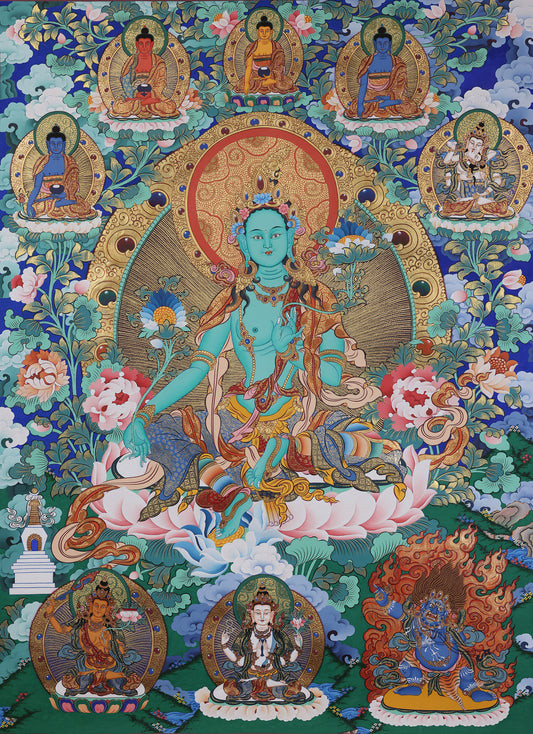
Among the splendid cultural treasures of Tibetan Buddhism, thangkas have always occupied a core position. They are not ordinary works of painting art, but more like a "spiritual map" connecting mundane life and the sacred realm, carrying the beliefs and wishes of the Tibetan people for thousands of years. Among them, the hand-painted thangka themed "Vaishravana Protecting the Five Directional Wealth Gods" perfectly integrates the mundane expectation of "prosperity and peace" with the religious pursuit of "achieving meritorious deeds". This thangka not only constructs a complete field of faith through a rigorous iconographic system, but also interprets the artistic spiritual core of Regong thangka art of "dignified yet not ferocious, prosperous yet not extravagant" with the unique exquisite craftsmanship of the Regong School. Today, let us walk into the world of this thangka and decode the faith code and craft ingenuity behind it.
I. Theme Core: The Dual Faith Narrative of Wealth and Protection
In the doctrinal system of Tibetan Buddhism, "wealth" has never been a tool for mundane pleasure, but "merit for achieving good deeds" — only with sufficient material foundation can one better practice compassion and do more altruistic things. The core theme of this thangka "Vaishravana Protecting the Five Directional Wealth Gods" is developed based on this profound concept, constructing a complete faith field of "protecting the Dharma and fulfilling the wishes of all beings" through the layout of the main deity and attendant gods.
From the perspective of Tibetan Buddhist cosmology, the composition of this thangka secretly contains the exquisite system of "Three Realms and Five Directions", and each area carries a specific religious meaning. The upper realm depicts Buddha and principal deity images, symbolizing the origin of wisdom and serving as the spiritual core of the entire faith system; the middle realm is the main deity Vaishravana, acting as a bridge connecting the mundane and the sacred, undertaking the core responsibility of "protecting the Dharma and blessing all beings"; the lower realm is distributed with the Five Directional Wealth Gods and various Dharma protectors, implying the grounding and nourishment of wealth and the elimination of obstacles on the path of practice. This layout not only strictly follows the normative requirements of the Measurement Sutra of Icon Painting, but also implies the practice logic of "generating merit from wisdom and achieving good deeds through merit", allowing viewers to perceive the profound connotation of faith while appreciating the beauty of art.
For the Tibetan people, this thangka is a concretization of spiritual sustenance. Over the long years, they have integrated their beautiful expectations for life and their persistent pursuit of good deeds into their faith in Vaishravana and the Five Directional Wealth Gods. Whether it is prayers during farming seasons or expectations on business trips, this thangka is like a spiritual lighthouse, giving them the strength to move forward, and making the concept of "achieving good deeds through merit" more profound from generation to generation.
II. Analysis of the Main Deity: The "Dignified-Compassionate Expression" and Symbolic System of Vaishravana
The main deity in the center of the thangka is Vaishravana (Sanskrit: Vaishravana, Tibetan: Namthö Se), an extremely influential Dharma protector in Tibetan Buddhism. As an important Dharma protector in the Tibetan Esoteric system, Vaishravana's iconography strictly follows classical regulations, and every detail carries a specific religious meaning, accurately interpreting the core doctrine of "protecting the good Dharma with powerful force".
1. Physical Characteristics: The Compassionate Core of Dignity Without Ferocity
Vaishravana is entirely golden yellow. This color is not chosen arbitrarily, but corresponds to the "treasure nature" of Ratnasambhava Buddha in the south, symbolizing "the pure and unblemished Buddha-nature" and "the endless treasure of merit". The main deity has one face and two arms, with a slightly angry yet not ferocious expression — this unique "dignified-compassionate expression" is a classic paradigm of Tibetan Esoteric iconography: the angry expression reflects the powerful force of the Dharma protector to subdue demons and dispel evil, while the implied compassionate expression reveals the Buddha's compassion to save all beings and protect believers. Between anger and compassion, the core responsibility of "protecting the good Dharma and benefiting all beings" is fully demonstrated.
2. Ritual Implements and Mount: Concrete Symbols of Wealth and Protection
Vaishravana's held ritual implements and mount are the core components of his symbolic system, and each one contains profound faith connotations. In his right hand, he holds a victory banner (treasure banner). The shape of the treasure banner incorporates the treasure top elements of traditional Tibetan architecture, with smooth lines and exquisite decorations, symbolizing "subduing all demons and gathering worldly merit", and is an important symbol of power and auspiciousness; in his left hand, he holds a treasure-spitting rat (Tibetan: Nüli), which spits out an endless stream of precious pearls, a concrete expression of "endless wealth and abundant merit", and also embodies the people's beautiful expectations for a prosperous life.
The main deity's mount is a majestic white lion (snow lion), which looks back at the main deity with a respectful and dignified posture. In Tibetan culture, the snow lion is a symbol of the snow-capped mountains in the north, corresponding to Vaishravana's identity as the "protector god of the north"; at the same time, the tamed posture of the snow lion also metaphorically represents the practice concept of "taming inner afflictions through practice" — only by subduing greed, anger and ignorance in the heart can one truly obtain wealth and peace.
3. Clothing and Adornments: Dignified Beauty in Prosperity
Vaishravana wears a Five Buddhas Crown, which is inlaid with precious jewels such as pearls, corals and turquoise, symbolizing the blessing of the Five Buddhas and implying "protecting all beings with the wisdom of the Five Buddhas". The main deity is adorned with intricate necklaces, arm bracelets, foot bracelets and other decorations, all made of natural treasures, magnificent yet dignified. These decorations are not purely for the pursuit of beauty, but a metaphor of Tibetan Esoteric iconography that "uses worldly treasures to express transcendental perfection" — no matter how many worldly treasures there are, they cannot compare to the perfection of Buddha-nature; and adorning the main deity with worldly treasures is to guide viewers to elevate their yearning for mundane wealth to the pursuit of transcendental perfection. This aesthetic style of "prosperous yet not extravagant" is also one of the typical characteristics of Regong thangkas.
III. Attendant Gods: The Functional System of the Five Directional Wealth Gods and Dharma Protectors
The attendant gods distributed around Vaishravana together form a complete network of the "Vaishravana Protection System". The layout, physical features and ritual implements of these gods strictly follow the "Five Paths of Wealth Gods" belief in Tibetan Buddhism, forming a functional closed loop of "protection, bestowal and elimination", fully meeting the believers' needs for "disaster elimination, merit increase and career achievement".
1. Upper Realm Gods: Wisdom Blessing and Disaster Elimination Protection
The group of gods in the upper part of the thangka takes Ratnasambhava Buddha as the core, with White Tara and Green Tara on both sides. Ratnasambhava Buddha in the center of the upper part is red in color, sitting cross-legged on a lotus throne with his hands in the samadhi mudra, symbolizing "achieving the merit of all beings with treasure nature". As the Dharma body origin of Vaishravana, the existence of Ratnasambhava Buddha provides wisdom blessing for the entire protection system, and also echoes the practice logic of "generating merit from wisdom".
White Tara and Green Tara on both sides of Ratnasambhava Buddha are emanations of Avalokiteshvara Bodhisattva and are also highly revered savior goddesses by the Tibetan people. White Tara is white in color, wearing a Five Buddhas Crown and holding a lotus and a treasure vase, symbolizing "calming disasters and eliminating illnesses"; Green Tara is green in color, holding a wish-fulfilling gem and a lotus, implying "increasing blessings and protecting careers". The existence of the two Taras complements Vaishravana's "blessing" function, constructing a dual guarantee of "wisdom blessing + disaster elimination protection" for viewers.
2. Five Directional Wealth Gods: A Well-Divided Wealth Enhancement System
The colored gods distributed around the thangka are the famous Five Directional Wealth Gods (Five-Colored Wealth Gods) in Tibetan Buddhism, namely White Wealth God, Yellow Wealth God, Red Wealth God, Green Wealth God and Black Wealth God. Each of these five wealth gods has clear physical characteristics and functional divisions, jointly forming a comprehensive wealth enhancement system covering "wisdom, wealth, popularity, health and career". Each wealth god also holds a treasure-spitting rat, echoing the ritual implements of the main deity and strengthening the theme of "wealth gathering".
The White Wealth God is white in color, holding a treasure and a treasure staff, in charge of "wisdom and disaster calming" — he can not only bestow wealth on all beings, but also help viewers attain wisdom and eliminate obstacles in practice and life; the Yellow Wealth God is yellow in color, holding a treasure vase and a wish-fulfilling object, and is the most popular and revered wealth god in Tibet, in charge of "wealth enhancement", capable of helping believers accumulate merit and improve their lives; the Red Wealth God is red in color, holding a mani pearl and a lasso, in charge of "affection and noble popularity", able to help viewers gain the love and support of others and pave the way for career development; the Green Wealth God is green in color, holding a wish-fulfilling gem and ears of grain, in charge of "health and career expansion", which can not only protect the health of all beings, but also help careers thrive; the Black Wealth God is black in color, holding a钺 knife and a treasure-spitting rat, in charge of "subduing enemies and eliminating obstacles", able to help viewers clear obstacles on the path to wealth and dispel evil forces.
It is worth noting that all five wealth gods adopt the "royal ease posture" — this relaxed and comfortable sitting posture breaks the dignity of traditional divine images, embodying the core doctrine of Tibetan Buddhism of "saving all beings with a free and easy posture": faith is not a rigid constraint, but allows all beings to receive blessings and nourishment in a relaxed and comfortable manner.
3. Lower Realm Dharma Protectors: The Powerful Force of Eliminating Obstacles
The wrathful gods at the bottom of the thangka are mostly the Eight-Horse Dharma Protectors or earth gods, serving as the "eliminators" in the entire protection system. These Dharma protectors are blue or black in color, holding ritual implements such as钺 knives and vajras, with a powerful posture and a dignified expression, showing a wrathful appearance. Their core responsibility is to "eliminate obstacles on the path to wealth", subduing the demons and evil forces that hinder sentient beings from accumulating merit and achieving good deeds.
From a functional logic perspective, the lower realm Dharma protectors form a perfect closed loop with the main deity's "protection" and the wealth gods' "enhancement": Vaishravana provides overall protection, the Five Directional Wealth Gods bestow various merits, and the lower realm Dharma protectors eliminate obstacles on the way forward. The three complement each other, jointly constructing a complete faith system of "protection, bestowal and elimination", allowing viewers to obtain comprehensive spiritual nourishment in faith.
IV. Painting Craft: The Dual Codes of "Nature and Ingenuity" in Regong Thangkas
This thangka "Vaishravana Protecting the Five Directional Wealth Gods" belongs to the important school of Tibetan Buddhist thangkas — the Regong School (Huangnan area, Qinghai Province). The Regong School is famous for its "exquisite craftsmanship, brilliant colors and profound meanings". Its works are not only works of art, but also regarded as "living carriers of faith" due to their strict traditional craftsmanship and devout creative attitude. The craft core of this thangka can be summarized into three dimensions: "precious materials, complex processes and devout spirit", and every detail reveals the ingenuity and faith of Regong painters.
1. Materials: The "Eternal Colors" of Natural Minerals
The value foundation of Regong thangkas lies first in their ultimate use of natural mineral pigments. The pigments used in this thangka are all gifts from nature, refined and specially prepared through fine grinding. They are not only rich in color and delicate in texture, but also can maintain their color for hundreds of years — this is the origin of the Tibetan proverb "The colors of thangkas will not fade, just as faith will not cool down".
Specifically, the gold color in the thangka comes from 24K gold foil. Painters need to repeatedly grind the gold foil into fine powder, then add cow bile to prepare it (cow bile can enhance the adhesion and stability of the pigment), which is mainly used for the main deity's treasure crown, ritual implements and backlight. The "never-fading" gold symbolizes "the eternal existence of the Dharma" and also makes the dignified image of the main deity more prominent; the blue color comes from Afghan lapis lazuli. Painters need to grind lapis lazuli to a fineness of 5μm (equivalent to 1/15 of a hair strand) to ensure uniform and transparent color, which is mainly used to paint the sky and the robes of Taras. The deep blue of lapis lazuli symbolizes "the infinite wisdom of the universe", filling the picture with a sense of peace and sacredness; the green color comes from the mixed grinding of malachite and turquoise, used to paint the body of the Green Wealth God and the plant patterns in the picture, symbolizing "the vitality of nature" and "the nourishment of merit"; the red color is prepared by mixing cinnabar and red coral powder in a specific ratio, used for the main deity's necklaces and the flower elements in the picture, representing "the vitality of compassion" and "the prosperity of good deeds"; the white color comes from the powder of tridacna shells, used to paint the body of White Tara and the image of the snow lion, symbolizing "the pure and unblemished Buddha-nature" and "the purity of the heart".
Regong painters often say: "Every grain of mineral is a gift from the mountain gods, and every stroke is a respect for nature." In their eyes, these natural materials are not just painting tools, but media connecting the mundane and the sacred — painting sacred images with natural things is both gratitude to nature and piety to faith.
2. Processes: The "Practice-Like Creation" of 12 Core Steps
An authentic Regong thangka requires 12 core steps to complete. The entire process is like a practice, requiring painters to be completely focused and undistracted. The creation of this thangka "Vaishravana Protecting the Five Directional Wealth Gods" also strictly follows this traditional process, with every step pursued to perfection.
The first step is canvas processing: pure cotton cloth is selected as the base, which undergoes 3 times of cowhide glue soaking, drying, framing, shell polishing and other processes, and finally forms a "mirror-smooth, tough and not easy to damage" canvas base. This step is the foundation for the long-term preservation of the thangka. Painters need to strictly control the concentration of cowhide glue and the intensity of polishing to ensure that the canvas is both flat and has a certain toughness.
The second step is draft drawing: painters need to strictly follow the "37:25 golden ratio" in the Measurement Sutra of Icon Painting and use charcoal pencils to outline the contours of the main deity and attendant gods. Whether it is the facial proportion of the main deity, the size of the ritual implements, or the distribution position of the attendant gods, there must be no deviation — this is not only an artistic aesthetic requirement, but also a religious ritual norm. When drawing the draft, painters need to repeatedly compare classical records to ensure that every detail meets the doctrinal requirements.
The third step is layered coloring: this is one of the most time-consuming and patience-testing processes of Regong thangkas. Painters need to color the picture in 5-7 layers of gradient in the order of "from dark to light". Taking the golden yellow robe of the main deity as an example, painters need to first apply a light yellow orpiment base color. After drying, they then overlay different concentrations of mixed pigments of "orpiment + gold powder". Each layer must be thin and uniform, and the next layer of gradient can be carried out after drying. After multiple overlays, the final effect of "magnificent from a distance and layered from a close view" is presented, making the robe more three-dimensional and textured.
The fourth step is golden line outlining: after the colors are completely dry, painters need to use a specially made fine brush dipped in gold juice to outline the details in the picture. The concentration of gold juice needs to be strictly controlled at about 15%, and the line fineness can reach 0.1mm with an error of no more than 0.005mm. These fine golden lines are mainly used to outline the patterns of the treasure crown, the contours of the ritual implements, the folds of the robes and other details, making the picture more exquisite and three-dimensional, and also highlighting the Regong craft characteristic of "ingenuity in every detail".
The final step is face and eye painting: this is the most sacred and crucial process in the entire creation. Before painting the face and eyes of the Buddha image, painters need to retreat and calm their minds, abandon all distractions, and create with a devout attitude. According to Tibetan Esoteric tradition, the eyes are the "soul of the Buddha image". Painters need to draw eyes with a "calm yet compassionate" look through precise brushstrokes — this is not only the ultimate embodiment of technology, but also the spiritual resonance between the painter and faith. When the last stroke is completed, the entire thangka seems to be endowed with spirituality, becoming a true "living carrier of faith".
3. Artistic Style: The Perfect Integration of Prosperity and Rigor
The artistic style of this thangka perfectly shows the typical characteristics of the Regong School, with the core of "the perfect integration of prosperity and rigor". In terms of composition, it adopts a "central radiation" layout. The main deity Vaishravana occupies the visual core of the picture, and the attendant gods are orderly distributed around the main deity, which not only strictly follows the requirements of religious rituals, but also forms a balance and harmony in vision. This layout naturally focuses the viewer's gaze on the main deity, and at the same time allows them to clearly see the complete structure of the entire protection system, taking into account both religious connotation and artistic aesthetics.
In terms of color application, the "brilliant yet not vulgar" feature of the Regong School is fully reflected. The high-saturation natural mineral colors interweave with gold, making the picture full of "prosperous" atmosphere, perfectly fitting the "wealth" theme; at the same time, painters neutralize the heaviness of warm colors through the adjustment of cool colors such as blue and green, making the picture more transparent and vivid, avoiding vulgarity. This color matching not only conforms to artistic aesthetics, but also contains the philosophical concept of "balance" — just like the balance between wealth and merit, and the balance between the mundane and the sacred.
In terms of detail processing, the "never tiring of complexity" of the Regong School is vividly displayed. The flower patterns (such as peonies and lotus flowers) in the picture are complex yet precise, and the layers of each petal and the direction of each vein are clearly visible; the hair lines of the snow lion are delicate and layered, as if you can feel the softness and smoothness of the hair; the inlay details of the jewels on the treasure crown are realistic and full of luster. These exquisite details are not redundant decorations, but a faith expression of "expressing piety through exquisiteness" — painters integrate their piety to faith into every detail with extreme ingenuity, allowing viewers to feel the power of faith while appreciating the beauty of art.
Conclusion: Thangka — The Cross-Time Inheritance of Faith
This hand-painted thangka "Vaishravana Protecting the Five Directional Wealth Gods" has never been a simple "wealth-themed painting", but a visualization of the Tibetan Buddhist concept of "dual cultivation of merit and wisdom". The dignity of the main deity, the enhancement of the wealth gods and the protection of the Dharma protectors jointly construct a connecting bridge between "mundane wishes and spiritual practice", allowing viewers to not forget the original intention of "achieving good deeds through merit" while pursuing a prosperous life; the eternal colors of natural minerals and the ingenuity inheritance of Regong craftsmanship have endowed this faith with cross-time vitality on the canvas.
In today's fast-paced era, when we stare at this thangka, we can not only feel the shock of art, but also the warmth of faith. It reminds us that the true meaning of wealth lies not in pleasure, but in assuming responsibilities and achieving good deeds; and true prosperity is the dual perfection of merit and wisdom. As a Tibetan proverb goes: "The colors of thangkas will not fade, just as faith will not cool down." The faith and ingenuity carried by this thangka will also nourish the hearts of every viewer in the passage of time, becoming a spiritual wealth that transcends time and space.
Schlagwörter:
Vorherige
Hand-Painted Tibetan Buddhist Four-Armed Avalokiteshvara Thangka: Decoding Theme, Deity, and Craftsmanship
Nächste
Hand-Painted Four-Armed Avalokiteshvara Thangka: The Spiritual Fabric of Compassion and Rebgong Art