Hand-Painted Tibetan Buddhist Four-Armed Avalokiteshvara Thangka: Decoding Theme, Deity, and Craftsmanship

In Tibetan Buddhist culture, a thangka is far more than a painting—it is a visual map carrying religious faith, spiritual guidance, and cultural memory. Among them, the Four-Armed Avalokiteshvara Thangka stands as a symbol of compassion and protection, reflecting not only the Tibetan religious belief system but also the ethnic and cultural identity of the Tibetan people. This article will provide a comprehensive analysis of the Four-Armed Avalokiteshvara Thangka from five dimensions: theme, central deity, attendant deities, artistic craftsmanship, and cultural significance, helping readers deeply understand its religious, artistic, and cultural value.
I. Core Theme: Compassionate Totem of the Snowy Realm
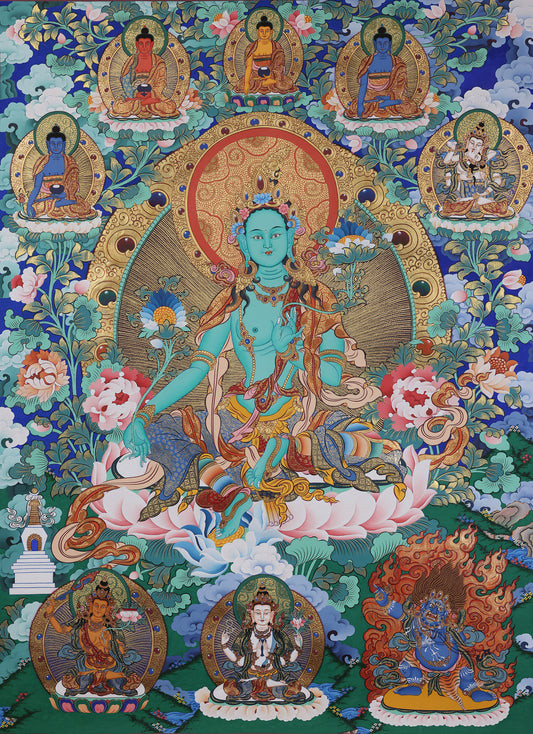
The central theme of the Four-Armed Avalokiteshvara Thangka is “Compassionate Protection by the Four-Armed Avalokiteshvara.” In Tibetan culture, Avalokiteshvara is revered as the protector of the Snowy Land and is a key figure in Tibetan origin legends. Traditionally, Tibetans are believed to be descendants of a divine union between Avalokiteshvara’s enlightened influence, a sacred monkey, and a rakshasi. Therefore, the Four-Armed Avalokiteshvara Thangka serves not only as a ritual tool for meditation but also as a symbol of ethnic and spiritual identity.
From a compositional perspective, the thangka strictly follows the Tibetan Buddhist cosmology of the Three Realms and Five Directions:
-
Upper Realm: the pure abode of Buddhas and Bodhisattvas;
-
Middle Realm: the human and intermediary realm, featuring the central deity and earthly protectors;
-
Lower Realm: the realm of material protection, including wealth deities and dharmapalas safeguarding sentient beings.
This spatial hierarchy narrates the descent of compassion from the divine to the mundane, reflecting Avalokiteshvara’s core vow to relieve the suffering of all beings. The combination of the central deity and attendants also aligns with the “Three Roots Practice” in tantric Buddhism: Guru as the root of blessing, Yidam (deity) as the root of accomplishment, and Dakini as the root of activity—manifesting the tantric principle of union of merit and wisdom.
II. Central Deity: Symbolism and Ritual Significance
At the center of the thangka sits the Serene Four-Armed Avalokiteshvara, drawn according to the golden ratio of 37:25 prescribed in the Sutra of Sacred Image Proportions. Every detail is imbued with religious meaning.
1. Body Features
-
Pure white body: symbolizes inherent purity, free from afflictions and karmic obstacles;
-
Four arms: represent the Four Immeasurables—loving-kindness, compassion, joy, and equanimity, illustrating Avalokiteshvara’s ability to save beings in multiple ways;
-
Serene facial expression: conveys the inner compassionate power of the Bodhisattva, inspiring reverence and peace in observers.
2. Mudras and Sacred Implements
-
Hands holding a wish-fulfilling jewel: signifies the integration of wisdom and skillful means;
-
Right hand holding a crystal mala: each bead represents salvation of countless beings from samsara;
-
Left hand holding an eight-petaled white lotus: represents purity and non-attachment, reflecting Avalokiteshvara’s untainted nature.
3. Crown and Lotus Pedestal
-
Crown featuring Amitabha Buddha: indicates Avalokiteshvara as the manifestation of Amitabha’s compassion;
-
Double-layered lotus pedestal: lower red lotus symbolizes liberation from defilements, upper moon lotus represents cool compassion, embodying the Bodhisattva ideal of “remaining in samsara without attachment, yet not detached from nirvana.”
This portrayal strictly adheres to ritual prescriptions, and any deviation may render it “non-conforming,” reducing its efficacy as a spiritual tool.
III. Attendant Deities: Sacred Protective Network Across Three Realms
The thangka includes a complete attendant deity network, forming a sacred protective system aligned with Tibetan Buddhism’s Guru–Yidam–Dakini–Protector structure.
1. Upper Realm Deities
-
Green Tara (left): eliminates obstacles and calamities, embodies Avalokiteshvara’s compassion;
-
White Tara (right): promotes longevity and health, reinforcing Avalokiteshvara’s protection of beings;
-
Vajrasattva (central red figure): symbolizes karmic purification, key for tantric confession practices.
2. Lower Realm Deities
-
Yellow Jambhala (left): golden body, holds a treasure mouse, representing prosperity and material well-being;
-
Blue Mahakala (right): dark blue, wields a vajra, subdues obstacles and safeguards practice.
This configuration embodies the principle of “union of compassion and wisdom, blessing and protection”: Avalokiteshvara represents “compassion,” Tara symbolizes “mercy,” Jambhala denotes “blessing,” and Mahakala ensures “protection,” creating a complete system of spiritual safeguarding.
IV. Artistic Craftsmanship: Fusion of Heritage Technique and Sacred Reverence
This thangka originates from the Rebgong (Hotog) school, entirely hand-painted, exemplifying both intangible cultural heritage and meditative practice through art.
1. Canvas Preparation
-
Pure cotton fabric treated with three layers of aged cowhide glue and polished with crushed shells to create a mirror-like surface;
-
Cowhide glue aged over five years, enhancing elasticity by 50%, symbolizing “patience and spiritual maturation.”
2. Mineral Pigments
-
Lapis lazuli (blue): wisdom;
-
Malachite (green): vitality;
-
Cinnabar (red): compassion;
-
24K gold powder: divine radiance;
-
Lapis lazuli ground to 5–20 μm, layered 3–5 times, maintaining rich tonal depth and color stability for over 300 years.
3. Linework and Gold Detailing
-
Squirrel-hair brushes for precise lines: robes use “thicker in the middle, thinner at ends” curves; flames are S-shaped arcs;
-
24K gold paint applied at 15–20% concentration, one-stroke completion, <0.3% breakage, achieving solemn and resplendent effects.
4. Face Opening Ritual
-
The central deity’s face painted during meditative retreat with mantra recitation, infusing the thangka with living spiritual energy;
-
Every jewel, lotus petal, and detail requires multiple layers and separate outlining, exemplifying the principle of “skill, faith, and practice in unity.”
V. Cultural Depth: Thangka as a Living Encyclopedia of Tibetan Buddhism
The Four-Armed Avalokiteshvara Thangka is more than an artwork—it is a microcosm of Tibetan Buddhist culture:
-
Spiritual Tool: visualizing Avalokiteshvara brings compassionate blessings;
-
Educational Medium: the arrangement of deities conveys the teachings of the Three Realms;
-
Cultural Memory: preserves Tibetan origin legends, spiritual identity, and intangible heritage.
From a contemporary perspective, the use of rare mineral pigments, such as lapis lazuli, underscores both craftsmanship rarity and the material challenges of traditional art, making it a testament to cultural transmission. The balance between ritual correctness and artistic creativity embodies the Tibetan Buddhist wisdom of “expressing Dharma through beauty”: faith is visualized, art becomes sacred.
Every stroke, mineral wash, and gold line represents the practical manifestation of faith, making this thangka not only a collectible art piece but also a visualized embodiment of compassion, protective order, and spiritual world reflection.
Conclusion
The Four-Armed Avalokiteshvara Thangka integrates religious devotion, artistic craftsmanship, and cultural heritage, serving as a vivid reflection of the Tibetan spiritual universe. Whether for home worship, meditation, cultural collection, or artistic appreciation, it holds irreplaceable value. Through meticulous hand-painted techniques and strict ritual adherence, it conveys the aesthetic principles and compassionate wisdom of the Snowy Land, allowing modern viewers to experience, feel, and preserve thousands of years of Tibetan spiritual and cultural legacy.
#FourArmedAvalokiteshvara #TibetanBuddhism #HandPaintedThangka #RebgongThangka #BodhisattvaArt #TibetanArt #MineralPigmentArt #CompassionAndProtection #TantricPractice #MeditationArt #SpiritualDecor #CulturalHeritage #TibetanThangka #ReligiousArt #SacredArt
Schlagwörter:
Vorherige
Tibetan Medicine Buddha Mandala Thangka: The Spiritual Dimensions of Healing, Order, and Craftsmanship
Nächste
Tibetan Buddhism Hand-Painted Thangka: The Faithful Vision and Craft Decoding of Vaishravana and the Five Directional Wealth Gods