Acala in Tibetan Buddhism: The Wrathful Compassion of a Protector Deity — Exploring the Hei Jin Thangka Adorned with the Six-Syllable Mantra

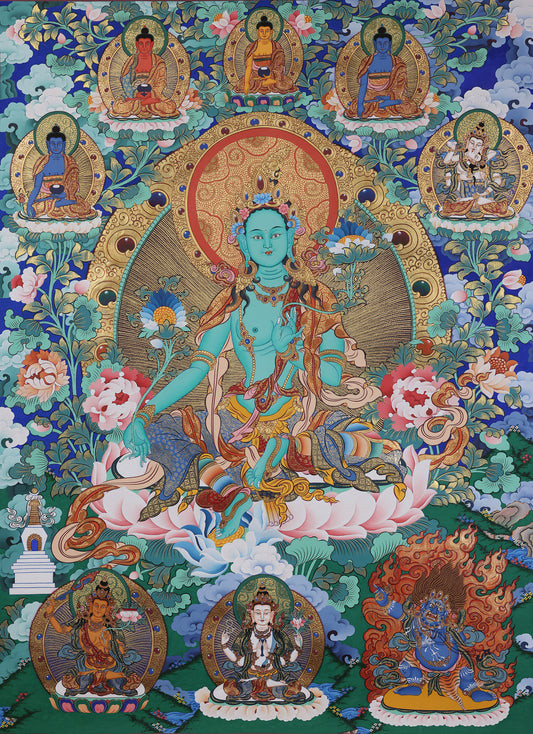
When you gaze at this Hei Jin Thangka, it’s hard not to be stunned by the indigo-blue, wrathful deity at its center: his taut skin is as unyielding as bedrock, three eyes glare open as if piercing through delusion, his right hand raises a Wisdom Sword high, his left clutches a lasso, and the surrounding Six-Syllable Mantra verses weave a golden 结界 (spiritual barrier) — this is Acala Vidyaraja, one of the most powerful protector deities in Tibetan Buddhism.
In Tibet, he is called “Dorje Jigje,” meaning “unshakable wisdom”; in Han Chinese Buddhist traditions, he is better known as “Acala Bodhisattva.” But regardless of the name, this deity who appears in wrath is never far from the core of compassion.
I. Acala’s Identity Code: The “Command Body” in Tibetan Buddhist Pantheon
In the spiritual hierarchy of Tibetan Buddhism, Acala holds a unique position — he is not an independent Buddha or Bodhisattva, but the Command Body (Krodha-rupa) of Vairocana Buddha (the Cosmic Buddha).
“Rupa” (form) is how esoteric Buddhism categorizes the manifestations of Buddhas and Bodhisattvas: Vairocana’s “Self-Nature Body” is his inherent, serene Dharma body, but when it is necessary to subdue stubborn afflictions and vanquish demonic obstacles, he manifests as the “Command Body” — the wrathful form of Acala. This explains why Acala is honored as “the leader of the Five Wisdom Kings”: he is the concentrated embodiment of all Buddhas’ wisdom and majesty, an avatar of “upholding compassionate vows with fierce power.”
Tibetan scriptures The Secret Accomplishment Method of Acala note that the true meaning of his name “Acala” (unmoving) is not physical stillness, but “unshakable Bodhicitta (awakening mind), and wisdom that cuts through all afflictions without being swayed”; “Vidya” (bright) represents the wisdom-light of Buddha-nature, and “Raja” (king) denotes the majesty to master all obstacles. In the mandalas of Tibetan monasteries, he always occupies the central position among the Five Wisdom Kings, serving as the core of the entire protector system.
II. Compassionate Messages in the Wrathful Form: Symbolism of the Indigo Body, Three Eyes, and Wisdom Sword
Every detail of Acala’s image in this thangka is a code of Tibetan esotericism’s “expressing Dharma through form”:
- Indigo-blue form: In Tibetan esotericism, blue symbolizes “unchanging Dharma nature” — it represents Vairocana’s essence, and also metaphorizes “purifying karmic obstacles like a clear sky dispelling dark clouds.”
- Three wide-open eyes: The right eye looks up to subdue the “heavenly demon” (arrogance), the left eye looks down to burn the “dragon demon” (ignorance), and the vertical eye on his forehead stares straight ahead to vanquish the “yaksha demon” (anger) — the three eyes correspond to the three most stubborn afflictions of sentient beings.
- Wisdom Sword and Lasso of Subjugation: The Wisdom Sword in his right hand is not a weapon of slaughter, but a “sword of wisdom” that symbolizes cutting the root of delusion; the lasso in his left hand is not a rope to bind others, but a “lasso to subdue inner demons,” signifying trapping and transforming inner attachments.
- Surrounding flame patterns: The golden flames in the thangka’s background are a variation of “Garuda flames,” representing the wisdom-fire that incinerates all karmic obstacles and impurities.
Tibetan monks often say: “Acala’s wrath is like the anger of parents toward a stubborn child — it is not hatred, but compassion that ‘resents iron for not becoming steel.’” His wrathful form is essentially a “skillful means” to subdue sentient beings’ “unyielding stubbornness.”
III. The Six-Syllable Mantra and Hei Jin Thangka: Spiritual Connection Behind Symbols
The most unique design of this thangka is the Six-Syllable Mantra (Om Mani Padme Hum) surrounding Acala — this is no random combination, but an echo of “compassion and majesty” in Tibetan esotericism.
The Six-Syllable Mantra is the “heart essence” of Avalokitesvara (the Bodhisattva of Compassion), and each syllable corresponds to purifying one karmic obstacle: “Om” purifies the arrogance of the heavenly realm, “Ma” purifies the jealousy of the asura realm, “Ni” purifies the greed of the human realm, “Pad” purifies the ignorance of the animal realm, “Me” purifies the hunger of the hungry ghost realm, and “Hum” purifies the anger of the hell realm. Acala’s majesty serves to “solidify” the purifying effect of the Six-Syllable Mantra — together, they form a complete Dharma gate of “compassionate appeasement + majestic protection.”
The “Hei Jin Thangka” that carries this combination is also the pinnacle of traditional Tibetan craftsmanship:
- Canvas base: Tibetan cotton is used as the material, coated with a graphite layer to give it a warm, calm texture;
- Gold-outlining technique: Pure gold powder must be ground for 36 hours until it is as fine as grease, then outlined with a wolf-hair brush — each stroke requires a steady wrist like a rock;
- Color metaphor: The indigo body painted with lapis lazuli corresponds to Dharma nature, and the fangs dyed with cinnabar symbolize “breaking delusion,” creating a visually tense contrast of “firmness and softness” with the black-gold background.
Completing an Acala Hei Jin Thangka often takes a painter several months — this is not just artistic creation, but a practice “using the brush as a tool.”
IV. Practice and Belief in Tibet: From Mandalas to Prayer Wheels
In Tibetan Buddhist practice, Acala’s system is extremely complete, centered on three core elements: “visualization, mantra recitation, and offerings”:
- Visualization ritual: Practitioners visualize Acala’s indigo form with three eyes, the Wisdom Sword emitting light to cut their own afflictions, the lasso binding inner attachments, and simultaneously visualize the Six-Syllable Mantra flowing from Acala’s heart to illuminate their entire being;
- Mantra recitation: The common heart mantra is “Namo Samanta Buddhanam, Atsara Nandi” — recited in sync with breathing, it is believed to quickly eliminate obstacles and strengthen Bodhicitta;
- Mandala offerings: Acala’s mandala in monasteries follows a 3x3 grid layout, with Acala’s statue in the center and vajras (ritual tools) and butter lamps placed around, symbolizing “upholding cosmic order with majesty.”
In the daily lives of Tibetans, Acala’s influence is everywhere: his heart mantra and the Six-Syllable Mantra are often carved into prayer wheels, his image painted on stone slabs in mani piles, and even the Acala masks in Cham dances (Tibetan ritual dances) use body language to interpret the spiritual transformation of “transmuting anger with wrath.”
V. Modern Insights: Inner Calm in the Wrathful Form
Modern psychology reveals that Acala’s “wrathful form” aligns with the logic of “emotional transformation”: his majesty is not “external aggression,” but “internal subjugation” — replacing “escaping suffering” with “fiercely confronting afflictions.”
In an era of widespread anxiety, this “unshakable” spirit is even more valuable: “Acala” (unmoving) means holding fast to one’s original intention amid temptation, and standing firm in one’s will amid hardship, just as Acala’s vow states: “Those who see my form will generate Bodhicitta; those who hear my name will abandon evil and do good; those who understand my mind will attain Buddhahood in this lifetime.”
From the golden lines of the Hei Jin Thangka to the hum of prayer wheels, Acala has never presented himself as “gentle,” but has always protected sentient beings with compassion. He is a spiritual totem of the Tibetan Plateau, and the “unshakable” courage each life needs when facing afflictions.
#AcalaInTibetanBuddhism #HeiJinThangka #SixSyllableMantra #TibetanBuddhistProtector #WrathfulCompassion #DorjeJigje #ThangkaArtTradition #TibetanEsotericBuddhism #BuddhistSymbolismExplained #AcalaVidyarajaMeaning #TibetanSpiritualPractices #WisdomKingsInBuddhism #HeiJinThangkaCraft #CompassionThroughWrath #TibetanCulturalHeritage
Explore Protector Deity Art and Ritual Supports
Recommended pieces and collections
Tags:
Previous
White Tara Thangka: The Gaze of Compassion, The Guardian of Life
Next
Shakyamuni Buddha Thangka Pendant: Nepalese Handmade Gau Shrine (Titanium Steel Case)