A Deep Dive into a Nepalese Hand-Painted Green Tara Thangka: Tibetan Buddhist Symbolism, Iconography, and Artisanal Craftsmanship

$499.00 USD
Thangka Name: Rainbow Tang Green Tara
Size: 20cm×30cm
Origin: Nepal
Haz una pregunta

¡Date prisa! ¡Solo quedan [número] en stock!

Tiempos de entrega estimados: 12-26 días (Internacional), 3-6 días (Estados Unidos).

Devolución dentro de los 45 días posteriores a la compra. Los aranceles e impuestos no son reembolsables.

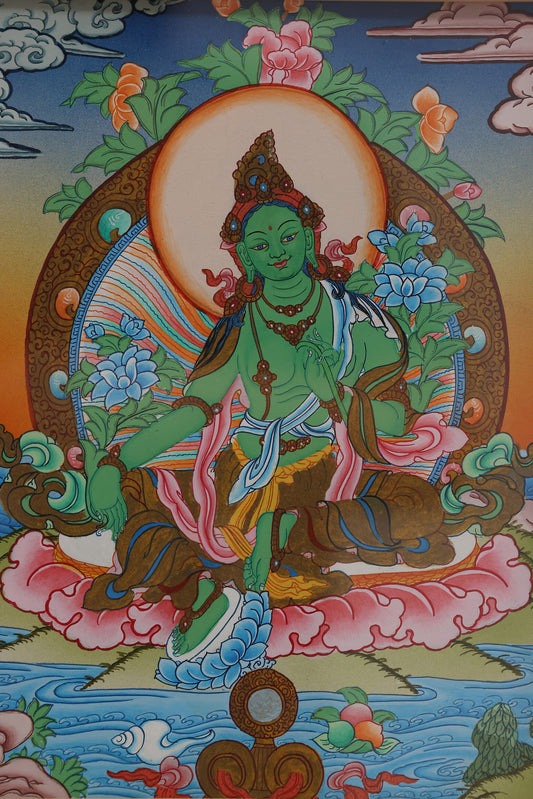
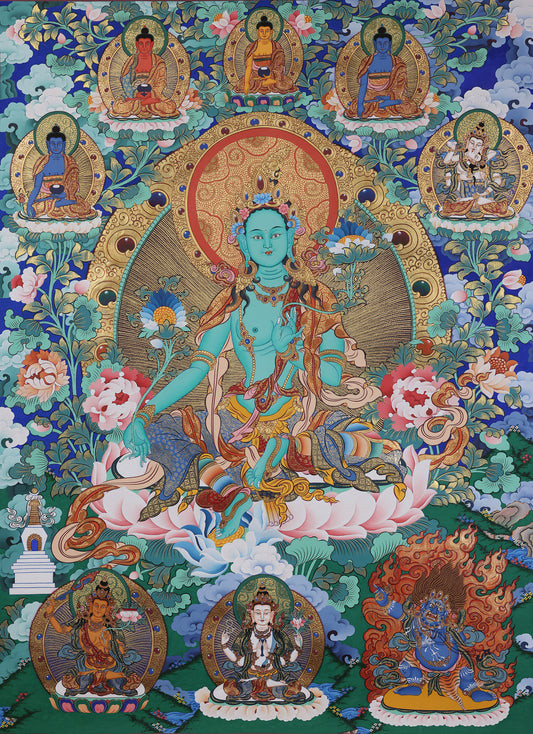
Alt text: Hand-painted Tibetan Thangka of Green Tara, showcasing intricate traditional artistry.
A Deep Dive into a Nepalese Hand-Painted Green Tara Thangka: Tibetan Buddhist Symbolism, Iconography, and Artisanal Craftsmanship
$499.00 USD
When a thangka of vivid emerald hues unfolds in the palm, its 20×30cm frame holds millennia of spiritual faith and artisanal heritage from the Himalayan cultural sphere. This is a hand-painted Green Tara thangka from Nepal: its central deity rendered in malachite-derived green, its background 晕染 with lapis lazuli, its crown and ornaments outlined in gold leaf—every stroke of color and line resonates with Tibetan Buddhist iconographic rules and Newari artisanal precision.

I. The Central Deity: Green Tara, the "Savioress from Eight Perils"

At the heart of this thangka is Green Tara, the most widely venerated female deity in Tibetan Buddhism.

According to Tibetan scriptures The Origin of Tara, Green Tara emerged from a teardrop shed from the left eye of Avalokiteshvara (the Bodhisattva of Compassion). When Avalokiteshvara wept at the suffering of sentient beings, his left tear fell to the earth, sprouting a lotus that bloomed into Green Tara. She vowed, "I shall liberate all beings in female form," cementing her role as a symbol of compassion in action. Revered as the "Savioress from Eight Perils," she is believed to free devotees from threats like lions, elephants, snakes, water, fire, imprisonment, thieves, and malevolent spirits. She also embodies the transformation of doubt (one of the "five poisons" of the mind) into wisdom.

Her iconography strictly adheres to the Iconometric Canon of Tibetan Buddhist Art:

  • Complexion and Form: Her emerald-green body (made from ground malachite pigment) symbolizes "vital, regenerative energy," aligning with the "Activity Family" of the Buddha Amoghasiddhi. She takes the form of a sixteen-year-old maiden, with the round cheeks and almond eyes characteristic of Nepal’s Newari school. Adorned with a Five-Buddha Crown, she embodies the "unified wisdom of the five directional Buddhas."
  • Mudras and Implements: Her right hand forms the Abhaya Mudra (gesture of fearlessness) resting on her right knee, signifying "responding to the wishes of sentient beings." Her left hand forms the Tri Ratna Mudra (gesture of the Three Jewels: Buddha, Dharma, Sangha) at her chest. Each hand holds a blue utpala lotus, its stem curling to her ear; the lotus bears fruit, a blooming flower, and an unopened bud—symbolizing the blessings of "past, present, and future Buddhas."
  • Posture and Lotus Throne: She sits in the Ardha Paryanka Asana (half-lotus, right leg extended to the ground), known as the "Savior’s Posture," representing readiness to rise and liberate beings. She rests on a double lotus moon disc: the lower, full petals signify worldly purity, while the upper moon disc represents the "pure dharmakaya realm"—a Tibetan iconographic marker of the divide between the mundane and the sacred.

II. Retinue Deities: Symbolic Protectors in Decoration

As a 20×30cm "personal thangka," this work does not depict retinue deities explicitly. Instead, it embeds their symbols in its decorations—a hallmark of small Nepalese thangkas, balancing size constraints with devotional functionality.

  • Background Flowers: Incarnations of Flower Offerings: The blue lotuses and pink peonies (a Nepalese variant of the "precious phase flower") surrounding the deity are not mere ornamentation; they symbolize flower-offering goddesses. In Tibetan ritual, offering flowers to a deity represents "devoting worldly beauty to the Dharma," and their interwoven branches evoke the "perfection of the dharmadhatu."
  • Bottom Ritual Implements: Protection of Vaishravana: The dharma wheel and white conch at the bottom are iconic symbols of Vaishravana (the Guardian King of Wealth). The wheel represents "the unceasing flow of the Dharma," while the conch symbolizes "the Buddha’s teaching voice." Nepalese Green Tara thangkas often integrate Vaishravana’s symbols to represent "dual blessings: liberation and abundance," aligning with devotees’ worldly aspirations.
  • Cloud Motifs: Guardianship of Dragon Spirits: The "auspicious cloud patterns" (a Newari style signature) are simplified symbols of the Naga (dragon spirits) from the Eight Classes of Protectors. In Tibetan belief, Nagas guard the Dharma, and the clouds’ flowing form signifies "protectors shielding practitioners from obstacles."

III. Craftsmanship: Newari Tradition’s Mineral-Pigment Precision

Half the value of this thangka lies in its spirituality; the other half in its craftsmanship—rooted in Nepal’s Newari school, which uses "natural materials and strict ritual" to create "eternal icons."

  • Canvas: The "Three-Varnish, Nine-Dye" Foundation: Made from fine Nepalese cotton, the canvas is coated with a mixture of cow bone glue and chalk, then sanded repeatedly (3–5 times) until smooth as paper. This "three-varnish, nine-dye" process ensures the thangka resists decay for centuries, reflecting the belief that "thangkas, as vessels of the Dharma, must endure."
  • Pigments: Gifts of Earth and Minerals: All pigments are natural, with each color carrying symbolic meaning and cost:
    • Green Tara’s complexion: Ground malachite (a copper-containing mineral) mixed with cow bile, layered 3–5 times to achieve a "vibrant yet subdued" hue.
    • Background blue: Ground lapis lazuli (sourced from Afghanistan), one of the most expensive thangka pigments, symbolizing "emptiness and wisdom."
    • Crown and ornaments: 24K gold leaf ground into powder and mixed with bone glue; the gold’s luster represents "the light of Buddha’s wisdom."

      These pigment-glue mixtures resist fading for hundreds of years, distinguishing traditional Nepalese thangkas from mass-produced prints.
  • Painting: Devotion Measured by the Canon: The work strictly follows the Iconometric Canon’s "twelve-finger measurement": the deity’s face spans three fingers, her body twelve fingers—no proportions are arbitrary. To Newari artisans, "precise iconography is reverence for the deity"; even minor deviations render the work "impure," requiring it to be destroyed and redone.

IV. Style: The Opulence and Refinement of the Newari School

This thangka exemplifies Nepal’s "Late Newari Style," distinct from the "open, substantial" aesthetic of Tibetan thangkas, embracing ornate refinement:

  • Composition: Centralized Density as Aesthetic: The deity occupies 90% of the frame, with decorations tightly surrounding her (no negative space)—a classic Newari composition symbolizing "no gaps in the dharmadhatu; the deity’s blessings are omnipresent."
  • Color: Saturated Spiritual Visuals: Bold contrasts between emerald (deity), deep blue (background), and vermilion (crown) are softened by gold outlines. The colors themselves carry meaning: green for vitality, blue for emptiness, red for compassion—merging aesthetics with doctrine.
  • Form: The Feminine Grace of Newari Art: The deity’s slender figure and clinging, curved drapery (unlike the heavy robes of Tibetan thangkas) and her round-cheeked, almond-eyed face embody feminine softness—reflecting Nepal’s cultural reverence for women as "nurturers of life."

Conclusion: Faith and Civilization in a Small Frame

This 20×30cm Green Tara thangka is more than art; it is a microcosm of Himalayan culture: it carries Tibetan Buddhism’s devotion to liberation, preserves the Newari artisans’ millennial craftsmanship, and distills the daily devotional practice of "personal visualization and constant protection."

As mineral pigments settle into the cotton and brushstrokes define the savioress’s compassion—this thangka transcends "objecthood" to become a visual expression of faith.

#NepaleseThangka #GreenTara #TibetanBuddhistArt #NewariSchool #MineralPigmentThangka
Descubre el thangka budista tibetano perfecto que se adapta a tus deseos, estilo de vida y espacio. Cada thangka tiene un significado espiritual y trae bendiciones cuando se coloca correctamente.

1. Define tu intención

Riqueza y éxito → Dzambhala amarillo (deidad de la riqueza)

Compasión y Paz → Avalokiteshvara, Tara Verde

Sabiduría y aprendizaje → Manjushri

Salud y sanación → Buda de la Medicina

Longevidad y protección familiar → Tara Blanca

2. Elija por identidad

Emprendedores y dueños de negocios → Deidades de la riqueza para la prosperidad.

Estudiantes y eruditos → Deidades de la sabiduría para el enfoque y la claridad.

Sanadores y practicantes de yoga → Buda de la Medicina para la energía y el equilibrio.

Familias y amas de hogar → Tara Deidades para la armonía y la seguridad.

Coleccionistas y amantes del arte → Mandalas raros o Thangkas obras maestras.

3. Combina tu espacio

Santuario casero / Sala de meditación → Thangkas medianos (60–80 cm).

Oficina / Sala de negocios → Grandes Thangkas para prosperidad y autoridad.

Sala de estar / Estudio → Thangkas decorativas para la paz y la belleza.

4. Auténtica artesanía

Pintado a mano con pigmentos minerales naturales y lienzo fino, cada Thangka refleja el arte tibetano y su poder espiritual. Fuentes verificadas garantizan la calidad y el respeto por la tradición.

✨Elige tu Thangka con corazón: no es solo arte, sino una bendición para tu vida.

Cada persona tiene necesidades diferentes, y elegir el thangka adecuado puede brindar apoyo espiritual, protección, buena fortuna y bendiciones. A continuación, se presentan recomendaciones de thangkas para diferentes roles:

1. Emprendedores

  • Necesidades : Sabiduría, riqueza, salud, éxito profesional.
  • Thangkas recomendadas :
    Manjushri : Mejora la toma de decisiones y la sabiduría empresarial.
    Deidad de la riqueza : trae riqueza y prosperidad.
    Buda de la Medicina : Apoya la salud y reduce el estrés.
    Mahakala : protege el negocio de la competencia y los desafíos.

2. Individuos exitosos

  • Necesidades : Paz interior, armonía familiar, longevidad.
  • Thangkas recomendadas :
    Buda Amitabha : trae paz interior y tranquilidad.
    Avalokiteshvara (Guanyin) : Promueve la armonía y la felicidad familiar.
    Amitayus (Buda de larga vida) : ruega por la buena salud y una larga vida.
    Manjushri : continúa mejorando la sabiduría.

3. Amas de casa/Maridos

  • Necesidades : Armonía familiar, protección, salud.
  • Thangkas recomendadas :
    Avalokiteshvara : Aumenta la felicidad y la armonía familiar.
    Deidades protectoras : protegen a la familia de las perturbaciones externas.
    Tara Blanca : Bendice a la familia con salud.

4. Estudiantes y académicos

  • Necesidades : Sabiduría, concentración, éxito académico.
  • Thangkas recomendadas :
    Manjushri : aumenta el aprendizaje, la memoria y la sabiduría.
    Buda Sakyamuni : ayuda con la concentración y la práctica espiritual.
    Jixiang Tianmu : trae buena suerte académica y éxito en los exámenes.

5. Artistas y profesionales creativos

  • Necesidades : Inspiración, creatividad, logro artístico.
  • Thangkas recomendadas :
    Manjushri : Estimula el pensamiento creativo y la inspiración.
    Vajrapani : Ayuda a superar los bloqueos creativos.
    Maitreya : Aporta una actitud relajada y optimista, aliviando el estrés.

6. Viajeros y aventureros

  • Necesidades : Protección, buena suerte, éxito en las aventuras.
  • Thangkas recomendadas :
    Hayagriva : Proporciona una fuerte protección durante los viajes y elimina obstáculos.
    Mahakala : trae buena fortuna y protección, especialmente para los aventureros.
    Vajrasattva : Ayuda a superar las dificultades y los desafíos durante el viaje.

7. Personas mayores

  • Necesidades : Salud, longevidad, paz espiritual.
  • Thangkas recomendadas :
    Amitayus : Reza por una larga vida y buena salud.
    Buda de la Medicina : Promueve la curación y el bienestar físico.
    Avalokiteshvara : trae compasión y paz interior en los años posteriores.

8. Ejecutivos corporativos

  • Necesidades : Liderazgo, sabiduría, trabajo en equipo y éxito empresarial.
  • Thangkas recomendadas :
    Manjushri : Mejora las habilidades de liderazgo y la toma de decisiones.
    Deidad de la riqueza : trae éxito y prosperidad al negocio y al equipo.
    Avalokiteshvara : Promueve la armonía y el equilibrio dentro del equipo.

9. Entusiastas de la salud y el fitness

  • Necesidades : Buena salud, vitalidad, energía.
  • Thangkas recomendadas :
    Buda de la Medicina : Mejora la salud física y la vitalidad.
    Tara Blanca : Trae salud y rejuvenecimiento.
    Vajrasattva : Limpia los problemas de salud y aumenta la energía.

10. Políticos

  • Necesidades : Liderazgo, sabiduría, paz.
  • Thangkas recomendadas :
    Manjushri : Mejora las habilidades de liderazgo y la toma de decisiones.
    Buda Vairocana : Ayuda a mantener la paz interior y la sabiduría.
    Avalokiteshvara : promueve la paz social y la armonía familiar.

Para todos los pedidos que superen un valor de 100 USD, el envío se ofrece gratis.

Se aceptarán devoluciones hasta 10 días después de la recepción o el número de seguimiento del cliente para artículos sin usar. Como cliente, debe informarnos por correo electrónico antes de devolver el artículo.

De lo contrario, se aplicarán los gastos de envío estándar. Consulta nuestros Términos y Condiciones de Envío para más detalles.

Se aceptarán devoluciones hasta 10 días después de la recepción o el número de seguimiento del cliente para artículos sin usar. Como cliente, está obligado a informarnos por correo electrónico antes de devolver el artículo, únicamente en caso de:

– Recibí el artículo equivocado.
– El artículo no llegó como se esperaba (es decir, embalaje dañado).
– El artículo tenía defectos.
– Exceso de tiempo de entrega.
– El remitente no permite que se inspeccionen las mercancías antes del pago.

El/los producto(s) devuelto(s) debe(n) estar en su embalaje original, envuelto(s) de forma segura, sin daños ni uso. Esto significa que debe(n) estar embalado(s) de forma segura en una caja de cartón para su protección durante el transporte, posiblemente la misma caja utilizada para el envío.

Vistos recientemente

¡No lo olvides! Los productos que viste. ¡Añádelos al carrito ahora!

Combina bien con

Mejora tu selección con accesorios perfectamente combinados y productos complementarios.

La gente también compró

Aquí tienes algunos de nuestros productos más similares que la gente compra. Haz clic para descubrir las tendencias.