Yellow Jambhala Thangka: Cultural Significance and Artistic Craftsmanship in Tibetan Buddhism

Tibetan Buddhist art, as an essential component of Eastern religious artistry, has evolved over centuries to develop a unique visual language combining religious symbolism, ritual iconography, and meticulous craftsmanship. Among various thangka themes, the Yellow Jambhala Thangka is particularly cherished for its embodiment of wealth wisdom and its role in protecting sentient beings. This article takes a hand-painted Yellow Jambhala thangka as a case study, analyzing its religious and cultural significance as well as its artistic craftsmanship, revealing the deep belief system and artistic appeal behind it.
I. The Religious and Cultural Significance of Yellow Jambhala
1. The Deity’s Identity and Symbolism
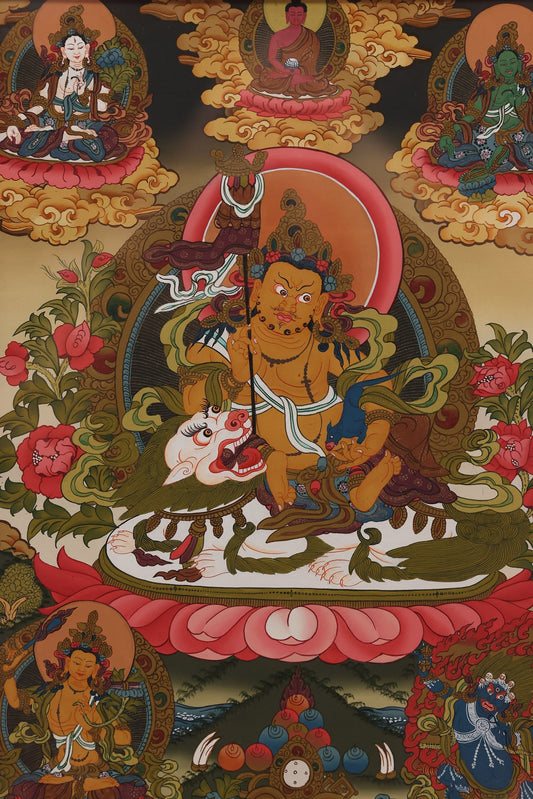
Yellow Jambhala (Tibetan: "Zambhala Serpo") is recognized as the chief among the Five Jambhala deities, governing material wealth and serving as a protector for practitioners to escape poverty and accumulate merit. Its iconography is highly symbolic, meticulously designed in accordance with religious prescriptions.
In the thangka, Yellow Jambhala is depicted with a large belly and rounded body, and orange-yellow skin, corresponding to the Tibetan Buddhist element of Earth, symbolizing stable and abundant wealth. The deity wears a Five-Buddha crown, representing the blessings and wisdom of the five directional Buddhas, signifying that wealth accumulation is inseparable from spiritual wisdom.
The deity’s facial expression is serene yet authoritative, reflecting the Buddhist ideal of compassion balanced with power, providing devotees with a sense of mental stability and spiritual guidance during meditation and offerings.
2. Ritual Implements and Posture
Yellow Jambhala’s attributes carry profound symbolic meanings:
-
Left Hand Holding a Treasure Mouse: The mouse, containing jewels in its mouth, symbolizes the continuous flow of wealth. It also reflects the Buddhist principle of generosity over hoarding, emphasizing that wealth should be used for the benefit of others.
-
Right Hand Holding a Mani Jewel: Represents the fulfillment of sentient beings’ legitimate wishes, implying that wealth, when guided by wisdom and compassion, serves meaningful purposes.
-
Seated in the Wish-Fulfilling Posture: The left leg folded and the right foot resting on a conch symbolizes attaining wealth through wisdom, illustrating that prosperity depends not only on external opportunities but also on skillful management and karmic alignment.
These symbols convey that Yellow Jambhala is not merely a deity of material gain; rather, the acquisition of wealth is a part of spiritual practice. Tibetan Buddhism emphasizes that material resources are tools for cultivating the mind and supporting virtuous deeds, reflecting a harmonious balance between material and spiritual life.
3. Cultural Significance
The veneration of Yellow Jambhala serves multiple cultural and social functions:
-
Spiritual Protection: Through visualization and offerings, devotees cultivate mental stability and a positive attitude.
-
Wealth Education: Encourages ethical accumulation of resources and the practice of generosity, discouraging greed and attachment.
-
Religious Practice: Rituals, prayers, and meditation on Yellow Jambhala assist practitioners in harmonizing worldly and spiritual life.
Thus, the Yellow Jambhala thangka is not only an artwork but also a vessel for conveying Tibetan Buddhist values, merging religious philosophy with visual and cultural expression.
II. Artistic Craftsmanship of Yellow Jambhala Thangka
The creation of a Yellow Jambhala thangka embodies the intersection of religious rigor and aesthetic sophistication. Its production involves multiple traditional techniques, from canvas preparation to painting and gilding.
1. Canvas Preparation and Grounding
This thangka is a hand-painted color thangka, using fine white cotton cloth as the base. Key steps include:
-
Ground Layer: A mixture of animal glue and white clay is applied evenly.
-
Polishing: The surface is meticulously polished with smooth stones until opaque and flat, preventing paint seepage and cracking.
-
Standardization: This preparation ensures the thangka’s longevity and pigment adhesion, allowing it to last centuries without fading.
This process reflects the Tibetan Buddhist emphasis on durability and sanctity, ensuring the artwork functions both as a religious tool and a long-lasting artifact.
2. Iconography Drafting and Proportions
The depiction of Yellow Jambhala strictly follows the “Sutra on Proportions of Sacred Images”:
-
Head, chest, and waist ratios are precisely measured to align with ritual standards.
-
Facial “opening” (detailing eyes, eyebrows, and expression) is completed by experienced artists.
-
Drafting and Inking: Initial sketches are drawn with charcoal, then finalized with ink lines to ensure the iconography adheres to religious protocols while remaining aesthetically pleasing.
This meticulous process emphasizes the concept that painting is a form of spiritual practice, where the artist simultaneously purifies the mind and invokes ritual energy.
3. Pigments and Coloring Techniques
Natural mineral and plant-based pigments are used:
-
Skin Tone: Orange-yellow, typically a blend of orpiment and ochre.
-
Background and Attire: Blue skies (azurite), golden clothing (pure gold powder), creating vivid colors and rich textures.
-
Layering: The background is painted first (light to deep gradation), followed by the lotus base and clothing, and finally the deity’s skin. Multiple layers highlight muscle contours and three-dimensionality.
This “background-first, subject-second” approach not only follows tradition but also enhances the visual impact, making the deity appear vibrant and lifelike.
4. Outlining and Gilding
-
Outlining: Fine brushes (typically made from weasel hair) are used to trace contours and clothing details. The “money-line” technique ensures fluid and elegant lines, while decorative background patterns vary line styles to add richness.
-
Gilding: The deity’s crown, jewelry, and clothing are gilded with 24K gold powder mixed with animal glue. Some areas are burnished with agate tools to intensify the brilliance, creating a luxurious visual effect.
These techniques showcase the mastery of Tibetan hand-painted thangka art, highlighting the “Gongbi heavy-color” style—characterized by vivid hues, precise outlines, and meticulous gold detailing—typical of the Hoton and Menba painting schools.
5. Stylistic Characteristics and School Attribution
Based on color, gilding, and iconographic precision, this Yellow Jambhala thangka exhibits the hallmarks of exquisite Gongbi heavy-color style:
-
Vivid Colors: Mineral pigments and natural gold powders produce strong visual impact.
-
Detailed Gilding: Jewelry, crown, and garment patterns are rendered intricately.
-
Proportionally Accurate Iconography: Faces, gestures, and postures are meticulously aligned with ritual standards.
These features suggest the thangka likely belongs to the Hoton or Menba painting schools, renowned for intricate craftsmanship and rich coloration, representing the pinnacle of hand-painted Tibetan thangka artistry.
III. Cultural and Collectible Value
1. Religious Value
The Yellow Jambhala thangka serves as more than an artwork:
-
Meditative and Ritual Use: Devotees gain merit and prosperity through offerings and visualization.
-
Practical Guidance: Reminds practitioners that wealth should be pursued wisely and ethically.
-
Ritual Integration: Used in ceremonies and daily practice to accumulate spiritual and material resources.
2. Artistic and Collectible Value
-
Handcrafted: Each thangka is a unique expression of the artist’s skill and spiritual engagement.
-
Premium Materials: Mineral pigments and pure gold ensure longevity and visual brilliance.
-
School Characteristics: Represents Hoton/Menba painting traditions, valuable for research and collection.
3. Educational and Cultural Significance
The thangka integrates religious philosophy, wealth ethics, and artistic expression, making it suitable for:
-
Tibetan Buddhist cultural education
-
Museum exhibitions and art collections
-
International cultural exchange and academic research
It illustrates not only the spiritual depth of Tibetan Buddhism but also the distinctive aesthetic of Eastern art traditions.
IV. Conclusion
The Yellow Jambhala thangka embodies both religious functionality and artistic excellence. Through the deity’s symbolic attributes, ritual implements, and posture, along with meticulous hand-painted techniques, viewers can appreciate not only its aesthetic beauty but also its underlying spiritual philosophy: wealth as a tool for practice, prosperity aligned with wisdom and compassion.
Whether serving as an object of devotion, a meditative aid, or a collectible, the Yellow Jambhala thangka exemplifies the unique value of Tibetan Buddhist art, harmonizing material and spiritual dimensions and preserving centuries-old cultural heritage.
#YellowJambhalaThangka #TibetanBuddhistArt #HandPaintedThangka #WealthDeityThangka #BuddhistArt #TibetanThangka #Dzambhala #TibetanCulture #BuddhistIconography #TraditionalThangka #ThangkaArtCollection #HotonPaintingSchool #MenbaPaintingSchool #TibetanBuddhism #SpiritualArt
Etiquetas:
Anterior
Hand-Painted Tibetan Buddhist Yellow Jambhala Thangka Decoding the Sacred Art of Wealth and Spiritual Protection
Próximo
Tibetan Buddhist Hand-Painted Yellow Jambhala Thangka: Decoding the Art of Wealth and Wisdom Blessings