Tibetan Thousand-Armed, Thousand-Eyed Avalokiteshvara Thangka: A Visual Epic of Compassion — Theme, Deities, and Craftsmanship Decoded

In the rich visual system of Tibetan Buddhism, Thangka is not merely an artwork but a three-dimensional religious text. The Eleven-Faced, Thousand-Armed, Thousand-Eyed Avalokiteshvara Thangka exemplifies this integration of compassion, wisdom, doctrine, and craftsmanship, serving as both a spiritual guide and a cultural artifact for practitioners and devotees. This article delves into the Thangka’s theme, main deity symbolism, attendant deities, and painting craftsmanship, revealing the unique charm of Tibetan Buddhist culture.
I. Core Theme: The Faith Loop of “Universal Compassion”
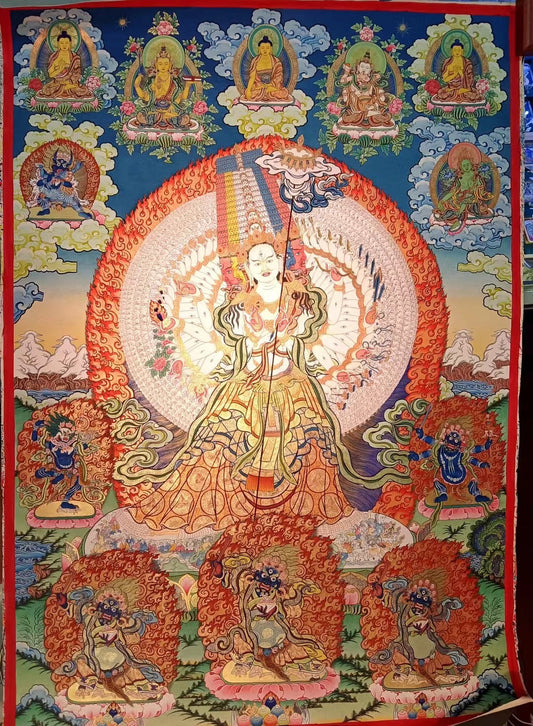
The Eleven-Faced, Thousand-Armed, Thousand-Eyed Avalokiteshvara (Tibetan: Kyenres) embodies the ultimate manifestation of Avalokiteshvara’s compassion. In Tibetan Buddhism, Avalokiteshvara is revered as the “Protector of the Snowy Land.” The Thousand-Armed, Thousand-Eyed form symbolizes the extreme fulfillment of the Bodhisattva’s vow: when Avalokiteshvara witnesses the endless suffering of sentient beings, the body shatters into a thousand petals, and Amitabha Buddha reshapes it into the Eleven-Faced, Thousand-Armed, Thousand-Eyed form. This form represents “countless hands to support beings, countless eyes to observe suffering,” forming a complete faith cycle of compassion — vow — salvation.
This Thangka does more than depict the deity; it constructs a spiritual connection: individual suffering — Avalokiteshvara’s salvation — worldly fulfillment. The deity’s thousand hands and eyes correspond to infinite human afflictions, the attendant deities represent diverse salvific methods, and the painting itself is a practice of “art as dharma”, offering a medium for meditation, prayer, and spiritual devotion.
II. Main Deity: Symbolism and Doctrinal Allegory
1. Eleven Faces: Hierarchical Manifestation of Compassion and Wisdom
The central deity follows the strict guidelines of the Canonical Measurement Sutra of Iconography and the Secret Tantra of Avalokiteshvara. Eleven stacked faces on the crown represent the compassionate manifestation of the Five Wisdom Buddhas:
-
Lower three faces (white, green, red): Calm and compassionate expressions representing purification of karma, nurturing sentient beings, and subduing afflictions;
-
Middle three faces (green, red, white): Reflecting the lower layer, symbolizing universal compassion for beings in the three lower realms;
-
Upper one face: Wrathful Rakshasa face, breaking arrogance and ego;
-
Top face: Amitabha Buddha, showing Avalokiteshvara as a manifestation of Buddha’s compassion and ultimate wisdom.
This arrangement illustrates the salvific logic of from compassion to wrath, from mundane to sacred, embodying Vajrayana teachings of responding skillfully to beings with different manifestations.
2. Thousand Hands and Eyes: The Dual Extremity of Compassion and Wisdom
The deity’s radiant halo simplifies the thousand hands (commonly represented by 42 hands) with each palm containing a wisdom eye, symbolizing Avalokiteshvara’s vow:
-
Thousand hands: Represent countless skillful means; hands hold lotus (purity), vase (blessing), dharma wheel (turning the law), bow and arrow (subduing afflictions), fulfilling varied aspirations of beings;
-
Thousand eyes: Represent omniscient wisdom, perceiving hidden sufferings and afflictions, demonstrating the union of compassion and wisdom.
This hand-eye integration elevates compassion from mere emotion to active salvation guided by wisdom.
3. Body and Lotus Throne: Symbolism of Purity and Salvation
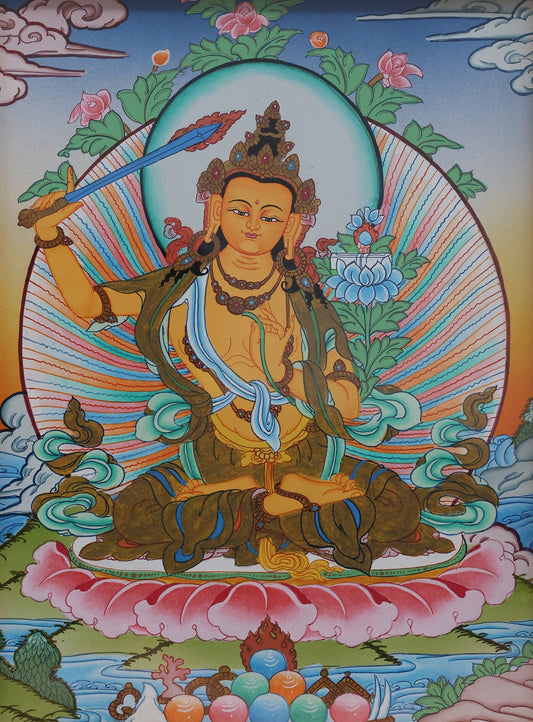
The deity’s sky-blue body symbolizes boundless compassion like space; adorned with celestial robes and jewelry, it embodies Bodhisattva dignity and the diversity of salvific methods. The double-layered blue lotus throne signifies dual meanings: the lower petals as worldly suffering, the upper petals as Avalokiteshvara’s pure salvation, embodying the teaching of universal deliverance.
III. Attendant Deities: Layered Salvation System
Attendant deities are not decorative; they represent the Tibetan Buddhist microcosm of “Three Roots — Dakinis — Protectors”, reflecting a hierarchy of salvation:
-
Supporting deities: Manjushri (wisdom) and Vajrapani (power) flank the main deity, forming a triad of compassion, wisdom, and strength;
-
Dakinis: Green Tara (swift rescuer of suffering) and White Tara (protector of longevity and health) embody Avalokiteshvara’s universal compassion in tangible, specific forms.
The background elements — deep blue sky, auspicious clouds, flowering vines — are not purely decorative. They symbolize the space of the three realms, worldly completeness, and the eternal presence of Avalokiteshvara’s compassion. The inclusion of Han-style meticulous painting techniques reflects cultural exchanges between Tibetan and Chinese art.
IV. Painting Craftsmanship: Practice of “Art as Compassion”
1. Base Preparation
Artists use pure cotton cloth, coated with layers of hide glue and chalk, polished to a mirror-like surface. This process is not just physical but a ritual purification, transforming mundane material into a sacred medium for compassionate manifestations.
2. Pigment System
Natural minerals and plant-based pigments are used:
-
Sky-blue body color: Derived from lapis lazuli, symbolizing everlasting compassion;
-
Gold lines: 24K gold powder mixed with saffron and glue, representing imperishable vow;
-
Red, green, white for faces: Derived from ochre, malachite, and chalk, corresponding to the Five Buddha Families and doctrinal symbolism.
Colors serve as doctrinal expression, integrating faith and artistry.
3. Painting Process
Artists follow strict ritual: purification bath, observance of vows, chanting mantras, precise charcoal sketching, and iron-line drawing. Layers are gradually colored, with final “opening of the eyes” using fine brush to awaken the deity in the painting, establishing a spiritual connection with the viewer.
4. Artistic Style
The Thangka belongs to the Rebkong (Rèbkong) School, known for vivid colors, intricate gold lines, radiating thousand-hand layout, and eleven-face hierarchy. The green-and-blue landscapes incorporate Chinese Gongbi techniques, lending warmth and approachability while maintaining intricate Tibetan composition, reflecting art as a medium for compassionate resonance.
V. Cultural Significance and Spiritual Value
The Eleven-Faced, Thousand-Armed, Thousand-Eyed Avalokiteshvara Thangka is not only a religious text but also a confluence of faith, art, and life:
-
For practitioners: Visualization cultivates compassion, enhances wisdom, and purifies afflictions.
-
For Tibetan devotees: Symbolizes protection and spiritual refuge, serving as a tool for prayer and daily devotion.
-
For cultural researchers: Microcosm of Tibetan cosmology, aesthetics, and ethics.
-
For art enthusiasts: Every pigment and gold line embodies centuries of time, skill, and devotion.
This Thangka is a living vessel of compassion, transforming abstract doctrinal teachings into tangible life experiences, offering viewers a timeless source of spiritual warmth.
#TibetanBuddhism #AvalokiteshvaraThangka #ThousandArmedThangka #BuddhistArt #HandPaintedThangka #TibetanArt #SpiritualArt #MeditationArt #CompassionArt #BodhisattvaThangka #ElevenFacedAvalokiteshvara #ReligiousArt #SacredArt #HomeShrineDecor #MindfulnessArt
Etiquetas: