Tibetan Hand-Painted Yellow Jambhala Thangka: Wealth Wisdom in Millennium-Old Craft, a Faith Totem of Handmade Mineral Pigments

$399.00 USD
Thangka Name: Yellow Jambhala Thangka
Size : 20cm x 30cm
Origin: Nepal
Eine Frage stellen

Beeil dich! Nur noch [Anzahl] auf Lager!

Geschätzte Lieferzeiten: 12–26 Tage (International), 3–6 Tage (USA).

Rückgabe innerhalb von 45 Tagen nach dem Kauf. Zölle und Steuern werden nicht erstattet.

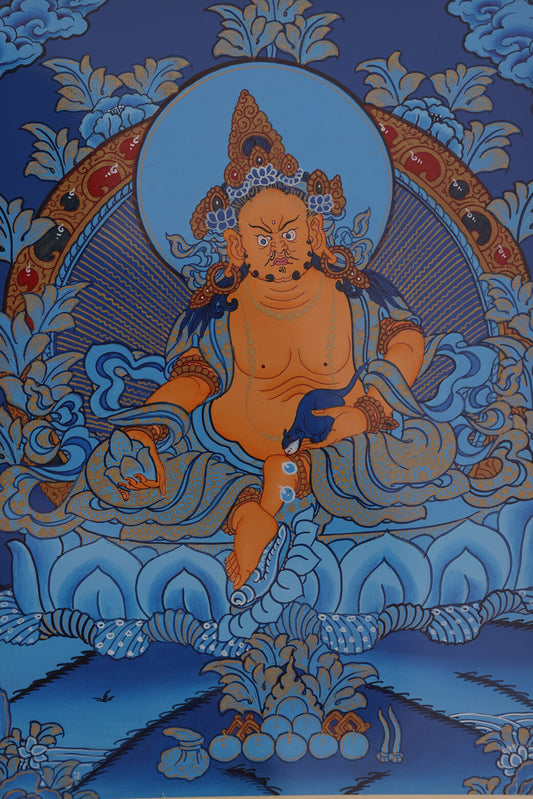
Tibetan Buddhist Yellow Jambhala thangka depicting the supreme wealth deity seated in royal posture, symbolizing prosperity and abundance
Tibetan Hand-Painted Yellow Jambhala Thangka: Wealth Wisdom in Millennium-Old Craft, a Faith Totem of Handmade Mineral Pigments
$399.00 USD
When the luster of 24K gold powder blooms on the lapis lazuli background, and when the third curve of the treasure-spitting rat’s jewel pattern is outlined by a cat-spine brush, this hand-painted Yellow Jambhala Thangka is no longer just a piece of canvas—it is the millennial heritage in the fingertips of Tibetan painters, the wealth philosophy in the faith of the Five Dhyani Buddhas of Wealth, and a cultural collection that can develop a patina over time.

I. The Soul of the Thangka: Yellow Jambhala, More Than a "Wealth-Attracting" Faith Totem

In Tibetan herders’ tents and monastery halls, the image of Yellow Jambhala has never been absent. As the "head of the Five Dhyani Buddhas of Wealth" in Tibetan Buddhism, every detail of his image holds wisdom beyond materiality:
1. Religious Codes in the IconographyThe main deity in this thangka is a "standard Yellow Jambhala form" strictly painted in accordance with the Iconometric Sutra:
  • His orange-yellow skin corresponds to the "earth" element in the Five Elements, symbolizing wealth as stable and enduring as the earth;
  • The Five-Buddha Crown on his head represents the wisdom blessings of the Five Dhyani Buddhas—meaning Yellow Jambhala’s "wealth-attracting" is never about greed, but "mastering wealth with wisdom";
  • The treasure-spitting rat (called Nure in Tibetan) held in his left arm, with jewels in its mouth, symbolizes "wealth as a favorable condition for practice": every sum of wealth you gain is a "tool" for benefiting sentient beings, not a shackle.
2. Practice Metaphors in PostureHe rests in the "auspicious posture" on a lotus throne: the left foot is curled and drawn to the abdomen (representing restraining greed), and the right foot steps on a conch (implying understanding the laws of wealth with wisdom). The Cintāmaṇi (called Laze in Tibetan) held in his right hand means "fulfilling all good wishes"—when you seek wealth with a bodhicitta mind, wealth naturally becomes a support for practice.

II. Millennium-Old Craft: The "Time Cost" in Hand-Painting

This is not an industrial product made by machine printing, but the painstaking work of a Regong painter over 45 days. "Handmade" in Tibetan thangkas is never a marketing slogan, but reverence engraved in every process:
1. Canvas: A Base Polished by TimeThe painter uses high-density white cotton cloth from Tibetan areas in Qinghai, repeatedly applying 3 layers of yak bone glue mixed with white clay, then polishing it with pebbles until it is "smooth as porcelain, opaque to light"—this process, called "preparing the base," is key to the thangka’s ability to resist fading and cracking for centuries. An old painter says: "If the canvas isn’t polished smooth, the pigments will fall like sand—this would be a disservice to the Wealth Buddha and the person who acquires the thangka."
2. Pigments: Colors From Mineral Veins and PlantsEvery color you see is a gift from the earth:
  • The main deity’s orange-yellow hue is made of natural mineral powder of ochre and yellow ochre, ground by hand in a mortar for 72 hours until it is as fine as dust;
  • The deep blue background uses lapis lazuli from eastern Tibetan copper mines, layered with "first-grade blue" and "second-grade blue" to create a sky-like gradient of "light near, dark far";
  • The gold in the crown and clothing patterns is 24K gold powder ground from gold leaf, mixed with bone glue and polished repeatedly with an agate knife—this "gold tracing" process allows a painter to complete only 3 square centimeters a day, yet it makes the thangka glow softly even in a dark room.
3. Linework: The "Millimeter Precision" of a Cat-Spine Brush TipThe brush used by the painter is a unique Tibetan "cat-spine brush"—made from soft hair beside a cat’s spine, with a tip as fine as a hair. When painting the treasure-spitting rat’s whiskers, the painter must hold their breath and draw a single unbroken line; a break means discarding the draft. The "coin-line strokes" for clothing folds follow the contours of the body’s muscle texture, with every curve corresponding to the "seven-part body" proportions in the Iconometric Sutra.
An old painter says: "You chant sutras before painting a thangka. When drawing the first line, your mind must be like a lake in the snow-capped mountains—calmness brings precision."

III. Why a "Hand-Painted Thangka"? It’s a Collection, and a "Living Heritage"

In an era flooded with machine-printed products, the value of this Yellow Jambhala Thangka lies in its "unreplicability":
1. The "Patina" Quality of TimeNatural mineral pigments settle over time: lapis lazuli becomes deeper blue, and gold powder takes on a warm luster, like the patina of old amber—after ten years, it is not "worn out," but "alive"; every color change is a symbiosis of time and faith.
2. The "Tangibility" of CultureWhen your fingertips touch the canvas, you can feel the fine grain of the polished base; when you look closely, you can see the "brush strokes" in the gold tracing—this is not the "perfection" of industrial products, but the warmth of a human hand: a Tibetan painter, with his hands, his chanting, and his reverence for faith, has "painted" culture into a tangible carrier.
3. The "Energy Field" in SpaceTibetans say "a thangka is where the Buddha ‘dwells’"—when this Yellow Jambhala Thangka hangs in a study or tea room, it is not a decorative painting, but a "field": it reminds you that "wealth is the manifestation of good wishes" and that "you should hold what you gain with a giving heart"—this is a spiritual resonance that machine-made paintings can never provide.

IV. How to Acquire and Care for It: Let the Thangka Accompany You Through the Years

Acquiring a hand-painted thangka is a "karmic connection" with a culture; caring for it is also nurturing this connection:
  • Hanging: Avoid direct sunlight (mineral pigments are sensitive to strong light); hang it in a clean, elevated position above eye level;
  • Cleaning: Use a soft brush to gently sweep away dust—never get it wet (the bone glue base will peel when exposed to water);
  • Offering: There’s no need for deliberate incense-burning; keeping a pure heart is the best offering to Yellow Jambhala.
As modern life speeds up, we need such an object that "slows down": it is 45 days of hand-painting time, a millennium of craft heritage, and the Tibetan Buddhist philosophy of "wealth and wisdom coexisting." This Yellow Jambhala Thangka is more than a collection—it is your link to Tibetan culture, a "faith totem" that can accumulate warmth over the years.
#YellowJambhalaThangka #HandPaintedThangka #TibetanBuddhistArt #MineralPigmentThangka #RegongThangkaCraft #ThangkaCollection #WealthWisdomThangka #TraditionalHandmadeCraft #TibetanCulturalCollection #24KGoldThangka

Entdecken Sie das perfekte tibetisch-buddhistische Thangka, das zu Ihren Wünschen, Ihrem Lebensstil und Ihrem Raum passt. Jedes Thangka hat eine spirituelle Bedeutung und bringt Segen, wenn es richtig platziert wird.

1. Definieren Sie Ihre Absicht

Reichtum & Erfolg → Gelber Dzambhala (Gottheit des Reichtums)

Mitgefühl und Frieden → Avalokiteshvara, Grüne Tara

Weisheit & Lernen → Manjushri

Gesundheit & Heilung → Medizinbuddha

Langlebigkeit und Familienschutz → Weiße Tara

2. Wählen Sie nach Identität

Unternehmer und Geschäftsinhaber → Reichtumsgottheiten für Wohlstand.

Studenten und Gelehrte → Weisheitsgottheiten für Konzentration und Klarheit.

Heiler und Yoga-Praktizierende → Medizinbuddha für Energie und Gleichgewicht.

Familien und Hausfrauen → Tara-Gottheiten für Harmonie und Sicherheit.

Sammler und Kunstliebhaber → Seltene Mandalas oder Meisterwerk-Thangkas.

3. Passen Sie Ihren Raum an

Heimschrein / Meditationsraum → Mittlere Thangkas (60–80 cm).

Büro / Geschäftshalle → Große Thangkas für Wohlstand und Autorität.

Wohnzimmer / Arbeitszimmer → Dekorative Thangkas für Frieden und Schönheit.

4. Authentische Handwerkskunst

Jedes Thangka ist mit natürlichen Mineralpigmenten und feiner Leinwand handbemalt und spiegelt tibetische Kunstfertigkeit und spirituelle Kraft wider. Überprüfte Quellen gewährleisten Qualität und Respekt für die Tradition.

✨ Wählen Sie Ihr Thangka mit Herz – es ist nicht nur Kunst, sondern ein Segen für Ihr Leben.

Jeder Mensch hat unterschiedliche Bedürfnisse. Die Wahl des richtigen Thangkas kann spirituelle Unterstützung, Schutz, Glück und Segen bieten. Nachfolgend finden Sie Thangka-Empfehlungen für verschiedene Rollen:

1. Unternehmer

  • Bedürfnisse : Weisheit, Reichtum, Gesundheit, beruflicher Erfolg.
  • Empfohlene Thangkas :
    Manjushri : Verbessert die Entscheidungsfindung und Geschäftsweisheit.
    Gottheit des Reichtums : Bringt Reichtum und Wohlstand.
    Medizinbuddha : Unterstützt die Gesundheit und reduziert Stress.
    Mahakala : Schützt Unternehmen vor Konkurrenz und Herausforderungen.

2. Erfolgreiche Einzelpersonen

  • Bedürfnisse : Innerer Frieden, Familienharmonie, Langlebigkeit.
  • Empfohlene Thangkas :
    Amitabha Buddha : Bringt inneren Frieden und Ruhe.
    Avalokiteshvara (Guanyin) : Fördert Harmonie und Glück in der Familie.
    Amitayus (Langlebens-Buddha) : Betet für gute Gesundheit und ein langes Leben.
    Manjushri : Stärkt weiterhin die Weisheit.

3. Hausfrauen/Ehemänner

  • Bedürfnisse : Familienharmonie, Schutz, Gesundheit.
  • Empfohlene Thangkas :
    Avalokiteshvara : Steigert das Familienglück und die Harmonie.
    Schutzgottheiten : Beschützen die Familie vor äußeren Störungen.
    Weiße Tara : Segnet die Familie mit Gesundheit.

4. Studierende und Wissenschaftler

  • Bedürfnisse : Weisheit, Konzentration, akademischer Erfolg.
  • Empfohlene Thangkas :
    Manjushri : Fördert Lernfähigkeit, Gedächtnis und Weisheit.
    Shakyamuni Buddha : Hilft bei der Konzentration und spirituellen Praxis.
    Jixiang Tianmu : Bringt akademisches Glück und Prüfungserfolg.

5. Künstler und Kreativprofis

  • Bedürfnisse : Inspiration, Kreativität, künstlerische Leistung.
  • Empfohlene Thangkas :
    Manjushri : Regt kreatives Denken und Inspiration an.
    Vajrapani : Hilft, kreative Blockaden zu überwinden.
    Maitreya : Sorgt für eine entspannte und optimistische Einstellung und baut Stress ab.

6. Reisende und Abenteurer

  • Bedürfnisse : Schutz, Glück, Erfolg bei Abenteuern.
  • Empfohlene Thangkas :
    Hayagriva : Bietet starken Schutz auf Reisen und beseitigt Hindernisse.
    Mahakala : Bringt Glück und Schutz, insbesondere für Abenteurer.
    Vajrasattva : Hilft, Schwierigkeiten und Herausforderungen während der Reise zu überwinden.

7. Ältere Menschen

  • Bedürfnisse : Gesundheit, Langlebigkeit, spiritueller Frieden.
  • Empfohlene Thangkas :
    Amitayus : Betet für ein langes Leben und gute Gesundheit.
    Medizinbuddha : Fördert Heilung und körperliches Wohlbefinden.
    Avalokiteshvara : Bringt Mitgefühl und inneren Frieden in späteren Jahren.

8. Führungskräfte

  • Bedürfnisse : Führung, Weisheit, Teamarbeit und geschäftlicher Erfolg.
  • Empfohlene Thangkas :
    Manjushri : Verbessert Führungsqualitäten und Entscheidungsfindung.
    Gottheit des Reichtums : Bringt dem Unternehmen und dem Team Erfolg und Wohlstand.
    Avalokiteshvara : Fördert Harmonie und Gleichgewicht innerhalb des Teams.

9. Gesundheits- und Fitnessbegeisterte

  • Bedürfnisse : Gute Gesundheit, Vitalität, Energie.
  • Empfohlene Thangkas :
    Medizinbuddha : Verbessert die körperliche Gesundheit und Vitalität.
    Weiße Tara : Bringt Gesundheit und Verjüngung.
    Vajrasattva : Beseitigt gesundheitliche Probleme und steigert die Energie.

10. Politiker

  • Bedürfnisse : Führung, Weisheit, Frieden.
  • Empfohlene Thangkas :
    Manjushri : Verbessert Führungsqualitäten und Entscheidungsfindung.
    Vairocana Buddha : Hilft, inneren Frieden und Weisheit zu bewahren.
    Avalokiteshvara : Fördert den gesellschaftlichen Frieden und die Harmonie in der Familie.

Für alle Bestellungen über 100 USD ist der Versand kostenlos.

Rücksendungen werden bis zu 10 Tage nach Erhalt des Kaufbelegs bzw. der Sendungsnummer (bei ungetragenen Artikeln) akzeptiert. Sie als Kunde sind verpflichtet, uns vor der Rücksendung des Artikels per E-Mail zu informieren.

Andernfalls fallen die Standardversandkosten an. Weitere Informationen finden Sie in unseren Lieferbedingungen .

Rücksendungen werden bis zu 10 Tage nach Erhalt des Kaufbelegs oder der Sendungsnummer (bei ungetragenen Artikeln) akzeptiert. Sie als Kunde sind verpflichtet, uns vor der Rücksendung des Artikels per E-Mail zu informieren, nur in folgenden Fällen:

– Den falschen Artikel erhalten.
– Artikel kam nicht wie erwartet an (z. B. beschädigte Verpackung).
– Artikel hatte Mängel.
– Über die Lieferzeit hinaus.
– Der Spediteur gestattet keine Besichtigung der Ware vor der Bezahlung.

Die zurückgesendeten Produkte müssen in der Originalverpackung, sicher verpackt, unbeschädigt und ungetragen sein. Dies bedeutet, dass die Artikel zum Schutz während des Transports sicher in einem Karton verpackt sein müssen, möglichst im selben Karton, in dem sie an Sie als Kunde versendet wurden.

Kürzlich angesehen

Nicht vergessen! Die Produkte, die Sie angesehen haben, legen Sie jetzt in den Warenkorb.

Passt gut zu

Erweitern Sie Ihre Auswahl mit perfekt abgestimmtem Zubehör und ergänzenden Produkten.

Leute kauften auch

Hier sind einige unserer ähnlichsten Produkte, die die Leute kaufen. Klicken Sie hier, um den Trendstil zu entdecken.