Nepali Blue Thangka of Vaishravana (Wealth King): Decoding the Art & Spiritual Symbolism of Tibetan Buddhism

$499.00 USD
Thangka Name: Blue Tang Treasure King
size: 20cm×30cm
origin: Nepal
Eine Frage stellen

Beeil dich! Nur noch [Anzahl] auf Lager!

Geschätzte Lieferzeiten: 12–26 Tage (International), 3–6 Tage (USA).

Rückgabe innerhalb von 45 Tagen nach dem Kauf. Zölle und Steuern werden nicht erstattet.

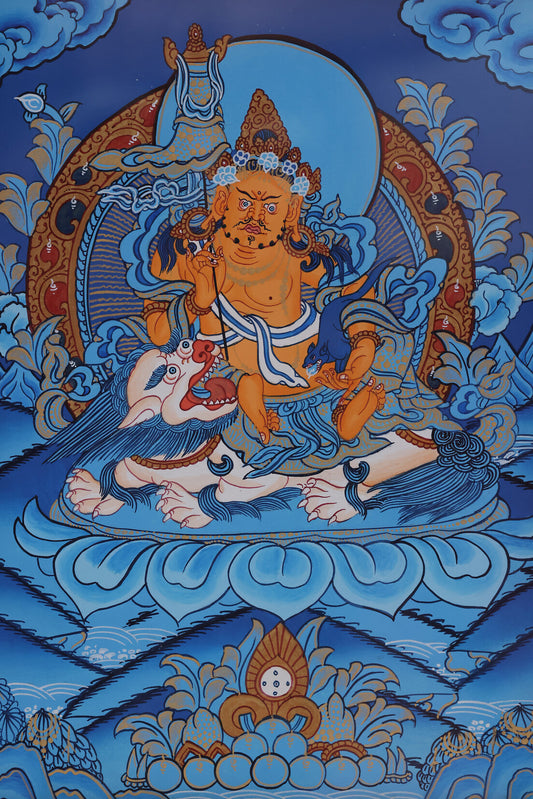
Alt text: Hand-painted Tibetan Buddhist Blue Thangka of Treasure King, a protector deity symbolizing wealth and spiritual guardianship.
Nepali Blue Thangka of Vaishravana (Wealth King): Decoding the Art & Spiritual Symbolism of Tibetan Buddhism
$499.00 USD
When a 20×30cm Nepali Blue Thangka unfurls on your desk, its deep lapis lazuli blue blending with the glow of gold powder, you’re not just looking at a painting—you’re encountering the Tibetan Buddhist philosophy of “Dharma and Wealth in Harmony,” the millennium-old craft heritage of Nepal’s Newari painting school, and the cultural weight of the Himalayas condensed into a small canvas.

This hand-painted thangka, centered on Vaishravana (the Wealth King) and rendered in mineral and earth pigments, builds a complete “universe of wealth protection” within its compact frame.

I. Theme: Dharma and Wealth in Harmony—Not Desire, but Spiritual Provision

In Tibetan Buddhism, Vaishravana is never a mere “god of wealth” in the secular sense.

The core theme of this thangka is Dharma and Wealth in Harmony: wealth serves as “spiritual provision” to support practice and benefit sentient beings, not a tool for self-indulgence. The Blue Thangka’s base color (lapis lazuli, symbolizing “emptiness” in Tibetan Buddhism) balances Vaishravana’s “wealth attribute”: blue represents “non-attachment to material things,” while the main deity’s yellow form (linked to the merit light of Ratnasambhava Buddha) stands for “wise use of material things.”

When devotees venerate this thangka, they pray for “worldly abundance to uphold the Dharma, and pure Dharma to guide the use of wealth”—a concrete expression of Tibetan Buddhism’s “Middle Way” in daily life.

II. The Main Deity: Every Stroke of Vaishravana is Devotion

As the northern protector among Tibetan Buddhism’s “Four Heavenly Kings,” Vaishravana’s iconography in this thangka strictly adheres to the Iconometric Canon and Newari painting traditions:

  • Form: Compassion in a Wrathful Yellow Body

    The deity’s bright yellow form symbolizes the “merit of Ratnasambhava Buddha”; his furrowed brows and wide, piercing eyes are not expressions of anger, but a display of majesty—to ward off wealth-stealing evils and protect virtuous wealth. The Newari school’s signature “infant-like face + wrathful demeanor” weaves compassion into ferocity, embodying how “protector deities safeguard sentient beings with power.”
  • Implements: The Vow of the Victory Banner and Treasure Vase Rat

    In his right hand, he holds a Victory Banner; its blue-and-gold patterns represent the “convergence of wealth from the heavenly, dragon, and human realms.” In his left hand, he cradles a treasure-vase rat (Nevu-le in Tibetan), Vaishravana’s “vow object”—it only spits jewels (never excretes), symbolizing “wealth used for virtuous deeds, not hoarded.”
  • Mount: The Protection of the Snow Lion

    The deity sits atop a snow lion, its mouth agape and mane billowing. The snow lion, a Tibetan Buddhist symbol of “northern protection and obstacle subjugation,” implies that “wealth must be guarded with wisdom and courage.”

III. Attendant Deities: A Divine Network in Miniature

Though only 20×30cm, the thangka contains a complete “wealth-protection deity system”:

  • Subtle Attendants: The Space of the Eight Horse-faced Wealth Gods

    In Tibetan Buddhism, Vaishravana commands the “Eight Horse-faced Wealth Gods” (eight attendants overseeing wealth from eight directions). While the thangka does not depict all eight, the scrollwork and cloud patterns around the main deity are their “spatial metaphor”—clouds symbolize “wealth circulation,” and scrollwork represents “the mountains and lands trodden by the eight horses.”
  • Visible Attendants: Guardians of the Treasure Vault

    The small blue beast clinging to the deity’s arm is a “treasure-vault attendant yaksha,” rooted in Hindu yaksha traditions, representing “the meticulous protection of wealth.”

IV. Craftsmanship: The Persistence of the Newari Painting School

Half the thangka’s value lies in devotion, the other in craft—it is the product of Newari family heritage:

  • Canvas: 15 Days of Polishing

    The base is coarse cotton cloth, repeatedly coated with cowhide glue and stone powder, then polished 5–6 times with pebbles until it is as smooth as silk. Even this small 20×30cm piece requires 15–20 days of canvas preparation, ensuring mineral pigments do not fade for centuries.
  • Pigments: From Lapis Lazuli to Gold Powder

    All pigments are mineral or earth-based:
    • Background blue: “First-grade lapis lazuli” refined via the “water-floating method” (imported from Afghanistan), with lightfastness exceeding 300 years;
    • Deity yellow: Orpiment mixed with 98% pure gold powder, bright and aligned with Ratnasambhava Buddha’s iconographic rules;
    • Snow lion white: Rinpung white earth blended with tridacna powder, where tridacna’s “sacredness” enhances the mount’s symbolism.
  • Painting: From Ritual to Eye-Opening

    The artist first chants sutras and purifies their hands, then uses charcoal to outline the deity per the Iconometric Canon, tracing lines with wolf-hair brushes (thick ink for the deity’s muscles, fine gold for ornaments). Next, “layered glazing” is applied—each layer of pigment dries for 72 hours. Finally, “eye-opening” (dotting the deity’s eyes) is a sacred ritual symbolizing “the infusion of divine nature.”

V. Style: The Middle Way Aesthetics of the Newari School

Its style differs from Tibet’s “solemn formality” or Rebkong’s “vibrant boldness”:

  • Dynamic Form: The deity and snow lion have S-curved limbs (influenced by Hindu iconography), using movement to express “divine vitality”;
  • Color Layers: Blue (emptiness) as the base, gold (sacredness) as ornamentation, and yellow (merit) as the deity—merging spiritual meaning with visual hierarchy;
  • Small-Scale Composition: “Central focus” places the deity in 70% of the frame, with balanced clouds and scrollwork to avoid clutter in the compact space.

This 20×30cm thangka is both a vessel for devotion and a specimen of craft. It shows us that Tibetan Buddhism’s “wealth view” is “wise use, not attachment,” and Nepal’s traditional art is “persistence, not compromise.”

#NepaliBlueThangka #VaishravanaThangkaExplained #TibetanBuddhistThangkaCulture #NewariPaintingTechnique #MineralPigmentThangka
Entdecken Sie das perfekte tibetisch-buddhistische Thangka, das zu Ihren Wünschen, Ihrem Lebensstil und Ihrem Raum passt. Jedes Thangka hat eine spirituelle Bedeutung und bringt Segen, wenn es richtig platziert wird.

1. Definieren Sie Ihre Absicht

Reichtum & Erfolg → Gelber Dzambhala (Gottheit des Reichtums)

Mitgefühl und Frieden → Avalokiteshvara, Grüne Tara

Weisheit & Lernen → Manjushri

Gesundheit & Heilung → Medizinbuddha

Langlebigkeit und Familienschutz → Weiße Tara

2. Wählen Sie nach Identität

Unternehmer und Geschäftsinhaber → Reichtumsgottheiten für Wohlstand.

Studenten und Gelehrte → Weisheitsgottheiten für Konzentration und Klarheit.

Heiler und Yoga-Praktizierende → Medizinbuddha für Energie und Gleichgewicht.

Familien und Hausfrauen → Tara-Gottheiten für Harmonie und Sicherheit.

Sammler und Kunstliebhaber → Seltene Mandalas oder Meisterwerk-Thangkas.

3. Passen Sie Ihren Raum an

Heimschrein / Meditationsraum → Mittlere Thangkas (60–80 cm).

Büro / Geschäftshalle → Große Thangkas für Wohlstand und Autorität.

Wohnzimmer / Arbeitszimmer → Dekorative Thangkas für Frieden und Schönheit.

4. Authentische Handwerkskunst

Jedes Thangka ist mit natürlichen Mineralpigmenten und feiner Leinwand handbemalt und spiegelt tibetische Kunstfertigkeit und spirituelle Kraft wider. Überprüfte Quellen gewährleisten Qualität und Respekt für die Tradition.

✨ Wählen Sie Ihr Thangka mit Herz – es ist nicht nur Kunst, sondern ein Segen für Ihr Leben.

Jeder Mensch hat unterschiedliche Bedürfnisse. Die Wahl des richtigen Thangkas kann spirituelle Unterstützung, Schutz, Glück und Segen bieten. Nachfolgend finden Sie Thangka-Empfehlungen für verschiedene Rollen:

1. Unternehmer

  • Bedürfnisse : Weisheit, Reichtum, Gesundheit, beruflicher Erfolg.
  • Empfohlene Thangkas :
    Manjushri : Verbessert die Entscheidungsfindung und Geschäftsweisheit.
    Gottheit des Reichtums : Bringt Reichtum und Wohlstand.
    Medizinbuddha : Unterstützt die Gesundheit und reduziert Stress.
    Mahakala : Schützt Unternehmen vor Konkurrenz und Herausforderungen.

2. Erfolgreiche Einzelpersonen

  • Bedürfnisse : Innerer Frieden, Familienharmonie, Langlebigkeit.
  • Empfohlene Thangkas :
    Amitabha Buddha : Bringt inneren Frieden und Ruhe.
    Avalokiteshvara (Guanyin) : Fördert Harmonie und Glück in der Familie.
    Amitayus (Langlebens-Buddha) : Betet für gute Gesundheit und ein langes Leben.
    Manjushri : Stärkt weiterhin die Weisheit.

3. Hausfrauen/Ehemänner

  • Bedürfnisse : Familienharmonie, Schutz, Gesundheit.
  • Empfohlene Thangkas :
    Avalokiteshvara : Steigert das Familienglück und die Harmonie.
    Schutzgottheiten : Beschützen die Familie vor äußeren Störungen.
    Weiße Tara : Segnet die Familie mit Gesundheit.

4. Studierende und Wissenschaftler

  • Bedürfnisse : Weisheit, Konzentration, akademischer Erfolg.
  • Empfohlene Thangkas :
    Manjushri : Fördert Lernfähigkeit, Gedächtnis und Weisheit.
    Shakyamuni Buddha : Hilft bei der Konzentration und spirituellen Praxis.
    Jixiang Tianmu : Bringt akademisches Glück und Prüfungserfolg.

5. Künstler und Kreativprofis

  • Bedürfnisse : Inspiration, Kreativität, künstlerische Leistung.
  • Empfohlene Thangkas :
    Manjushri : Regt kreatives Denken und Inspiration an.
    Vajrapani : Hilft, kreative Blockaden zu überwinden.
    Maitreya : Sorgt für eine entspannte und optimistische Einstellung und baut Stress ab.

6. Reisende und Abenteurer

  • Bedürfnisse : Schutz, Glück, Erfolg bei Abenteuern.
  • Empfohlene Thangkas :
    Hayagriva : Bietet starken Schutz auf Reisen und beseitigt Hindernisse.
    Mahakala : Bringt Glück und Schutz, insbesondere für Abenteurer.
    Vajrasattva : Hilft, Schwierigkeiten und Herausforderungen während der Reise zu überwinden.

7. Ältere Menschen

  • Bedürfnisse : Gesundheit, Langlebigkeit, spiritueller Frieden.
  • Empfohlene Thangkas :
    Amitayus : Betet für ein langes Leben und gute Gesundheit.
    Medizinbuddha : Fördert Heilung und körperliches Wohlbefinden.
    Avalokiteshvara : Bringt Mitgefühl und inneren Frieden in späteren Jahren.

8. Führungskräfte

  • Bedürfnisse : Führung, Weisheit, Teamarbeit und geschäftlicher Erfolg.
  • Empfohlene Thangkas :
    Manjushri : Verbessert Führungsqualitäten und Entscheidungsfindung.
    Gottheit des Reichtums : Bringt dem Unternehmen und dem Team Erfolg und Wohlstand.
    Avalokiteshvara : Fördert Harmonie und Gleichgewicht innerhalb des Teams.

9. Gesundheits- und Fitnessbegeisterte

  • Bedürfnisse : Gute Gesundheit, Vitalität, Energie.
  • Empfohlene Thangkas :
    Medizinbuddha : Verbessert die körperliche Gesundheit und Vitalität.
    Weiße Tara : Bringt Gesundheit und Verjüngung.
    Vajrasattva : Beseitigt gesundheitliche Probleme und steigert die Energie.

10. Politiker

  • Bedürfnisse : Führung, Weisheit, Frieden.
  • Empfohlene Thangkas :
    Manjushri : Verbessert Führungsqualitäten und Entscheidungsfindung.
    Vairocana Buddha : Hilft, inneren Frieden und Weisheit zu bewahren.
    Avalokiteshvara : Fördert den gesellschaftlichen Frieden und die Harmonie in der Familie.

Für alle Bestellungen über 100 USD ist der Versand kostenlos.

Rücksendungen werden bis zu 10 Tage nach Erhalt des Kaufbelegs bzw. der Sendungsnummer (bei ungetragenen Artikeln) akzeptiert. Sie als Kunde sind verpflichtet, uns vor der Rücksendung des Artikels per E-Mail zu informieren.

Andernfalls fallen die Standardversandkosten an. Weitere Informationen finden Sie in unseren Lieferbedingungen .

Rücksendungen werden bis zu 10 Tage nach Erhalt des Kaufbelegs oder der Sendungsnummer (bei ungetragenen Artikeln) akzeptiert. Sie als Kunde sind verpflichtet, uns vor der Rücksendung des Artikels per E-Mail zu informieren, nur in folgenden Fällen:

– Den falschen Artikel erhalten.
– Artikel kam nicht wie erwartet an (z. B. beschädigte Verpackung).
– Artikel hatte Mängel.
– Über die Lieferzeit hinaus.
– Der Spediteur gestattet keine Besichtigung der Ware vor der Bezahlung.

Die zurückgesendeten Produkte müssen in der Originalverpackung, sicher verpackt, unbeschädigt und ungetragen sein. Dies bedeutet, dass die Artikel zum Schutz während des Transports sicher in einem Karton verpackt sein müssen, möglichst im selben Karton, in dem sie an Sie als Kunde versendet wurden.

Kürzlich angesehen

Nicht vergessen! Die Produkte, die Sie angesehen haben, legen Sie jetzt in den Warenkorb.

Passt gut zu

Erweitern Sie Ihre Auswahl mit perfekt abgestimmtem Zubehör und ergänzenden Produkten.

Leute kauften auch

Hier sind einige unserer ähnlichsten Produkte, die die Leute kaufen. Klicken Sie hier, um den Trendstil zu entdecken.