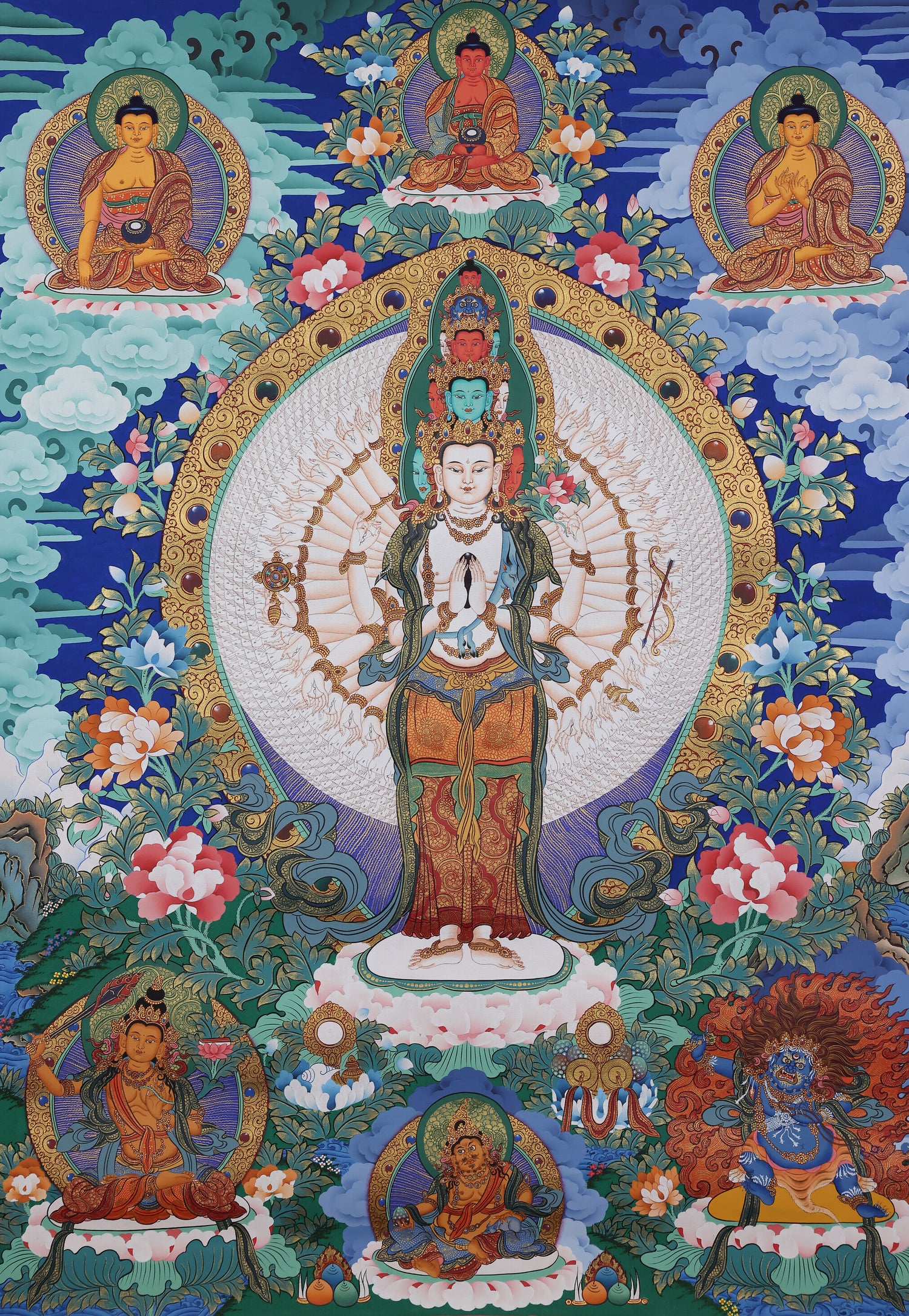
When a vivid, intricately detailed Nepalese painted thangka is placed before you, it is never just a “decorative painting” – especially this 45×60cm hand-painted piece featuring “Yellow Jambhala as the Main Deity with the Five Directions Wealth Deities”. It is a tangible expression of Tibetan Buddhist belief systems and a living specimen of Nepal’s Newari artistic heritage. Today, we unpack the deep value of this thangka across three dimensions: culture, faith, and craftsmanship.
I. The Thangka’s Theme: In Tibetan Buddhism, Wealth Is a Provision for Dharma Practice – Not an Object of Attachment
Many people, upon first seeing a “Wealth Deity Thangka,” assume it is a symbol for chasing material gain. But in the context of Tibetan Buddhism, the core theme of the “Five Directions Wealth Deities” is the fulfillment of provisions (or sambhara in Sanskrit).
Provisions in this context split into two categories: merit provisions (material abundance, security, and freedom from want – so practitioners are not distracted from Dharma practice by hardship) and wisdom provisions (freedom from attachment to wealth, so practitioners maintain a pure mind in their spiritual work).
This thangka’s configuration – Yellow Jambhala as the central main deity, paired with the White, Red, Green, and Black Wealth Deities as attendants – is a classic Tibetan Buddhist setup for “comprehensive provision blessings.” Yellow Jambhala oversees the core of wealth, while the other four deities manage distinct dimensions of abundance. Here, wealth is framed as a tool for Dharma practice, not a target of obsession – this is the core of Tibetan Wealth Deity belief.
II. Main Deity: Yellow Jambhala – Stability and Abundant Merit in His Golden Form
Every detail of Yellow Jambhala (the central deity) carries precise symbolic meaning in Tibetan culture:
-
Form and Visage: His bright golden-yellow body corresponds to the “central direction,” symbolizing a deep, unshakable foundation for wealth (one that does not easily dissipate). His wide, unblinking eyes and taut lips form a “wrathful visage” – not an expression of anger, but a symbol of “subduing karmic obstacles to poverty and breaking the grip of greed,” using sacred authority to protect virtuous deeds.
-
Attire and Posture: He wears a five-Buddha crown (even as a worldly protector, this crown links him to the wisdom of the Buddha families) and a necklace of ornaments and a longevity lock (symbolizing the convergence of treasures and the dual fulfillment of wealth and long life). His lalita asana (half-lotus, “playful” posture) – right leg curled against the left thigh, left leg hanging loosely beside the throne – balances protector 威严 (dignity) with the ease of one who masters wealth. His double lotus throne (with upward and downward pink petals) implies “upholding bodhicitta even amid worldly desires.”
-
Core Ritual Implements: One hand cradles a treasure-vomiting rat (Nure in Tibetan), whose slightly parted mouth hints at its ability to spew jewels, gold, and precious goods – the iconic symbol of a Wealth Deity’s generosity. The other hand holds a wish-fulfilling gem (or vase), which represents the fulfillment of all needs: both worldly wealth and the provisions required for spiritual practice. Together, these implements clarify Yellow Jambhala’s role as a protector of both daily life and Dharma practice.
III. Accompanying Deities: The Five Directions Wealth Deities – Tailored Blessings for Life’s Wealth Needs
The four attendants (White, Red, Green, Black Wealth Deities) surrounding Yellow Jambhala correspond to specific directions and distinct dimensions of abundance:
-
Top Left: Red Jambhala (Southern Direction): His crimson body symbolizes “interpersonal vitality,” overseeing relationship-based wealth – ideal for merchants and professionals, as he blesses smooth collaborations and expanded networks.
-
Top Right: Green Jambhala (Eastern Direction): His deep green body evokes “growing vegetation,” governing career and livelihood wealth – suited for entrepreneurs and workers, as he protects business success and bountiful harvests (for agriculture or livestock).
-
Bottom Left: White Jambhala (Western Direction): His milky-white body represents “purity and non-staining,” managing virtuous wealth – perfect for practitioners, as he blesses wealth gained without violating karma, plus the acquisition of Dharma items (sutras, ritual tools).
-
Bottom Right: Black Jambhala (Northern Direction): His inky-black body signifies “subduing obstacles,” focusing on misfortune-breaking wealth – ideal for those in hardship, as he dissolves financial setbacks and clears karmic barriers to prosperity.
IV. Nepalese Newari Painted Thangka: Sacredness and Delicacy in Craftsmanship
This thangka is a hallmark of traditional Nepalese Newari painted thangka art, whose craftsmanship and style carry the unique DNA of Himalayan creativity:
-
Stylistic Traits: Newari art is renowned for its “fine lines, vivid colors, and dense ornamentation.” You can discern the veins of lotus petals, the fur of the treasure-vomiting rat, and the folds of flowing ribbons – all rendered with delicate wolf-hair brushes. Bold color contrasts (golden main deity, sapphire backdrop, pink lotus petals) feel harmonious thanks to gradient transitions, avoiding garishness. The background is filled with scrollwork clouds and lotus blossoms, symbolizing “endless treasures and boundless auspiciousness.”
-
The Sacredness of Pigments: The mineral and earth pigments used not only ensure colors last for centuries but also carry the belief of “connecting heaven and earth.” Yellow comes from realgar, blue from azurite, red from cinnabar, and the binder is natural ox bone glue – avoiding “impure energies” and aligning with the ritual of “pure painting” for thangkas.
-
Practical Size: At 45×60cm, this is a “medium worship-sized thangka” – perfect for home shrines or study walls, making it an ideal choice for “lived faith.”
Conclusion: The Thangka’s True Value – Bridging Life and Practice
This Yellow Jambhala and Five Directions Wealth Deities thangka is never a “tool for greedy pursuit of wealth.” It is a vessel for the Tibetan Buddhist wisdom of “supporting Dharma practice with wealth”: the blessings of the Five Directions Wealth Deities free practitioners from life’s worries, allowing them to focus on spiritual work; the opulence of the Newari painted thangka uses worldly treasures to symbolize the “majesty of one’s inherent nature.”
From the grinding of mineral pigments to the stroke of every line, every detail of this thangka is a fusion of faith and art.
#NepalesePaintedThangka #YellowJambhalaFiveDirectionsWealthDeitiesThangka #TibetanBuddhistThangka #NewariArtThangka #HandPaintedMineralPigmentThangka #TibetanBuddhistWealthPhilosophy #PaintedThangkaArt #HimalayanTraditionalArt #WealthDeityBuddhistThangka