Nepalese Hand-Painted Blue Thangka of Mahasthamaprapta: Decoding Tibetan Buddhist Symbolism, Artistry & Craftsmanship

$499.00 USD
Thangka name: Blue Tang Great Power
size: 20cm×30cm
origin: Nepal
Eine Frage stellen

Beeil dich! Nur noch [Anzahl] auf Lager!

Geschätzte Lieferzeiten: 12–26 Tage (International), 3–6 Tage (USA).

Rückgabe innerhalb von 45 Tagen nach dem Kauf. Zölle und Steuern werden nicht erstattet.

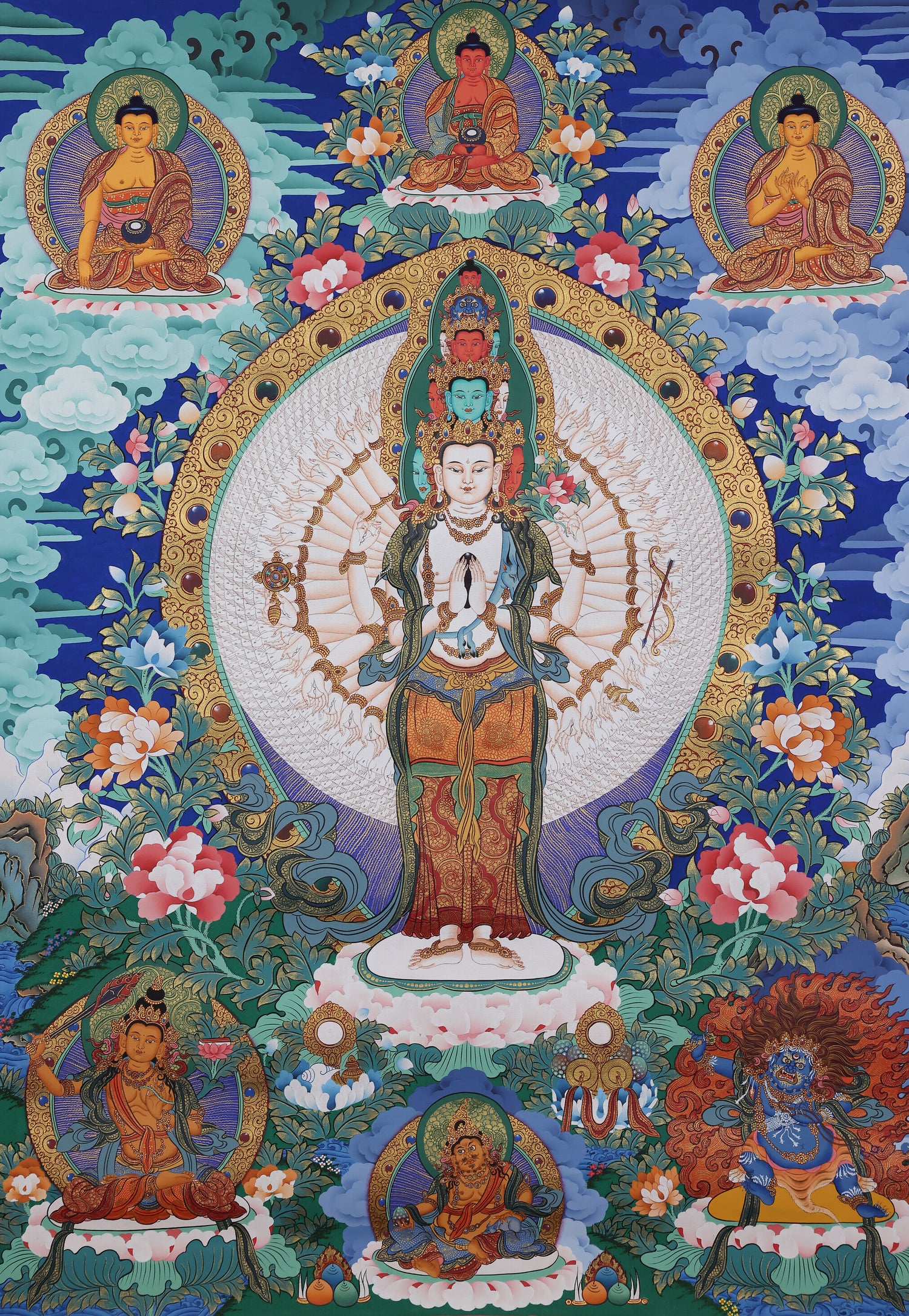
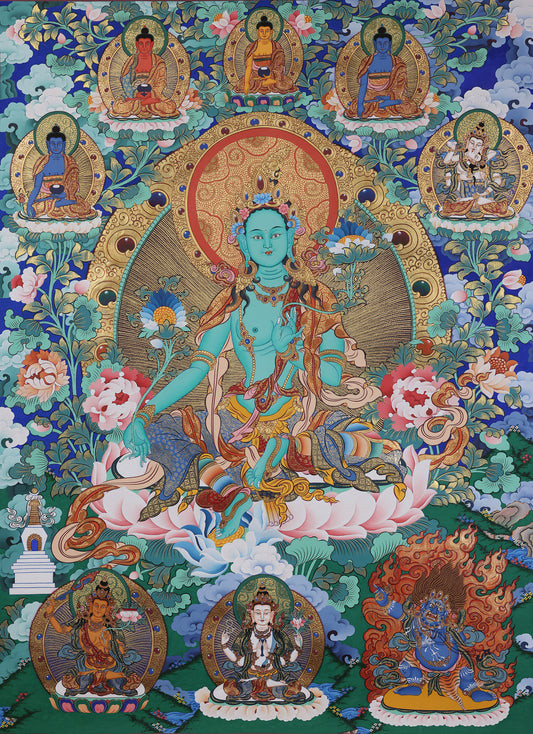
Blue Thangka of Mahasthamaprapta Bodhisattva symbolizing wisdom and spiritual power in Tibetan Buddhist culture
Nepalese Hand-Painted Blue Thangka of Mahasthamaprapta: Decoding Tibetan Buddhist Symbolism, Artistry & Craftsmanship
$499.00 USD
In the heart of Nepal’s Kathmandu Valley, where Tibetan Buddhist ritual and Newari artistry have intertwined for centuries, small-scale hand-painted thangkas emerge as intimate, sacred objects—portable vessels of faith that condense complex spiritual traditions into 方寸 spaces. The 20x30cm Blue Thangka of Mahasthamaprapta (known in Tibetan Buddhism as Semchen Chenpo) we examine here is one such masterpiece: a pure handcrafted work using natural mineral and earth pigments, it embodies the fusion of Tibetan Buddhist doctrine and Nepalese artisanal heritage. More than a decorative piece, this thangka functions as both a visual scripture (for teaching Buddhist tenets) and a ritual object (for meditation and devotion)—a duality that defines its cultural significance.

1. The Core Theme: Mahasthamaprapta in the Western Trinity of Tibetan Buddhism

At its essence, this thangka centers on the Western Trinity (a key tenet in both Pure Land Buddhism and Tibetan Vajrayana), where Mahasthamaprapta serves as the right attendant of Amitabha Buddha, paired with Avalokiteshvara (the left attendant) to embody the dual virtues of “wisdom” and “compassion.”
In Tibetan Buddhist cosmology, Mahasthamaprapta is revered as the bodhisattva of “transcendent wisdom”—a role distinct from Avalokiteshvara’s focus on universal compassion. The “blue thangka” format is not arbitrary: in Vajrayana (Tibetan esoteric Buddhism), the color blue is associated with the Vajra Family (one of the five Buddha families), symbolizing “empty wisdom” and “demonic subdual.” This links Mahasthamaprapta to his wrathful emanation, Vajrapani (the bodhisattva of power), framing the thangka as a vessel of both Pure Land “rebirth aspirations” and Vajrayana “wisdom-powered protection.”
For Nepalese Buddhist practitioners, this compact thangka is a portable portal to the Western Pure Land: its 20x30cm size allows it to be displayed in home shrines or carried during pilgrimages, making the Trinity’s blessings accessible in daily life.

2. The Main Deity: Iconography of Blue Mahasthamaprapta

Every detail of the central figure adheres to the strict iconometric rules of Tibetan Buddhist art (outlined in the Iconometry Sutra), while infusing Newari art’s decorative elegance:
  • Physical Form & Distinct Markers: Seated in the full lotus position (padmasana), the bodhisattva’s body is rendered in deep lapis lazuli blue (derived from Nepalese azurite)—the signature hue of his Vajra Family affiliation. His most recognizable marker is the urn in his topknot: per the Sutra of Contemplation on Amitayus, this urn “holds all luminous blessings,” distinguishing him from Avalokiteshvara (who bears a Buddha figure in his topknot). A small urna (cranial protuberance) between his brows symbolizes enlightenment.
  • Mudra & Ritual Implements: Mahasthamaprapta holds the Dhyana Mudra (meditation gesture) with hands resting on his lap, subtly clutching a lotus (representing rebirth in the Pure Land) and a rosary (echoing his role in the Sutra of Mahasthamaprapta’s Perfect Enlightenment as the patron of mindfulness practice).
  • Attire & Adornments: He wears a diaphanous blue-and-gold celestial robe (devatasana) draped over one shoulder, adorned with gold-leaf 璎珞 (necklaces) and armlets. Newari artisans use a combination of “iron-line outlines” (for sharp, ritual-compliant contours) and “silk-thread strokes” (for flowing, decorative folds)—balancing Tibetan iconographic rigor with Nepalese aesthetic grace.

3. Retinue Deities: Hidden Symbolism in Background Details

Given its small size, this thangka does not feature explicit retinue figures; instead, it encodes the Western Trinity’s support system in subtle background elements:
  • Lotus Throne: The double-layered lotus seat (painted with layered indigo and malachite) bears faint gold wheel (dharmachakra) motifs, referencing the “Seven Jeweled Lotus Pond” of the Western Pure Land and implicitly invoking the Eight Bodhisattvas who guard Amitabha’s realm.
  • Clouds & Ritual Symbols: The blue-and-gold cloud patterns framing the deity include micro-scale vajras (diamond scepters) and conchs (auspicious instruments)—symbols of the Vajra Family’s retinue (e.g., dakinis and yakshas), who are believed to protect practitioners who venerate the thangka.

4. Craftsmanship: Traditional Newari Techniques & Natural Pigments

Nepalese thangka artisans (known as thangka chitrakars) preserve a 1,000-year-old craft legacy in this piece, with processes tailored to its small size:
  • Canvas Preparation: The base is hand-woven cotton-linen cloth from the Kathmandu Valley, treated with five coats of sheep’s white clay (mixed with 牛皮 glue) and polished five times with river stones after each coat. This creates a smooth, crack-resistant surface that can bear multiple pigment layers—critical for the thangka’s longevity.
  • Pigment Preparation: All colors are natural mineral or earth-based, prepared via labor-intensive methods:
    • Lapis Lazuli Blue: Sourced from northern Nepalese mountains, azurite is crushed and refined via water-separation precipitation to extract the deepest “first-grade blue,” then ground for 60+ hours until textureless, and mixed with 牛皮 glue (thinned in summer, thickened in winter).
    • Gold Leaf: 24K gold is hammered into micro-thin foil, ground into powder, and blended with bone glue for outlines and decorations—ensuring resistance to oxidation over decades.
    • Earth Pigments: Ochre and chalk (local to the Valley) are wet-ground seven times for the cloud and lotus shadow details, yielding a soft, matte finish that contrasts with the luminous blue.
  • Painting & Consecration: The process begins with charcoal sketching (aligned to Iconometry Sutra proportions: e.g., “three fingers for face length”), followed by ink-line outlining. Pigments are applied from dark to light, with each layer air-dried and re-polished. The final step—“opening the eyes” (drawing the deity’s pupils with gold powder)—is a sacred ritual: artisans bathe and burn incense beforehand, as this act is believed to “infuse the thangka with divine presence.”

5. Art Style: The Newari School’s Fusion of Ritual & Aesthetics

This thangka exemplifies the Newari (Nepalese) thangka school, distinct from Tibet’s Menri or Karma Gadri schools:
  • Composition: The 20x30cm canvas balances density and negative space: the deity occupies 60% of the frame, while blue-gold clouds and lotus motifs fill the background without feeling cluttered—Newari artisans prioritize “empty space as spiritual resonance” over the “full-patterned” style of Tibetan thangkas.
  • Color Palette: Cool blues and greens dominate, warmed by gold leaf accents—creating a tone that is both solemn (fitting Vajrayana ritual) and opulent (evoking the Pure Land’s grandeur).
  • Perspective: While rejecting Western linear perspective, Newari artisans use “three-layer shading” (on the forehead, nose, and cheeks) to create subtle volume—adding human-like warmth to the deity’s divine form, a hallmark of Newari art.

Conclusion: A Small Thangka, A Vast Cultural Legacy

This 20x30cm Blue Thangka of Mahasthamaprapta is more than an artwork: it is a cross-cultural tapestry weaving Tibetan Buddhist doctrine, Nepalese artisanal skill, and spiritual devotion. Its mineral pigments (fading only over centuries) and ritualized craftsmanship ensure it functions as both a visual guide to the Western Trinity and a living object of faith. For anyone interested in Tibetan Buddhism or traditional art, this thangka reveals how small-scale works can encapsulate entire cultural and spiritual worlds.


#NepaleseThangka #BlueThangka #Mahasthamaprapta #TibetanBuddhistArt #TraditionalNepaleseArt #MineralPigmentArt #NewariArtSchool #WesternTrinityBuddhism
Entdecken Sie das perfekte tibetisch-buddhistische Thangka, das zu Ihren Wünschen, Ihrem Lebensstil und Ihrem Raum passt. Jedes Thangka hat eine spirituelle Bedeutung und bringt Segen, wenn es richtig platziert wird.

1. Definieren Sie Ihre Absicht

Reichtum & Erfolg → Gelber Dzambhala (Gottheit des Reichtums)

Mitgefühl und Frieden → Avalokiteshvara, Grüne Tara

Weisheit & Lernen → Manjushri

Gesundheit & Heilung → Medizinbuddha

Langlebigkeit und Familienschutz → Weiße Tara

2. Wählen Sie nach Identität

Unternehmer und Geschäftsinhaber → Reichtumsgottheiten für Wohlstand.

Studenten und Gelehrte → Weisheitsgottheiten für Konzentration und Klarheit.

Heiler und Yoga-Praktizierende → Medizinbuddha für Energie und Gleichgewicht.

Familien und Hausfrauen → Tara-Gottheiten für Harmonie und Sicherheit.

Sammler und Kunstliebhaber → Seltene Mandalas oder Meisterwerk-Thangkas.

3. Passen Sie Ihren Raum an

Heimschrein / Meditationsraum → Mittlere Thangkas (60–80 cm).

Büro / Geschäftshalle → Große Thangkas für Wohlstand und Autorität.

Wohnzimmer / Arbeitszimmer → Dekorative Thangkas für Frieden und Schönheit.

4. Authentische Handwerkskunst

Jedes Thangka ist mit natürlichen Mineralpigmenten und feiner Leinwand handbemalt und spiegelt tibetische Kunstfertigkeit und spirituelle Kraft wider. Überprüfte Quellen gewährleisten Qualität und Respekt für die Tradition.

✨ Wählen Sie Ihr Thangka mit Herz – es ist nicht nur Kunst, sondern ein Segen für Ihr Leben.

Jeder Mensch hat unterschiedliche Bedürfnisse. Die Wahl des richtigen Thangkas kann spirituelle Unterstützung, Schutz, Glück und Segen bieten. Nachfolgend finden Sie Thangka-Empfehlungen für verschiedene Rollen:

1. Unternehmer

  • Bedürfnisse : Weisheit, Reichtum, Gesundheit, beruflicher Erfolg.
  • Empfohlene Thangkas :
    Manjushri : Verbessert die Entscheidungsfindung und Geschäftsweisheit.
    Gottheit des Reichtums : Bringt Reichtum und Wohlstand.
    Medizinbuddha : Unterstützt die Gesundheit und reduziert Stress.
    Mahakala : Schützt Unternehmen vor Konkurrenz und Herausforderungen.

2. Erfolgreiche Einzelpersonen

  • Bedürfnisse : Innerer Frieden, Familienharmonie, Langlebigkeit.
  • Empfohlene Thangkas :
    Amitabha Buddha : Bringt inneren Frieden und Ruhe.
    Avalokiteshvara (Guanyin) : Fördert Harmonie und Glück in der Familie.
    Amitayus (Langlebens-Buddha) : Betet für gute Gesundheit und ein langes Leben.
    Manjushri : Stärkt weiterhin die Weisheit.

3. Hausfrauen/Ehemänner

  • Bedürfnisse : Familienharmonie, Schutz, Gesundheit.
  • Empfohlene Thangkas :
    Avalokiteshvara : Steigert das Familienglück und die Harmonie.
    Schutzgottheiten : Beschützen die Familie vor äußeren Störungen.
    Weiße Tara : Segnet die Familie mit Gesundheit.

4. Studierende und Wissenschaftler

  • Bedürfnisse : Weisheit, Konzentration, akademischer Erfolg.
  • Empfohlene Thangkas :
    Manjushri : Fördert Lernfähigkeit, Gedächtnis und Weisheit.
    Shakyamuni Buddha : Hilft bei der Konzentration und spirituellen Praxis.
    Jixiang Tianmu : Bringt akademisches Glück und Prüfungserfolg.

5. Künstler und Kreativprofis

  • Bedürfnisse : Inspiration, Kreativität, künstlerische Leistung.
  • Empfohlene Thangkas :
    Manjushri : Regt kreatives Denken und Inspiration an.
    Vajrapani : Hilft, kreative Blockaden zu überwinden.
    Maitreya : Sorgt für eine entspannte und optimistische Einstellung und baut Stress ab.

6. Reisende und Abenteurer

  • Bedürfnisse : Schutz, Glück, Erfolg bei Abenteuern.
  • Empfohlene Thangkas :
    Hayagriva : Bietet starken Schutz auf Reisen und beseitigt Hindernisse.
    Mahakala : Bringt Glück und Schutz, insbesondere für Abenteurer.
    Vajrasattva : Hilft, Schwierigkeiten und Herausforderungen während der Reise zu überwinden.

7. Ältere Menschen

  • Bedürfnisse : Gesundheit, Langlebigkeit, spiritueller Frieden.
  • Empfohlene Thangkas :
    Amitayus : Betet für ein langes Leben und gute Gesundheit.
    Medizinbuddha : Fördert Heilung und körperliches Wohlbefinden.
    Avalokiteshvara : Bringt Mitgefühl und inneren Frieden in späteren Jahren.

8. Führungskräfte

  • Bedürfnisse : Führung, Weisheit, Teamarbeit und geschäftlicher Erfolg.
  • Empfohlene Thangkas :
    Manjushri : Verbessert Führungsqualitäten und Entscheidungsfindung.
    Gottheit des Reichtums : Bringt dem Unternehmen und dem Team Erfolg und Wohlstand.
    Avalokiteshvara : Fördert Harmonie und Gleichgewicht innerhalb des Teams.

9. Gesundheits- und Fitnessbegeisterte

  • Bedürfnisse : Gute Gesundheit, Vitalität, Energie.
  • Empfohlene Thangkas :
    Medizinbuddha : Verbessert die körperliche Gesundheit und Vitalität.
    Weiße Tara : Bringt Gesundheit und Verjüngung.
    Vajrasattva : Beseitigt gesundheitliche Probleme und steigert die Energie.

10. Politiker

  • Bedürfnisse : Führung, Weisheit, Frieden.
  • Empfohlene Thangkas :
    Manjushri : Verbessert Führungsqualitäten und Entscheidungsfindung.
    Vairocana Buddha : Hilft, inneren Frieden und Weisheit zu bewahren.
    Avalokiteshvara : Fördert den gesellschaftlichen Frieden und die Harmonie in der Familie.

Für alle Bestellungen über 100 USD ist der Versand kostenlos.

Rücksendungen werden bis zu 10 Tage nach Erhalt des Kaufbelegs bzw. der Sendungsnummer (bei ungetragenen Artikeln) akzeptiert. Sie als Kunde sind verpflichtet, uns vor der Rücksendung des Artikels per E-Mail zu informieren.

Andernfalls fallen die Standardversandkosten an. Weitere Informationen finden Sie in unseren Lieferbedingungen .

Rücksendungen werden bis zu 10 Tage nach Erhalt des Kaufbelegs oder der Sendungsnummer (bei ungetragenen Artikeln) akzeptiert. Sie als Kunde sind verpflichtet, uns vor der Rücksendung des Artikels per E-Mail zu informieren, nur in folgenden Fällen:

– Den falschen Artikel erhalten.
– Artikel kam nicht wie erwartet an (z. B. beschädigte Verpackung).
– Artikel hatte Mängel.
– Über die Lieferzeit hinaus.
– Der Spediteur gestattet keine Besichtigung der Ware vor der Bezahlung.

Die zurückgesendeten Produkte müssen in der Originalverpackung, sicher verpackt, unbeschädigt und ungetragen sein. Dies bedeutet, dass die Artikel zum Schutz während des Transports sicher in einem Karton verpackt sein müssen, möglichst im selben Karton, in dem sie an Sie als Kunde versendet wurden.

Kürzlich angesehen

Nicht vergessen! Die Produkte, die Sie angesehen haben, legen Sie jetzt in den Warenkorb.

Passt gut zu

Erweitern Sie Ihre Auswahl mit perfekt abgestimmtem Zubehör und ergänzenden Produkten.

Leute kauften auch

Hier sind einige unserer ähnlichsten Produkte, die die Leute kaufen. Klicken Sie hier, um den Trendstil zu entdecken.