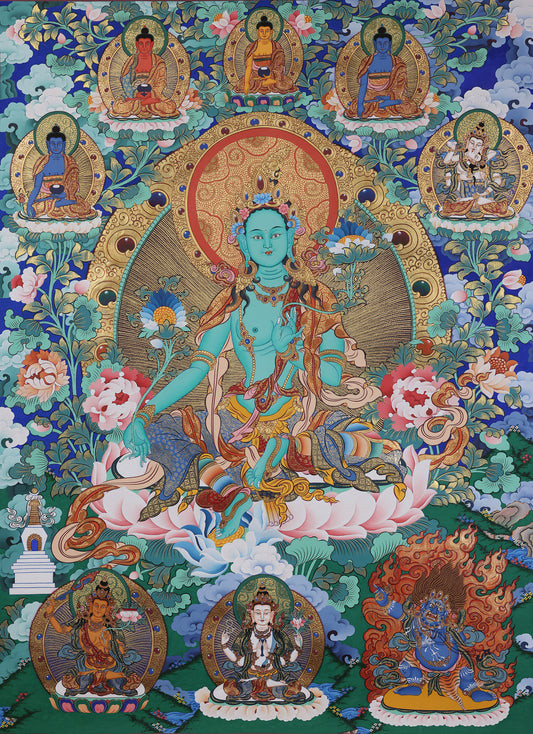
When the sacred rituals of Tibetan Buddhism meet the gentle artistry of Nepal’s Newari tradition, a 50x70cm hand-painted color Thangka of Vaisravana becomes a tangible embodiment of "faith coexisting with daily life" in the Himalayan cultural sphere. Unlike mass-produced decor, this Thangka—rendered with natural mineral and earth pigments—carries both the spiritual tenets of Tibetan Buddhism and Nepalese folk wishes for abundant living: it is both a religious ritual object and a touchable cultural heritage.
1. Vaisravana: The Dual Divine Identity of "Dharma Protector + Wealth Deity" in Tibetan Buddhism
Within the Tibetan Buddhist system, Vaisravana (the Northern Guardian King, in Sanskrit) — the central deity of this Thangka — originates from the fusion of Kubera (the Hindu Wealth Deity) and one of Buddhism’s Four Guardian Kings. In cross-border Tibetan-Nepalese beliefs, he holds a dual identity:
-
Dharma Protector Role: As one of the Four Guardian Kings, he oversees the protection of Dharma in the northern continent of Uttarakuru, symbolizing the "removal of obstacles to practice and daily life";
-
Wealth Deity Role: Among commercial communities in Nepal’s Kathmandu Valley, he is the "guardian of business," revered as a core Wealth Deity who bestows both material and spiritual blessings.
This duality allows the 50x70cm Thangka to serve both religious worship and daily wish-making: it can be enshrined in a home shrine or hung in shops and households, aligning with the Himalayan cultural trait of "integrating faith into daily life."
2. The Main Deity’s Form: Every Detail is a Concretized Religious Symbol
The main deity in this Thangka strictly adheres to the Iconometric Canon, with each detail carrying specific symbolic meaning:
-
Body Color & Adornments: The deity’s bright yellow body corresponds to the "earth element" in Tibetan Buddhist five-element cosmology, metaphorizing wealth’s "stability, abundance, and dignity." He wears a Five-Buddha Crown, adorned with pearls and lotus patterns representing the wisdom blessings of the Five Dhyani Buddhas—implying "governing blessings with wisdom and overcoming attachment to wealth." The gold bracelets, necklaces, and other jewel adornments are not mere decor; they are tangible symbols of "accumulated merit," signifying "adorning the body and mind with treasures to achieve perfect virtue."
-
Implements & Functions: In his right hand, he holds a Victory Banner (red cinnabar with gold patterns), symbolizing "the spread of Dharma and the subjugation of poverty and career obstacles." In his left hand, he supports a black Treasure-Owning Weasel (called Norbu Jyalung in Tibetan)—originally a greedy dragon spirit, tamed to become a "treasure-bestowing messenger." The pile of colored jewels it holds in its mouth represents both "endless material wealth" and the metaphor of "transforming greed into altruistic spiritual merit through Dharma."
-
Posture & Ritual: The deity sits in a Lalita Asana (half-lotus pose) atop a snow lion—distinct from the full lotus pose of Buddhas, this posture reflects both the Dharma Protector’s "unrestrained majesty" and the Wealth Deity’s "adaptability to sentient beings and generosity of blessings," implying his protection can integrate into the nuances of daily life.
3. Attendant Creatures: The "Purity + Treasure-Bestowing" Symbolism of the Snow Lion & Treasure-Owning Weasel
This Thangka adopts a simplified attendant design typical of Nepalese folk worship Thangkas, using "mount + companion creature" to convey core meanings:
-
Mount: Snow Lion: The white-bodied, green-maned snow lion symbolizes "pure power" in Tibetan Buddhism—white represents "uncontaminated wisdom," while green manes signify "vitality and abundance." Its reclining posture supporting the deity reflects both "ferocity to subjugate evil" and the metaphor of "bearing sentient beings’ blessings with pure aspirations." Unlike the fierce snow lions in Tibetan Thangkas, this Newari-style snow lion is gentler and more agile, aligning with folk wishes for "gentle protection."
-
Companion: Treasure-Owning Weasel: The black weasel in the deity’s arms carries the meaning of "subjugating hidden obstacles" in Nepalese Thangkas—black corresponds to "overcoming invisible barriers to wealth," and its jewel-spitting movement is a direct expression of "manifested merit." The detail of the deity gently supporting (not restraining) the weasel aligns with the Tibetan ritual principle of "taming rather than suppressing," implying wealth is "the natural result of good karma."
4. Newari Color Thangka Craft: Blending Natural Mineral Pigments & Hand-Painting Rituals
This Thangka is a fine example of Nepal’s traditional "hand-painted color Thangka," with craftsmanship that adheres to religious rituals while highlighting the value of natural materials:
-
Canvas Preparation: It uses cotton-linen blended fabric from the Kathmandu Valley, processed through three steps: stretching the fabric over a custom wooden frame, coating it with yak bone glue mixed with chalk powder, and polishing it 7-9 times with an agate stone after drying—until the surface takes on a "pearl-like warm luster." Newari artists view this process as a "practice to clear mundane distractions," imbuing the Thangka with spiritual meaning from its material preparation stage.
-
Natural Pigment Application: All pigments are natural minerals or earth materials: the bright yellow background comes from sun-dried and purified loess from southern Nepal; the snow lion’s green manes use graded-ground malachite (fine grinding for light green, coarse grinding for dark green); the banner’s red comes from cinnabar; the crown’s gold is ground gold leaf; and the weasel’s black is a mixture of 酥油 lamp soot and ochre. These pigments not only have stable, century-lasting colors but are also believed in Tibetan beliefs to enhance the Thangka’s "blessing power."
-
Hand-Painting Rituals: The artist strictly follows the Iconometric Canon: the ratio of the deity’s head diameter to the canvas width is 1:7.5 (from the Kalachakra Tantra’s "perfect human proportions"); the painting starts with the Victory Banner (a ritual taboo for Dharma Protectors); the artwork is wrapped in five-colored silk at the end of each day; and facial painting is forbidden on rainy days. This 50x70cm Thangka takes 20-30 days to complete, representing a typical Nepalese fine Thangka.
5. Art Style: A Folk Worship Thangka Blending Tibetan & Nepalese Cultures
This Thangka’s "Newari color Thangka style" differs from the "rigorous solemnity" of Tibetan Thangkas, embodying "decorativeness and daily warmth":
-
Lines & Colors: Newari artists use "soft, silkworm-spit-like lines" to outline clothing folds and layered fine brushes to depict jewel textures (distinct from the bold lines of Tibetan Thangkas). The color palette centers on warm tones, accented with high-saturation hues: the bright yellow background sets a "prosperous and warm" tone, while blue, green, and red highlight the deity and attendants—aligning with the Wealth Deity theme and reflecting the "bright gentleness" of Nepalese art.
-
Background & Composition: The background includes stylized landscapes (pointed mountains, sloping grasslands) and rolling clouds—a Newari artistic trait of "integrating daily nature into religious painting," which enriches the composition and makes the Thangka more accessible to folk aesthetics. The central deity with surrounding attendants follows the Thangka’s "cosmic center" ritual, while the layout of the snow lion and jewel pile reinforces the "wealth protection" theme.
6. Cultural & Collection Value: A Dual Carrier of Religious Ritual Object & Art Collectible
This Thangka’s value lies in its dual "religious + artistic" identity:
-
Religious Ritual Value: It serves as a spiritual anchor for devotees wishing for wealth and career protection; its ritualized form and natural pigments are believed to carry the "blessing power of the deity."
-
Art Collection Value: Its hand-painted craftsmanship and natural mineral pigments make it a rare example of contemporary Newari Thangka heritage—over time, the natural pigments develop a "warm patina," combining aesthetic and collection value.
Most importantly, it epitomizes Tibetan-Nepalese cultural fusion: Vaisravana’s religious meaning stems from Tibetan Buddhism, while its artistic expression is rooted in Newari tradition—this blend is a tangible example of "cross-regional faith and artistic coexistence" in the Himalayan cultural sphere.
#Nepal Vaisravana Thangka #Hand-Painted Color Thangka #Tibetan Buddhist Thangka #Mineral Pigment Thangka #Newari Thangka Craft #Thangka Cultural Value #Handmade Himalayan Art #Traditional Newari Thangka Painting #Earth Pigment Thangka Art #Wealth Deity Thangka for Worship #50x70cm Fine Thangka Collection #Tibetan-Nepalese Cultural Fusion Art