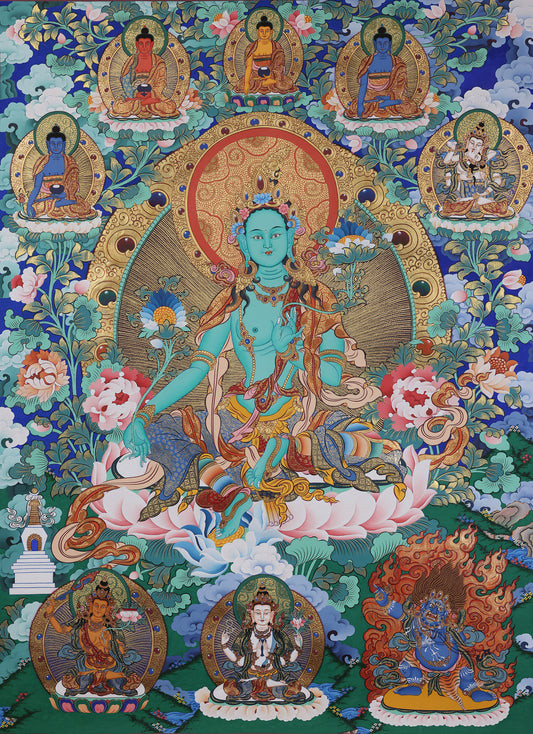
Within the artistic and religious system of Tibetan Buddhism, a thangka is never merely a painting. It is a sacred visual scripture, created for contemplation, ritual offering, and spiritual transmission. This pure hand-painted thangka of Guru Rinpoche in his Royal Manifestation is rooted in the Nyingma (Ancient) School of Tibetan Buddhism and integrates strict iconographic measurements, an authentic lineage system, and refined mineral-pigment craftsmanship. It stands as a work of profound religious significance, artistic mastery, and cultural collectability.
I. Core Theme: A Spiritual Totem of Vajrayana Lineage
The central theme of this thangka is Guru Rinpoche (Padmasambhava) in his Royal Aspect (Padma Gyalpo)—one of the most authoritative manifestations within Tibetan Buddhist iconography. Revered as the founding master of Vajrayana Buddhism in Tibet, Guru Rinpoche played a decisive role in the 8th century by subduing local forces, establishing Samye Monastery, ordaining the “Seven Enlightened Disciples,” and systematizing tantric transmission on the Tibetan plateau.
As such, this thangka embodies a dual cultural significance:
On one level, it visually records the historic transmission of Vajrayana Buddhism into Tibet;
On another, it functions as a yidam (meditational deity) thangka, used for visualization practice, ritual offerings, and empowerment within the Nyingma tradition—especially in connection with Dzogchen teachings emphasizing “enlightenment in this very body.”
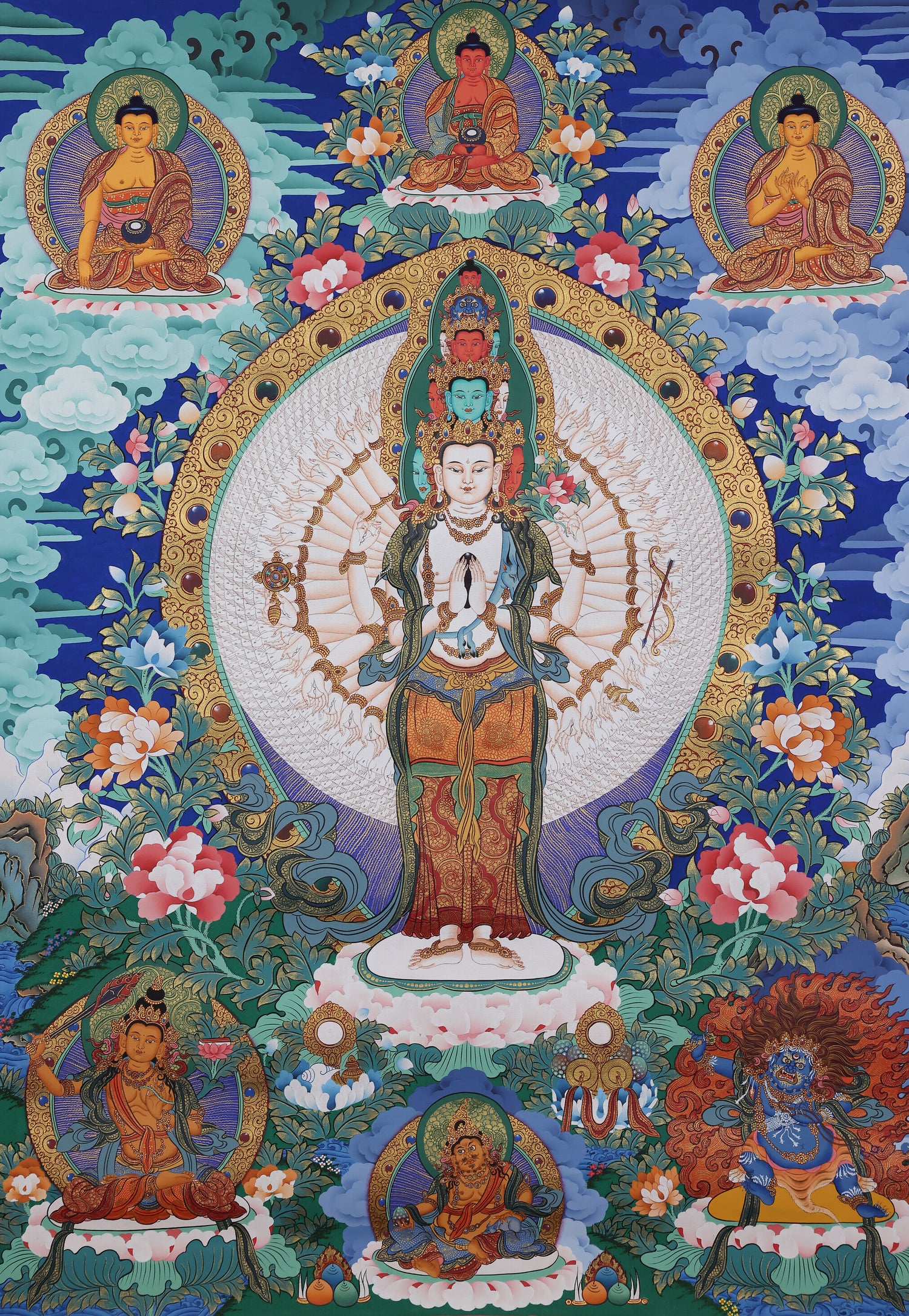
The composition strictly follows the 37:25 golden ratio prescribed in the Buddhist Iconometric Treatises, ensuring ritual accuracy and symbolic harmony. Guru Rinpoche occupies the central axis, surrounded by attendants and protectors, while lotus blossoms, auspicious clouds, and snow mountains form a mandala-like sacred space. This structure guides the viewer into a contemplative cycle of visualization, purification, and awakening.
II. The Principal Deity: The Symbolic System of Guru Rinpoche’s Royal Form
At the center of the composition appears Guru Rinpoche in his Royal Manifestation, with every detail governed by Vajrayana symbolism.
Head Ornament
He wears the iconic Lotus Crown, crowned with a vajra and peacock feather.
-
The vajra symbolizes the destruction of ignorance and illusion.
-
The feather recalls Guru Rinpoche’s miraculous birth upon a lotus in the land of Uddiyana.
Golden ribbons descend from the crown, rendered in fine gold lines, corresponding to textual descriptions of the “King of Zahor” attire and affirming his role as one who protects the Dharma through enlightened authority.
Physical Form
His face is square and dignified, adorned with a short beard. The skin tone is rendered in warm golden hues using natural mineral pigments, in accordance with canonical descriptions likening the Buddha’s face to a full moon on the fifteenth day.
Gold earrings hang from elongated earlobes, while a necklace of fifty-three beads made of pearls and coral symbolizes mastery of the Five Paths and Ten Bodhisattva Grounds.
Mudras and Ritual Implements
-
The right hand holds a vajra in the subjugation mudra, representing the conquest of inner afflictions and external obstacles.
-
The left hand supports a kapala bowl containing a vase of longevity nectar, symbolizing the nourishment of beings’ wisdom-life.
-
Resting against the left shoulder is the khatvanga staff, adorned with white silk and topped with a trident, signifying the transcendence of desire, anger, and ignorance.
Lotus Throne
Guru Rinpoche sits in full vajra posture upon a double-layered lotus throne:
-
The lower “wrathful lotus” with outward-turned petals symbolizes the subjugation of negative forces.
-
The upper “peaceful lotus” with inward-curving petals represents compassion and serenity.
Together, they embody the Vajrayana principle of the union of wisdom and compassion.
III. Attendants and Protectors: The Complete Lineage Mandala
The surrounding deities form a fully integrated Nyingma lineage structure, arranged according to ritual protocol.
Upper Deity
Above Guru Rinpoche appears Amitabha Buddha, seated within a lotus shrine. This placement affirms the doctrinal view that Guru Rinpoche is an emanation of Amitabha, expressing the teaching of the unity of the Three Bodies (Trikaya).
Attendant Figures
-
On the left stands a lineage master (traditionally identified as one of Guru Rinpoche’s Indian teachers), wearing red robes, forming the teaching mudra, and holding a scripture case—symbolizing the transmission of Dzogchen wisdom.
-
On the right appears Yeshe Tsogyal, Guru Rinpoche’s principal disciple and guardian of the treasure teachings (terma). Her youthful and serene appearance reflects the dakini quality of transforming hardness through gentleness.
Dharma Protector
Below the lotus throne appears Hayagriva, identifiable by the horse-head motif, shown in wrathful form as Guru Rinpoche’s personal protector. His fierce posture symbolizes the forceful preservation of the tantric lineage and echoes traditional multi-deity mandala arrangements.
IV. Painting Technique: Materials, Mastery, and Sacred Craft
This thangka is a pure hand-painted masterpiece, combining the precision of the Newar school with the compositional clarity of the Menri tradition. It exemplifies the Tibetan principle that materials form the body, technique forms the function, and faith forms the soul.
Canvas Preparation
The base is Tibetan cotton cloth, stretched on a traditional frame and treated with three layers of yak-bone glue and multiple layers of mineral ground, followed by repeated polishing with stone and shell tools. The result is a mirror-smooth surface that prevents pigment bleeding and ensures structural longevity for centuries.
Natural Mineral Pigments
-
Deep blue robes are rendered using finely ground Afghan lapis lazuli, producing a celestial, star-like hue.
-
Red robes use detoxified Shigatse cinnabar, known for its durability and insect-repelling properties.
-
Green landscapes are composed from malachite and turquoise powders, layered to evoke the vitality of Himalayan terrain.
Gold Application
Gold details are created using 24K gold leaf ground into liquid gold, mixed with animal glue and honey, applied with a weasel-hair brush, and burnished with agate stone. The resulting gold lines—some as fine as 0.15 mm—remain luminous and stable over time.
Technical Features
-
Line work combines iron-wire outlines for figures and ritual implements with silk-thread lines for clouds and florals.
-
Shading employs a thirty-two-tone gradient system, layering mineral particles from coarse to ultra-fine for seamless transitions.
-
The final step, the eye-opening ceremony, is performed with ritual recitation by a qualified lama, infusing the thangka with spiritual vitality.
V. Cultural Value: A Living Vessel of Faith and Art
This thangka is not merely an artwork—it is a living cultural vessel of Tibetan Buddhism. Its iconography preserves centuries-old ritual standards; its mineral pigments reflect the Tibetan pursuit of permanence; and its craftsmanship represents an unbroken, master-to-disciple intangible heritage.
Traditionally displayed in household shrines or monastery halls, such a thangka serves as both a visual scripture and a spiritual heirloom. Every gold line and every layer of pigment is an offering created with the discipline of spiritual practice, transforming the thangka into a bridge between the human and the enlightened realm.
-
#GuruRinpoche
-
#Padmasambhava
-
#LotusBornMaster
-
#TibetanBuddhism
-
#VajrayanaBuddhism
-
#NyingmaTradition
-
#TibetanThangka
-
#HandPaintedThangka
-
#BuddhistArt
-
#HimalayanArt
-
#SacredBuddhistArt
-
24KGoldThangka
-
#TraditionalThangka
-
#NewarStyle
-
#MenriStyle
-
#MeditationArt
-
#SpiritualArt
-
#BuddhistIconography
-
#TantricDeity
-
#RitualThangka
-
#CollectibleThangka
-
#AuthenticTibetanArt
-
#MuseumQualityArt
-
#BuddhistArtCollection