I. Core Theme: The Long Life Trinity and the Aspiration for Longevity
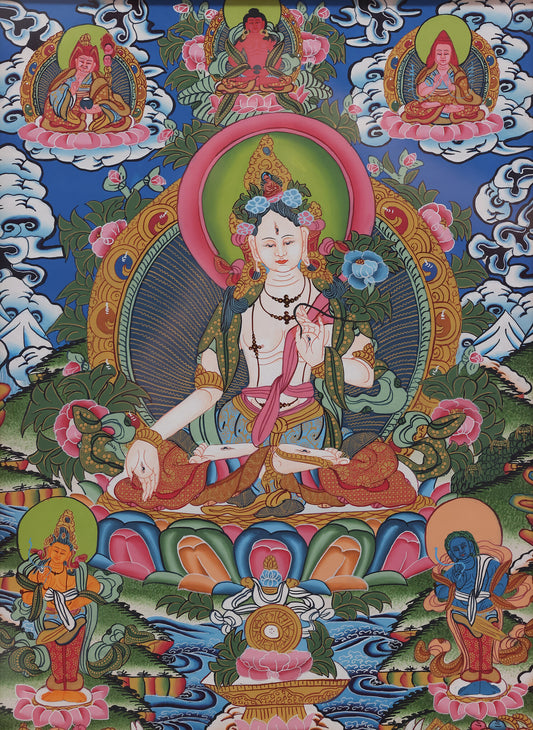
This hand-painted thangka centers on the Long Life Trinity, one of the most revered devotional themes in Tibetan Buddhism. Symbolizing longevity, obstacle removal, and the increase of merit, the Long Life Trinity is regarded as a fundamental source of blessing for physical health, mental stability, and spiritual continuity.
The veneration of the Long Life Trinity does not arise from a simple desire for extended lifespan alone. Rather, it emerges from the integration of Vajrayana ritual traditions with the Tibetan understanding of life shaped by the harsh realities of the Himalayan plateau. In an environment marked by extreme climate and uncertainty, the preservation and flourishing of life became a deeply spiritual concern. As a result, the Long Life Trinity evolved into one of the most accessible and universally embraced devotional configurations in Tibetan Buddhist practice.
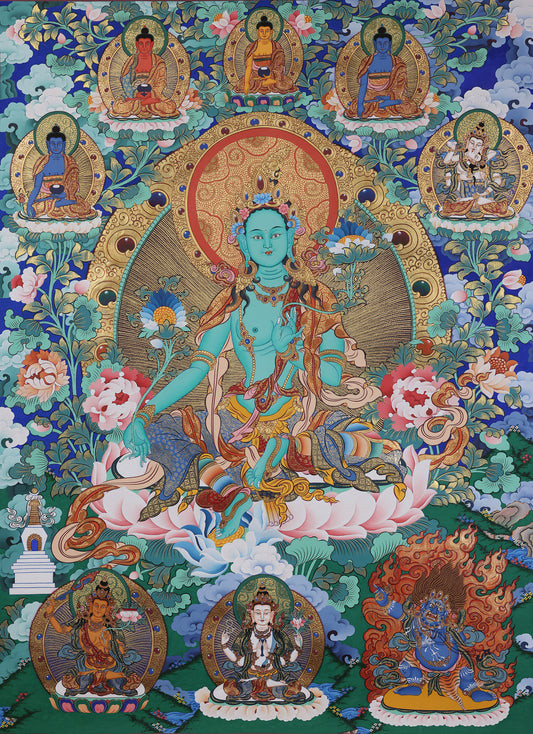
Traditionally, Amitayus (the Buddha of Infinite Life) occupies the central position within the Long Life Trinity. However, this thangka presents a ritually valid variant composition, placing White Tara at the visual center. This choice emphasizes her unique qualities of swift compassion, protection from danger, and the rapid fulfillment of prayers, while still preserving the tantric principle of combined blessings through the unity of the three deities.
For practitioners and devotees, offering and contemplating this thangka is not merely an act of wishing for a longer life. It represents a holistic aspiration: to be seen and guided by White Tara’s all-perceiving wisdom, purified by Amitayus’ nectar of immortality, and protected by Ushnishavijaya’s indestructible power—ultimately attaining physical well-being, mental peace, and the harmonious union of merit and wisdom.
II. The Principal Deity: Iconography and Symbolism of White Tara
At the center of the composition sits White Tara (Tibetan: Drolma Karpo), one of the Twenty-One Taras and an emanation of Avalokiteshvara’s compassionate tears. In Tibetan Buddhism, White Tara embodies boundless compassion, longevity, healing, and the swift alleviation of suffering.
Her iconography strictly follows classical Vajrayana measurements and ritual texts, with every visual element carrying symbolic meaning.
Physical Appearance
White Tara’s body is luminous white, like a full moon, symbolizing pure, undefiled wisdom. She appears in the form of a sixteen-year-old maiden, representing eternal youth, vitality, and the unceasing flow of life force.
She wears a jeweled crown adorned with floral motifs, along with earrings, necklaces, armlets, and anklets—ornaments associated with sambhogakaya manifestations and the Tibetan aesthetic ideal of spiritual completeness.
Her most defining feature is her seven eyes: two on her face, one on her forehead, and one on each palm and sole. The eye on her forehead perceives all Buddha realms, while the eyes on her hands and feet observe the beings of the six realms. This signifies uninterrupted, all-embracing compassion without blind spots, earning her the title “The Seven-Eyed Mother.”
Hand Gestures and Attributes
Her right hand rests upon her knee in the gesture of granting wishes, signifying responsiveness to the sincere prayers of sentient beings.
Her left hand, held at her heart in the Three Jewels mudra, gently supports the stem of a blooming white lotus that rises beside her shoulder. The lotus represents purity and awakening, while its open blossom symbolizes the nourishment of wisdom through the Dharma.
Lotus Seat and Aura
White Tara sits upon a lotus and moon disc throne. The lotus signifies liberation from worldly afflictions, and the moon disc represents cool serenity and mental clarity.
Behind her, layered halos of green, pink, and gold radiate outward, embellished with scrolling floral patterns. This luminous backdrop reflects the doctrinal teaching that enlightened beings naturally emit light, while also showcasing the distinctive color transitions of the Rebgong thangka tradition.
III. Attendant Deities: A Mandala of Protection and Blessing
The surrounding figures are arranged in a mandala-like structure, expressing the hierarchical order of Tibetan Buddhist cosmology—principal deity, attendant figures, and protective guardians—and reinforcing the concept of accumulated blessings.
Upper Register
Above the central deity appear the remaining members of the Long Life Trinity, often accompanied by lineage masters:
— Amitayus, depicted with a red body and holding a vase of longevity nectar, symbolizes infinite life, merit, and blissful wisdom.
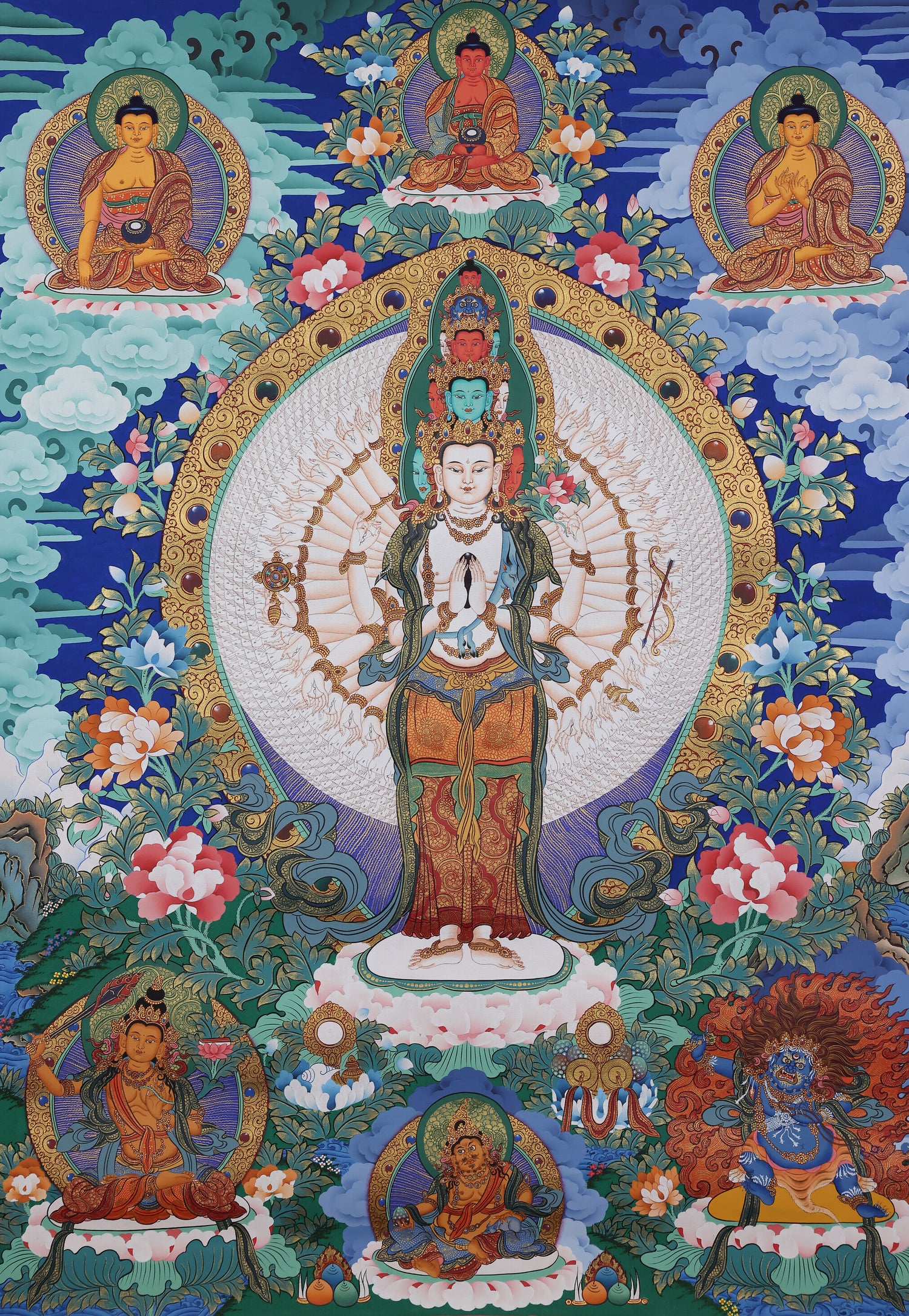
— Ushnishavijaya, shown with multiple arms and faces, represents the power to purify karma, avert misfortune, and stabilize life circumstances. Her attributes—such as the longevity vase and the gesture of fearlessness—signify purification and protection.
This arrangement reflects both the thematic unity of the Long Life Trinity and the Vajrayana emphasis on lineage transmission and guru blessing.
Lower Register and Protectors
At the lower section of the thangka appear bodhisattvas such as Manjushri and Vajrapani, typically distinguished by orange and blue hues, symbolizing wisdom and spiritual power.
Fierce worldly protectors occupy the central and flanking positions below. Their wrathful expressions embody the forceful removal of obstacles and the safeguarding of the Dharma. The coexistence of peaceful deities and wrathful protectors reflects Tibetan Buddhism’s understanding of compassion and power as complementary forces, addressing both spiritual and worldly challenges.
IV. Painting Technique: The Mineral Colors and Gold Craft of Rebgong Thangka
This thangka belongs to the Rebgong (Rongwo) thangka tradition, originating in present-day Qinghai. Renowned for its refined line work, rich mineral pigments, and sophisticated gold application, Rebgong thangka represents one of the highest achievements in Tibetan sacred art.
Canvas Preparation
The painting surface begins with pure cotton cloth, coated with a solution of animal bone glue and fine mineral ground, then polished repeatedly with smooth stones. This meticulous preparation ensures a flawless surface and allows mineral pigments to adhere securely, forming the foundation for a thangka that can endure for generations.
Natural Pigments
All colors are derived from natural minerals and plants:
white from finely ground stone powders of central Tibet, blue and green from azurite and malachite, red from cinnabar or coral powder, and yellow from mineral ochre and orpiment.
These pigments produce a dense, jewel-like luminosity and remarkable color stability. White Tara’s complexion is rendered with layered white pigments blended with traces of pearl powder, achieving a gentle radiance and subtle depth.
Gold Application
The painting incorporates 24K gold through both line gilding and gold leaf application.
Ultra-fine brushes are used to outline details such as jewelry and halos, while broader gold surfaces are burnished and engraved with agate tools—a hallmark technique of Rebgong thangka—creating contrasts between matte and reflective gold that enhance dimensionality and sacred splendor.
Artistic Technique
The composition combines flat color application with gradual shading. Facial features are built through delicate tonal transitions, while clouds and decorative motifs emphasize rhythmic ornamentation.
The most demanding stage, known as “opening the face,” determines the spiritual presence of the deity. White Tara’s serene expression—arched brows, gentle gaze, and subtle smile—along with the precise symmetry of her seven eyes, reflects the master artist’s discipline and spiritual training.
This thangka is more than just a painting—it is a vital vessel for the "visualization of faith" in Tibetan Buddhism.
It responds to humanity’s universal longing for health and stability through the Three Longevity Deities; it embodies the cosmic order of Buddhism via its rigorous iconographic system; and it interprets the profound meaning of "the eternal abiding of the Dharma" through enduring mineral pigments and pure gold.
#TibetanBuddhistThangka
#LongLifeTrinity#ThreeDeitiesOfLongevity
#LongevityThangka#TibetanSacredArt#WhiteTara
#AmitayusBuddha#Ushnishavijaya#BuddhistBlessings#HandPaintedThangka
#RegongThangka#HimalayanArt#MineralPigmentArt#24KGoldThangka#MeditationArt
#HomeShrineArt#SpiritualWallArt#BuddhistArtCollection#LongevityAndProtection