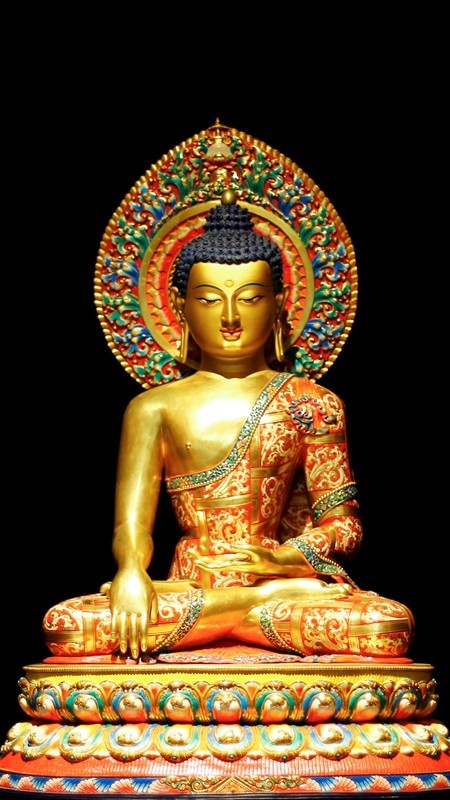
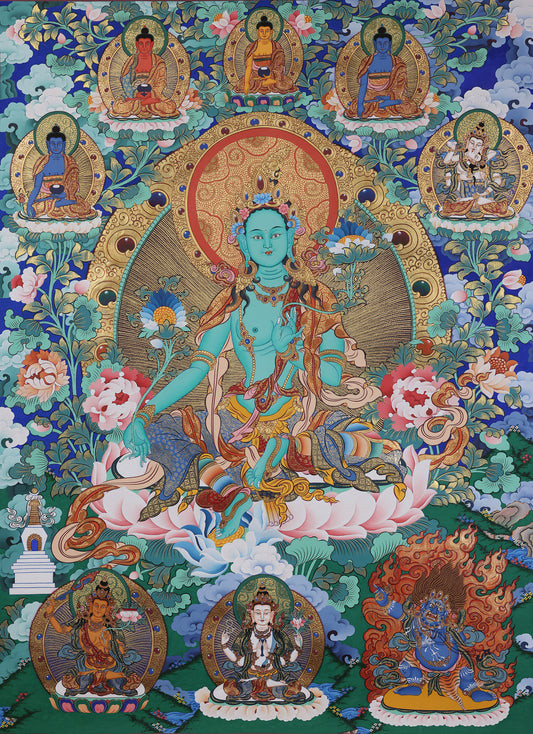
Have you ever seen a hand-painted Nepalese work labeled a "Shakyamuni Thangka," only to find it depicts a golden-hued figure holding a treasure-vomiting rat? This 50x50cm thangka, painted entirely with mineral pigments, hides the deep wisdom of Tibetan Buddhism: "using secular resources to support spiritual practice." It is not an image of the Buddha, but a solitary thangka of Yellow Dzambhala—the chief of the Five Wealth Gods, and a crystallization of the Newar School’s millennium-old religious art from Nepal.
I. Correcting the Misconception: From "Shakyamuni Thangka" to Yellow Dzambhala’s Core Meaning
Many initially mistake this thangka for Shakyamuni Buddha, but its golden body and treasure-vomiting rat (per Tibetan Buddhist iconographic rules) clearly identify it as Yellow Dzambhala (Zambala Serpo in Tibetan)—the chief of the Five Wealth Gods.
The core theme of this thangka is not a story from the Buddha’s life, but the Tibetan Buddhist wisdom of "Dharma and Material Abundance": Yellow Dzambhala is a "Buddhist Protector + Wealth Deity" ordained by the Buddha himself. His role is to protect sincere practitioners, granting material resources to remove poverty as an obstacle to practice, while warning sentient beings that "wealth is a supportive condition for practice, not an object of greed."
This theme stems from Yellow Dzambhala’s canonical legend: When Shakyamuni Buddha taught the Great Prajnaparamita Sutra at Vulture Peak, demons caused landslides to disrupt the Dharma assembly. Yellow Dzambhala appeared in his golden form to quell the chaos and protect the assembly. The Buddha then enthroned him as the "Holy Lord of Yellow Treasures," tasking him with using wealth to support practitioners in achieving "both material and spiritual fulfillment."
II. Yellow Dzambhala: The Symbolic Language of Tibetan Buddhism in Iconography
This thangka strictly follows the Iconometric Canon, with every detail serving as a "symbolic language" of Tibetan Buddhism:
-
Golden Body: Corresponds to the "earth element" in Buddhist cosmology, symbolizing the stability and abundance of the earth; the golden hue also represents nobility and wealth enhancement.
-
Five-Buddha Crown: The crown worn on his head corresponds to the Five Dhyani Buddhas (Vairocana, Akshobhya, etc.), symbolizing Yellow Dzambhala’s wisdom to overcome the five poisons (greed, anger, delusion, arrogance, doubt).
-
Implements & Ritual Tools:
- Right hand holding the "Brahma Ratna" (peach-shaped fruit/vase): Symbolizes fulfilling sentient beings’ virtuous wishes, reminding supplicants to seek desires aligned with the Dharma.
- Left hand supporting the "Treasure-Vomiting Rat": This is a celestial treasure spirit that continuously spits out jewels, coral, and other treasures—symbolizing "wealth should circulate, not be hoarded," echoing the Buddhist teaching that "generosity is the source of wealth."
-
Royal Ease Posture + Foot on Conch: With his left leg crossed and right foot resting lightly on a white conch, this posture symbolizes freedom in samsara without being bound by greed; the conch represents both the ability to "retrieve treasures from the sea" and a warning: "Only by subduing greed can one truly possess wealth."
-
Ornaments & Belly Shape: The jewels adorning his body are not displays of luxury, but symbols of the merits of the "Six Paramitas" (generosity, morality, patience, etc.); his "large belly, small frame" is not a sign of gluttony, but compassion that embraces impoverished sentient beings—embodying the wisdom that "a broad heart brings good fortune."
III. The "Special Retinue" of Solitary Thangkas: Sacred Blessings of Circular Scripture
This 50x50cm thangka uses a solitary composition (no attendant bodhisattvas or offering goddesses). Its "retinue function" is replaced by the Tibetan scriptures written in gold powder around the main deity (typically Yellow Dzambhala’s mantra: "Om Dzambhala Zilay Zay Svaha").
In Tibetan Buddhist culture, thangkas are "mobile temples." These scriptures transform the work from mere visual art into a tool of religious ritual: when devotees recite the mantra while venerating the thangka, they align with Yellow Dzambhala’s aspirations and receive blessings for material support. The "retinue-free" layout also emphasizes the main deity, making it ideal for focused visualization during personal practice.
IV. Nepal’s Newar School: Craftsmanship and Artistry Behind the 50x50cm Thangka
This thangka is a hand-painted work of Nepal’s Newar School, whose craftsmanship and style blend religious orthodoxy with local artistic traits:
1. Rigorous Production Process
-
Pre-Painting Rituals: The artist bathes, purifies their mind, and chants prayers to ensure the purity of the creation—this is the starting point of the thangka’s "sacredness."
-
Canvas Preparation: Linen-cotton canvas is polished, coated with cow bone glue mixed with white clay, and treated with alum to prevent pigment bleeding; the 50x50cm size follows the same steps as large thangkas.
-
Coloring & Gilding: Mineral pigments (cinnabar, lapis lazuli, realgar) are layered for shading, then gold powder (ground from pure gold, mixed with glue) is used to outline scriptures and decorations—mineral pigments are hand-ground to over 2000 mesh, ensuring vivid colors that last for centuries.
-
Eye-Opening & Framing: The final step is painting the deity’s eyes (the "animation" of the thangka), performed by a qualified artist or lama; the thangka is framed with crimson silk (symbolizing the protective power of Dharma protectors in Tibetan Buddhism).
2. Artistic Traits of the Newar School
-
Vibrant Color Contrasts: The golden deity, black background, and crimson frame create a striking visual impact, aligning with Tibetan Buddhism’s aesthetic of "using bright colors to represent the sacred world."
-
Intricate Gilding: Gold powder details add opulence to the solemnity (distinguishing it from the more understated style of Tibetan thangkas).
-
Symmetrical Yet Dynamic Layout: The central deity and circular scriptures balance geometric symmetry with natural curves (e.g., flower branches), creating a composition that is both orderly and lively.
V. Dual Value of Nepal’s Yellow Dzambhala Thangka: Religious Vessel and Cultural Treasure
For Tibetan Buddhist devotees, this thangka is a "mobile temple for material support," embodying the wisdom of "Dharma and Material Abundance." For art enthusiasts, it is a microcosm of Newar School craftsmanship—its mineral pigments grant it timelessness, making it a cultural heritage spanning millennia.
Its value lies not just in visual splendor, but in the underlying Tibetan Buddhist spirit: "using wealth to serve practice, embracing sentient beings with compassion." This is the symbiosis of religion and art, and a testament to the cultural fusion of Nepal and Tibetan Buddhism.
#YellowDzambhalaThangka #NewarSchoolThangkaCraft #TibetanBuddhistThangkaMeaning #MineralPigmentHandpaintedThangka #FiveWealthGodsThangkaExplained #NepaleseThangkaArt #TibetanBuddhistWealthDeity #HandmadeBuddhistThangka #SacredThangkaIconography #NewarBuddhistArt #TraditionalNepaleseCraft #ThangkaCulturalHeritage #MineralPigmentThangka