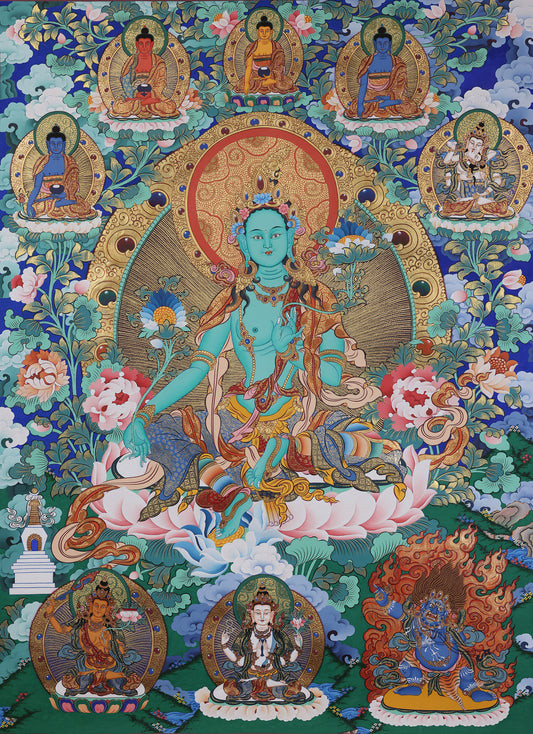
In the visual system of Tibetan Buddhism, a thangka is never merely a painting. It is a visible form of Dharma—an object to be contemplated, venerated, and practiced with. This Black Gold Tibetan Thangka of Akashagarbha Bodhisattva, created in the rare Rebgong black-gold tradition, integrates profound Vajrayana cosmology, spiritual symbolism, and intangible cultural heritage craftsmanship into a single sacred artwork of exceptional depth.
This thangka is not only a religious implement, but also a masterpiece of sacred art, embodying spiritual devotion, aesthetic refinement, and cultural legacy.
I. Theme and Main Deity: A Cosmic Symbol of Perfect Wisdom and Merit
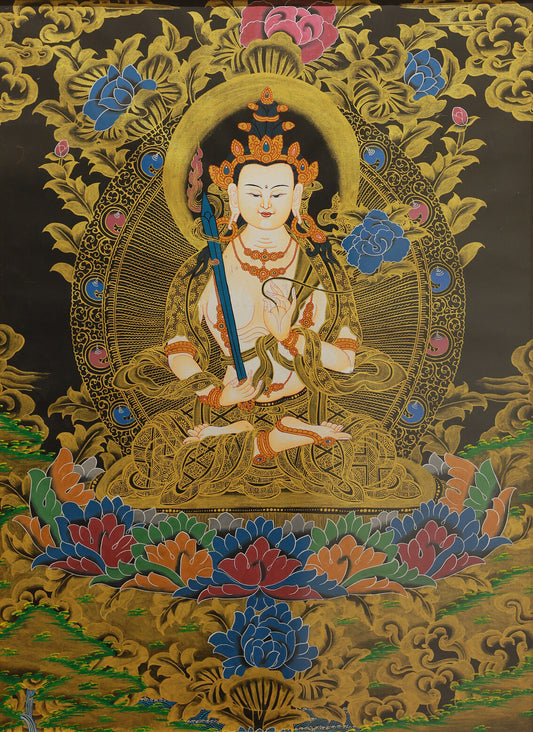
The central subject of this thangka is Akashagarbha Bodhisattva (Sanskrit: Ākāśagarbha), one of the Eight Great Bodhisattvas in Tibetan Buddhism. His name literally means “Treasury of Space,” symbolizing wisdom as vast as the sky and merit as inexhaustible as a treasure vault.
Within the Vajrayana Womb Realm Mandala, Akashagarbha presides over the Akashagarbha Court and is revered as the foremost attendant of the Buddhas of the three times—past, present, and future. He represents the complete accumulation of wisdom (prajñā) and merit (puṇya), making him a central figure in esoteric Buddhist practice.
In Tibetan Buddhist belief, Akashagarbha Bodhisattva fulfills three essential spiritual functions:
-
Lord of Wisdom – guardian of memory, learning, clarity, and intellectual development
-
Lord of Merit and Abundance – bestower of spiritual and material resources
-
Lord of Discipline – examiner of ethical conduct and purity in esoteric practice
For this reason, thangkas of Akashagarbha are traditionally enshrined in shrines, meditation rooms, and study spaces, serving as spiritual anchors for practitioners pursuing both wisdom and merit.
II. Iconography: A Precise and Majestic Vajrayana Form
This thangka strictly follows classical Tibetan iconometric texts and Vajrayana lineage standards, presenting Akashagarbha Bodhisattva with unmistakable iconographic clarity.
1. Sacred Physical Form
The Bodhisattva appears in a warm golden body tone, corresponding to the Ratna (Jewel) family of deities. He wears a Five-Buddha crown, symbolizing the five transcendent wisdoms, with a wish-fulfilling jewel set in the topknot—an emblem of Mount Sumeru and the cosmic center of the universe.
Adorned with jeweled earrings, necklaces, and celestial garments, his appearance fully accords with classical descriptions of Akashagarbha as “majestic as Indra, king of the gods.”
2. Attributes and Hand Gestures
-
Right hand holding the Sword of Wisdom: Surrounded by flames, it symbolizes the cutting away of ignorance and afflictions
-
Left hand forming the wish-granting gesture, gently holding a lotus stem: representing generosity, fulfillment of virtuous aspirations, and compassion
This specific combination distinguishes Akashagarbha from Manjushri, who holds a scripture in his left hand.
3. Posture and Lotus Throne
The Bodhisattva sits in full lotus posture upon a multi-layered lotus throne. The petals are shaded in red, blue, and green tones, adhering to iconometric prescriptions that require Bodhisattva lotus thrones to possess eight principal petals, while symbolizing emergence from the mire of samsara into awakened purity.
III. Hidden Guardians: A Protective System Embedded in Ornamentation
This thangka adopts the classic single-deity composition of Rebgong black thangkas. Attendant deities are not depicted explicitly, but rather implied through symbolic patterns and visual metaphors—an esoteric method emphasizing unity within multiplicity.
-
Halo and Aureole: Interwoven vajra motifs and flame patterns signify the encircling protection of Vajra-family guardians
-
Border Ornamentation: Blue lotuses and pink peonies (often used in Tibetan art as substitutes for auspicious floral offerings) represent the Eight Offering Goddesses
-
Landscape Motifs: Golden cloud patterns and turquoise hills beneath the lotus throne subtly reference the Nāga spirits of the Eight Classes of Beings, protectors of the Dharma
The black background itself carries profound meaning—symbolizing the formidable power of protector deities in Bön and Vajrayana traditions—while the layered gold linework reflects the continuous radiance of the Five Dhyani Buddhas. This visual strategy preserves solemn simplicity while conveying an all-encompassing cosmology.
IV. Artistic Craftsmanship: The Pinnacle of Rebgong Black Gold Thangka Art
This work belongs to the Rebgong Black Thangka tradition (Tibetan: Nag Thang), one of the most technically demanding and prestigious forms of Tibetan sacred painting.
1. Creation of the Black Ground
The base is prepared using 99.9% pure natural graphite, finely ground and blended with aged yak-hide glue. Applied in over 50 ultra-thin layers—each under 0.02 mm thick—onto specially treated Tibetan cloth, the surface achieves a matte, lacquer-like texture renowned for its durability and stability.
This method inherits ancient Bön reverence for black while ensuring exceptional pigment longevity, with color retention exceeding 96% after 50 years.
2. Gold Line Drawing
All outlines are rendered using 24K pure gold pigment, applied with ultra-fine brushes made of only a few hairs.
-
Robe folds combine iron-wire and orchid-leaf line techniques, achieving both silk-like fluidity and strict anatomical correctness
-
Halo vajra patterns employ an advanced black-gold layered shading method, creating luminous depth through engraved shadows
This technique requires approximately three times the labor of standard thangka painting and is mastered by only a handful of non-heritage lineage artists.
3. Mineral Pigments and Facial Rendering
Natural mineral pigments—lapis lazuli, cinnabar, and malachite—are sparingly applied to crowns and lotus petals. Each pigment undergoes traditional purification processes to ensure permanence over centuries.
The face is rendered using subtle ink outlines blended with gold powder, producing gentle brows and lotus-petal eyes in accordance with classical descriptions of Bodhisattva physiognomy. This restrained elegance reflects the distinctive style of the Wutun Upper Village school, famed for its gold-line facial technique.
V. Cultural Significance: A Living Union of Faith and Art
This Black Gold Akashagarbha Thangka stands at the intersection of devotion, artistry, and cultural transmission:
-
Spiritual Value: A visual embodiment of the Vajrayana ideal of cultivating wisdom and merit simultaneously
-
Artistic Value: A supreme example of contemporary Rebgong black-gold thangka aesthetics
-
Heritage Value: Created using UNESCO-recognized intangible cultural heritage techniques, with a production cycle of up to 18 months, ensuring rarity and authenticity
It is not merely a painting, but a sacred object through which Buddhist philosophy becomes visible.
Conclusion
Centered on Akashagarbha Bodhisattva and realized through black-gold mastery, this thangka condenses Tibetan Buddhist cosmology, spiritual discipline, and artistic devotion into a single, radiant form. It transcends decorative art, standing instead as a “visible Dharma”—a sacred presence meant to be contemplated, revered, and preserved across generations.
Akashagarbha Bodhisattva
Black Gold Thangka
Tibetan Thangka
Tibetan Buddhism
Vajrayana Art
Sacred Buddhist Art
Hand Painted Thangka
Rebgong Thangka
Himalayan Art
Bodhisattva Thangka
Meditation Art
Spiritual Wall Art
Buddhist Altar Art