A Deep Dive into a Nepalese Hand-Painted Green Tara Thangka: Tibetan Buddhist Symbolism, Iconography, and Artisanal Craftsmanship

$499.00 USD
Thangka Name: Rainbow Tang Green Tara
Size: 20cm×30cm
Origin: Nepal
Eine Frage stellen

Beeil dich! Nur noch [Anzahl] auf Lager!

Geschätzte Lieferzeiten: 12–26 Tage (International), 3–6 Tage (USA).

Rückgabe innerhalb von 45 Tagen nach dem Kauf. Zölle und Steuern werden nicht erstattet.

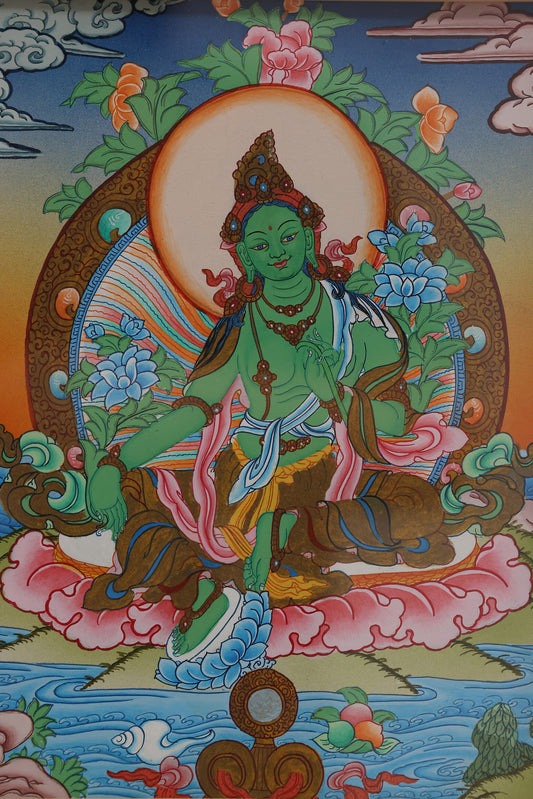
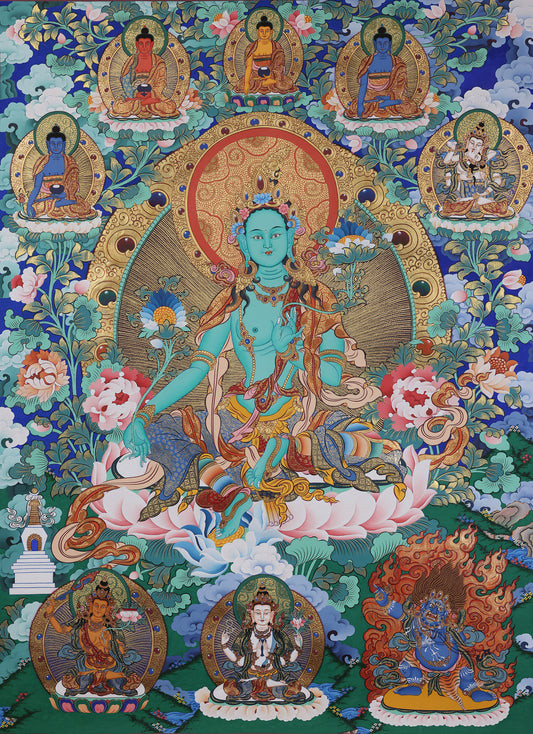
Alt text: Hand-painted Tibetan Thangka of Green Tara, showcasing intricate traditional artistry.
A Deep Dive into a Nepalese Hand-Painted Green Tara Thangka: Tibetan Buddhist Symbolism, Iconography, and Artisanal Craftsmanship
$499.00 USD
When a thangka of vivid emerald hues unfolds in the palm, its 20×30cm frame holds millennia of spiritual faith and artisanal heritage from the Himalayan cultural sphere. This is a hand-painted Green Tara thangka from Nepal: its central deity rendered in malachite-derived green, its background 晕染 with lapis lazuli, its crown and ornaments outlined in gold leaf—every stroke of color and line resonates with Tibetan Buddhist iconographic rules and Newari artisanal precision.

I. The Central Deity: Green Tara, the "Savioress from Eight Perils"

At the heart of this thangka is Green Tara, the most widely venerated female deity in Tibetan Buddhism.

According to Tibetan scriptures The Origin of Tara, Green Tara emerged from a teardrop shed from the left eye of Avalokiteshvara (the Bodhisattva of Compassion). When Avalokiteshvara wept at the suffering of sentient beings, his left tear fell to the earth, sprouting a lotus that bloomed into Green Tara. She vowed, "I shall liberate all beings in female form," cementing her role as a symbol of compassion in action. Revered as the "Savioress from Eight Perils," she is believed to free devotees from threats like lions, elephants, snakes, water, fire, imprisonment, thieves, and malevolent spirits. She also embodies the transformation of doubt (one of the "five poisons" of the mind) into wisdom.

Her iconography strictly adheres to the Iconometric Canon of Tibetan Buddhist Art:

  • Complexion and Form: Her emerald-green body (made from ground malachite pigment) symbolizes "vital, regenerative energy," aligning with the "Activity Family" of the Buddha Amoghasiddhi. She takes the form of a sixteen-year-old maiden, with the round cheeks and almond eyes characteristic of Nepal’s Newari school. Adorned with a Five-Buddha Crown, she embodies the "unified wisdom of the five directional Buddhas."
  • Mudras and Implements: Her right hand forms the Abhaya Mudra (gesture of fearlessness) resting on her right knee, signifying "responding to the wishes of sentient beings." Her left hand forms the Tri Ratna Mudra (gesture of the Three Jewels: Buddha, Dharma, Sangha) at her chest. Each hand holds a blue utpala lotus, its stem curling to her ear; the lotus bears fruit, a blooming flower, and an unopened bud—symbolizing the blessings of "past, present, and future Buddhas."
  • Posture and Lotus Throne: She sits in the Ardha Paryanka Asana (half-lotus, right leg extended to the ground), known as the "Savior’s Posture," representing readiness to rise and liberate beings. She rests on a double lotus moon disc: the lower, full petals signify worldly purity, while the upper moon disc represents the "pure dharmakaya realm"—a Tibetan iconographic marker of the divide between the mundane and the sacred.

II. Retinue Deities: Symbolic Protectors in Decoration

As a 20×30cm "personal thangka," this work does not depict retinue deities explicitly. Instead, it embeds their symbols in its decorations—a hallmark of small Nepalese thangkas, balancing size constraints with devotional functionality.

  • Background Flowers: Incarnations of Flower Offerings: The blue lotuses and pink peonies (a Nepalese variant of the "precious phase flower") surrounding the deity are not mere ornamentation; they symbolize flower-offering goddesses. In Tibetan ritual, offering flowers to a deity represents "devoting worldly beauty to the Dharma," and their interwoven branches evoke the "perfection of the dharmadhatu."
  • Bottom Ritual Implements: Protection of Vaishravana: The dharma wheel and white conch at the bottom are iconic symbols of Vaishravana (the Guardian King of Wealth). The wheel represents "the unceasing flow of the Dharma," while the conch symbolizes "the Buddha’s teaching voice." Nepalese Green Tara thangkas often integrate Vaishravana’s symbols to represent "dual blessings: liberation and abundance," aligning with devotees’ worldly aspirations.
  • Cloud Motifs: Guardianship of Dragon Spirits: The "auspicious cloud patterns" (a Newari style signature) are simplified symbols of the Naga (dragon spirits) from the Eight Classes of Protectors. In Tibetan belief, Nagas guard the Dharma, and the clouds’ flowing form signifies "protectors shielding practitioners from obstacles."

III. Craftsmanship: Newari Tradition’s Mineral-Pigment Precision

Half the value of this thangka lies in its spirituality; the other half in its craftsmanship—rooted in Nepal’s Newari school, which uses "natural materials and strict ritual" to create "eternal icons."

  • Canvas: The "Three-Varnish, Nine-Dye" Foundation: Made from fine Nepalese cotton, the canvas is coated with a mixture of cow bone glue and chalk, then sanded repeatedly (3–5 times) until smooth as paper. This "three-varnish, nine-dye" process ensures the thangka resists decay for centuries, reflecting the belief that "thangkas, as vessels of the Dharma, must endure."
  • Pigments: Gifts of Earth and Minerals: All pigments are natural, with each color carrying symbolic meaning and cost:
    • Green Tara’s complexion: Ground malachite (a copper-containing mineral) mixed with cow bile, layered 3–5 times to achieve a "vibrant yet subdued" hue.
    • Background blue: Ground lapis lazuli (sourced from Afghanistan), one of the most expensive thangka pigments, symbolizing "emptiness and wisdom."
    • Crown and ornaments: 24K gold leaf ground into powder and mixed with bone glue; the gold’s luster represents "the light of Buddha’s wisdom."

      These pigment-glue mixtures resist fading for hundreds of years, distinguishing traditional Nepalese thangkas from mass-produced prints.
  • Painting: Devotion Measured by the Canon: The work strictly follows the Iconometric Canon’s "twelve-finger measurement": the deity’s face spans three fingers, her body twelve fingers—no proportions are arbitrary. To Newari artisans, "precise iconography is reverence for the deity"; even minor deviations render the work "impure," requiring it to be destroyed and redone.

IV. Style: The Opulence and Refinement of the Newari School

This thangka exemplifies Nepal’s "Late Newari Style," distinct from the "open, substantial" aesthetic of Tibetan thangkas, embracing ornate refinement:

  • Composition: Centralized Density as Aesthetic: The deity occupies 90% of the frame, with decorations tightly surrounding her (no negative space)—a classic Newari composition symbolizing "no gaps in the dharmadhatu; the deity’s blessings are omnipresent."
  • Color: Saturated Spiritual Visuals: Bold contrasts between emerald (deity), deep blue (background), and vermilion (crown) are softened by gold outlines. The colors themselves carry meaning: green for vitality, blue for emptiness, red for compassion—merging aesthetics with doctrine.
  • Form: The Feminine Grace of Newari Art: The deity’s slender figure and clinging, curved drapery (unlike the heavy robes of Tibetan thangkas) and her round-cheeked, almond-eyed face embody feminine softness—reflecting Nepal’s cultural reverence for women as "nurturers of life."

Conclusion: Faith and Civilization in a Small Frame

This 20×30cm Green Tara thangka is more than art; it is a microcosm of Himalayan culture: it carries Tibetan Buddhism’s devotion to liberation, preserves the Newari artisans’ millennial craftsmanship, and distills the daily devotional practice of "personal visualization and constant protection."

As mineral pigments settle into the cotton and brushstrokes define the savioress’s compassion—this thangka transcends "objecthood" to become a visual expression of faith.

#NepaleseThangka #GreenTara #TibetanBuddhistArt #NewariSchool #MineralPigmentThangka
Entdecken Sie das perfekte tibetisch-buddhistische Thangka, das zu Ihren Wünschen, Ihrem Lebensstil und Ihrem Raum passt. Jedes Thangka hat eine spirituelle Bedeutung und bringt Segen, wenn es richtig platziert wird.

1. Definieren Sie Ihre Absicht

Reichtum & Erfolg → Gelber Dzambhala (Gottheit des Reichtums)

Mitgefühl und Frieden → Avalokiteshvara, Grüne Tara

Weisheit & Lernen → Manjushri

Gesundheit & Heilung → Medizinbuddha

Langlebigkeit und Familienschutz → Weiße Tara

2. Wählen Sie nach Identität

Unternehmer und Geschäftsinhaber → Reichtumsgottheiten für Wohlstand.

Studenten und Gelehrte → Weisheitsgottheiten für Konzentration und Klarheit.

Heiler und Yoga-Praktizierende → Medizinbuddha für Energie und Gleichgewicht.

Familien und Hausfrauen → Tara-Gottheiten für Harmonie und Sicherheit.

Sammler und Kunstliebhaber → Seltene Mandalas oder Meisterwerk-Thangkas.

3. Passen Sie Ihren Raum an

Heimschrein / Meditationsraum → Mittlere Thangkas (60–80 cm).

Büro / Geschäftshalle → Große Thangkas für Wohlstand und Autorität.

Wohnzimmer / Arbeitszimmer → Dekorative Thangkas für Frieden und Schönheit.

4. Authentische Handwerkskunst

Jedes Thangka ist mit natürlichen Mineralpigmenten und feiner Leinwand handbemalt und spiegelt tibetische Kunstfertigkeit und spirituelle Kraft wider. Überprüfte Quellen gewährleisten Qualität und Respekt für die Tradition.

✨ Wählen Sie Ihr Thangka mit Herz – es ist nicht nur Kunst, sondern ein Segen für Ihr Leben.

Jeder Mensch hat unterschiedliche Bedürfnisse. Die Wahl des richtigen Thangkas kann spirituelle Unterstützung, Schutz, Glück und Segen bieten. Nachfolgend finden Sie Thangka-Empfehlungen für verschiedene Rollen:

1. Unternehmer

  • Bedürfnisse : Weisheit, Reichtum, Gesundheit, beruflicher Erfolg.
  • Empfohlene Thangkas :
    Manjushri : Verbessert die Entscheidungsfindung und Geschäftsweisheit.
    Gottheit des Reichtums : Bringt Reichtum und Wohlstand.
    Medizinbuddha : Unterstützt die Gesundheit und reduziert Stress.
    Mahakala : Schützt Unternehmen vor Konkurrenz und Herausforderungen.

2. Erfolgreiche Einzelpersonen

  • Bedürfnisse : Innerer Frieden, Familienharmonie, Langlebigkeit.
  • Empfohlene Thangkas :
    Amitabha Buddha : Bringt inneren Frieden und Ruhe.
    Avalokiteshvara (Guanyin) : Fördert Harmonie und Glück in der Familie.
    Amitayus (Langlebens-Buddha) : Betet für gute Gesundheit und ein langes Leben.
    Manjushri : Stärkt weiterhin die Weisheit.

3. Hausfrauen/Ehemänner

  • Bedürfnisse : Familienharmonie, Schutz, Gesundheit.
  • Empfohlene Thangkas :
    Avalokiteshvara : Steigert das Familienglück und die Harmonie.
    Schutzgottheiten : Beschützen die Familie vor äußeren Störungen.
    Weiße Tara : Segnet die Familie mit Gesundheit.

4. Studierende und Wissenschaftler

  • Bedürfnisse : Weisheit, Konzentration, akademischer Erfolg.
  • Empfohlene Thangkas :
    Manjushri : Fördert Lernfähigkeit, Gedächtnis und Weisheit.
    Shakyamuni Buddha : Hilft bei der Konzentration und spirituellen Praxis.
    Jixiang Tianmu : Bringt akademisches Glück und Prüfungserfolg.

5. Künstler und Kreativprofis

  • Bedürfnisse : Inspiration, Kreativität, künstlerische Leistung.
  • Empfohlene Thangkas :
    Manjushri : Regt kreatives Denken und Inspiration an.
    Vajrapani : Hilft, kreative Blockaden zu überwinden.
    Maitreya : Sorgt für eine entspannte und optimistische Einstellung und baut Stress ab.

6. Reisende und Abenteurer

  • Bedürfnisse : Schutz, Glück, Erfolg bei Abenteuern.
  • Empfohlene Thangkas :
    Hayagriva : Bietet starken Schutz auf Reisen und beseitigt Hindernisse.
    Mahakala : Bringt Glück und Schutz, insbesondere für Abenteurer.
    Vajrasattva : Hilft, Schwierigkeiten und Herausforderungen während der Reise zu überwinden.

7. Ältere Menschen

  • Bedürfnisse : Gesundheit, Langlebigkeit, spiritueller Frieden.
  • Empfohlene Thangkas :
    Amitayus : Betet für ein langes Leben und gute Gesundheit.
    Medizinbuddha : Fördert Heilung und körperliches Wohlbefinden.
    Avalokiteshvara : Bringt Mitgefühl und inneren Frieden in späteren Jahren.

8. Führungskräfte

  • Bedürfnisse : Führung, Weisheit, Teamarbeit und geschäftlicher Erfolg.
  • Empfohlene Thangkas :
    Manjushri : Verbessert Führungsqualitäten und Entscheidungsfindung.
    Gottheit des Reichtums : Bringt dem Unternehmen und dem Team Erfolg und Wohlstand.
    Avalokiteshvara : Fördert Harmonie und Gleichgewicht innerhalb des Teams.

9. Gesundheits- und Fitnessbegeisterte

  • Bedürfnisse : Gute Gesundheit, Vitalität, Energie.
  • Empfohlene Thangkas :
    Medizinbuddha : Verbessert die körperliche Gesundheit und Vitalität.
    Weiße Tara : Bringt Gesundheit und Verjüngung.
    Vajrasattva : Beseitigt gesundheitliche Probleme und steigert die Energie.

10. Politiker

  • Bedürfnisse : Führung, Weisheit, Frieden.
  • Empfohlene Thangkas :
    Manjushri : Verbessert Führungsqualitäten und Entscheidungsfindung.
    Vairocana Buddha : Hilft, inneren Frieden und Weisheit zu bewahren.
    Avalokiteshvara : Fördert den gesellschaftlichen Frieden und die Harmonie in der Familie.

Für alle Bestellungen über 100 USD ist der Versand kostenlos.

Rücksendungen werden bis zu 10 Tage nach Erhalt des Kaufbelegs bzw. der Sendungsnummer (bei ungetragenen Artikeln) akzeptiert. Sie als Kunde sind verpflichtet, uns vor der Rücksendung des Artikels per E-Mail zu informieren.

Andernfalls fallen die Standardversandkosten an. Weitere Informationen finden Sie in unseren Lieferbedingungen .

Rücksendungen werden bis zu 10 Tage nach Erhalt des Kaufbelegs oder der Sendungsnummer (bei ungetragenen Artikeln) akzeptiert. Sie als Kunde sind verpflichtet, uns vor der Rücksendung des Artikels per E-Mail zu informieren, nur in folgenden Fällen:

– Den falschen Artikel erhalten.
– Artikel kam nicht wie erwartet an (z. B. beschädigte Verpackung).
– Artikel hatte Mängel.
– Über die Lieferzeit hinaus.
– Der Spediteur gestattet keine Besichtigung der Ware vor der Bezahlung.

Die zurückgesendeten Produkte müssen in der Originalverpackung, sicher verpackt, unbeschädigt und ungetragen sein. Dies bedeutet, dass die Artikel zum Schutz während des Transports sicher in einem Karton verpackt sein müssen, möglichst im selben Karton, in dem sie an Sie als Kunde versendet wurden.

Kürzlich angesehen

Nicht vergessen! Die Produkte, die Sie angesehen haben, legen Sie jetzt in den Warenkorb.

Passt gut zu

Erweitern Sie Ihre Auswahl mit perfekt abgestimmtem Zubehör und ergänzenden Produkten.

Leute kauften auch

Hier sind einige unserer ähnlichsten Produkte, die die Leute kaufen. Klicken Sie hier, um den Trendstil zu entdecken.