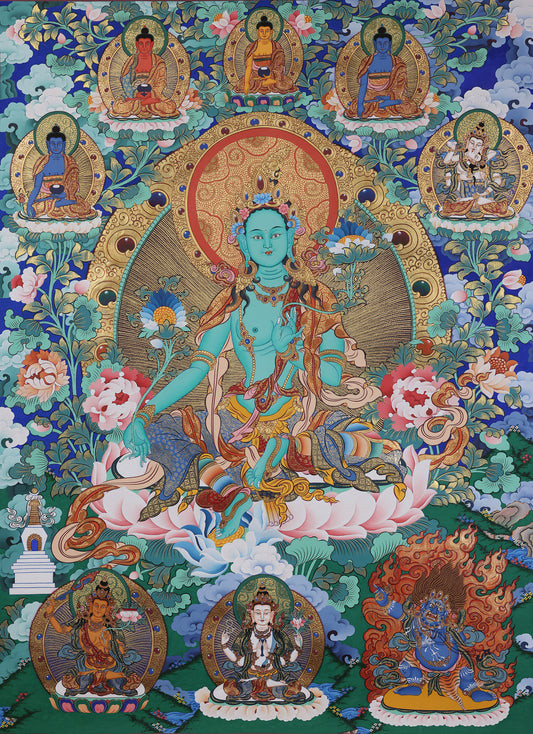
In Tibetan Buddhism, thangka paintings are more than visual art; they are ritual implements and meditation tools for practitioners. This “Lion’s Roar Manjushri Bodhisattva Thangka” is created in the Regong (Rebgong) style, entirely hand-painted, combining religious significance with artistic beauty. This article provides a detailed analysis of this thangka from five perspectives: thematic positioning, central deity symbolism, attendant figures and background, painting techniques, and cultural value.
1. Thematic Positioning: The Faith Carrier of “Wisdom Conquering Obstacles”
The central theme of this thangka is the “Lion’s Roar Manjushri Bodhisattva”, representing the wisdom protector within the Vajrayana and Sutrayana integrated system. In Tibetan Buddhism, Manjushri (Tibetan: Jangpai Yang) is revered as the “Teacher of the Seven Buddhas” and symbolizes supreme wisdom.
The “Lion’s Roar” aspect embodies conquering obstacles through wisdom, empowering practitioners to overcome mental afflictions and challenges. The thangka’s red background with gold detailing and the lion mount represent classic scriptural references from the Manjushri Root Texts: “Manjushri rides a lion and wields the sword of wisdom.” This composition also addresses the dual needs of practitioners: spiritual cultivation and removal of obstacles.
2. Central Deity Analysis: Symbolism of Lion’s Roar Manjushri
Body and Proportions
The central figure follows the 21:16 Bodhisattva ratio in the Sutra on Iconometry, ensuring that every detail embodies ritual significance.
-
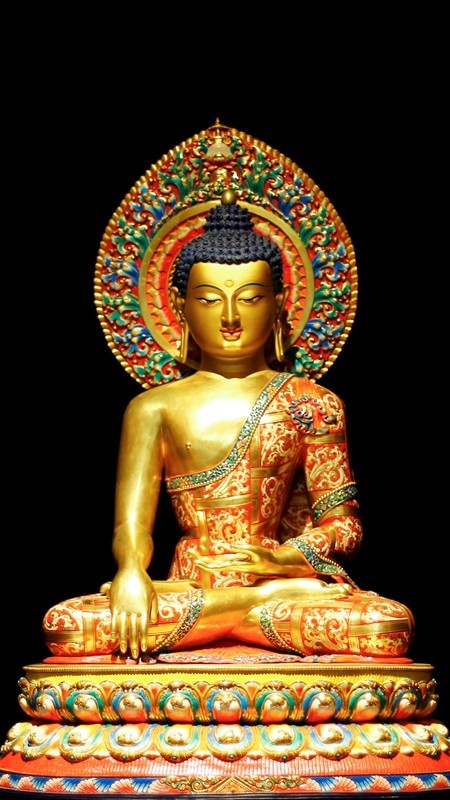
Golden Yellow Body: Yellow symbolizes “radiant wisdom” in Tibetan Buddhism. The skin is blended using realgar and gold powder at a 5:2 ratio, achieving a warm, luminous effect.
-
Facial Expression: Eyes cast downward in contemplation, lips slightly upturned — downward gaze represents observing sentient beings’ suffering, slight smile represents alleviating pain through wisdom, embodying compassion and intellect simultaneously.
Mudra and Attributes
-
Teaching Mudra (Manjushri Mudra): Represents expounding prajna teachings and guiding practitioners toward enlightenment.
-
Wisdom Sword on Left Shoulder: Sheath decorated with lapis lazuli; symbolizes cutting through ignorance and mental afflictions, consistent with Prajnaparamita Sutras.
Attire and Ornaments
-
Five-Buddha Crown: Represents the collective wisdom of the five directions, inlaid with turquoise and coral.
-
Three Strands of Jewelry: Necklaces and bracelets adorned with lapis lazuli and amber; lapis symbolizes cosmic wisdom, amber represents worldly merit accumulation.
Mount: Blue Lion
-
The blue lion (snow lion) is the iconic mount of Lion’s Roar Manjushri, symbolizing fearless bodhicitta.
-
White mane, black tail, red tongue, and a golden bell on the neck symbolize “awakening sentient beings with the sound of Dharma,” in accordance with the Avatamsaka Sutra: “Manjushri rides a blue lion, demonstrating courage and majesty.”
3. Attendants and Background: Functional Extensions of Symbolism
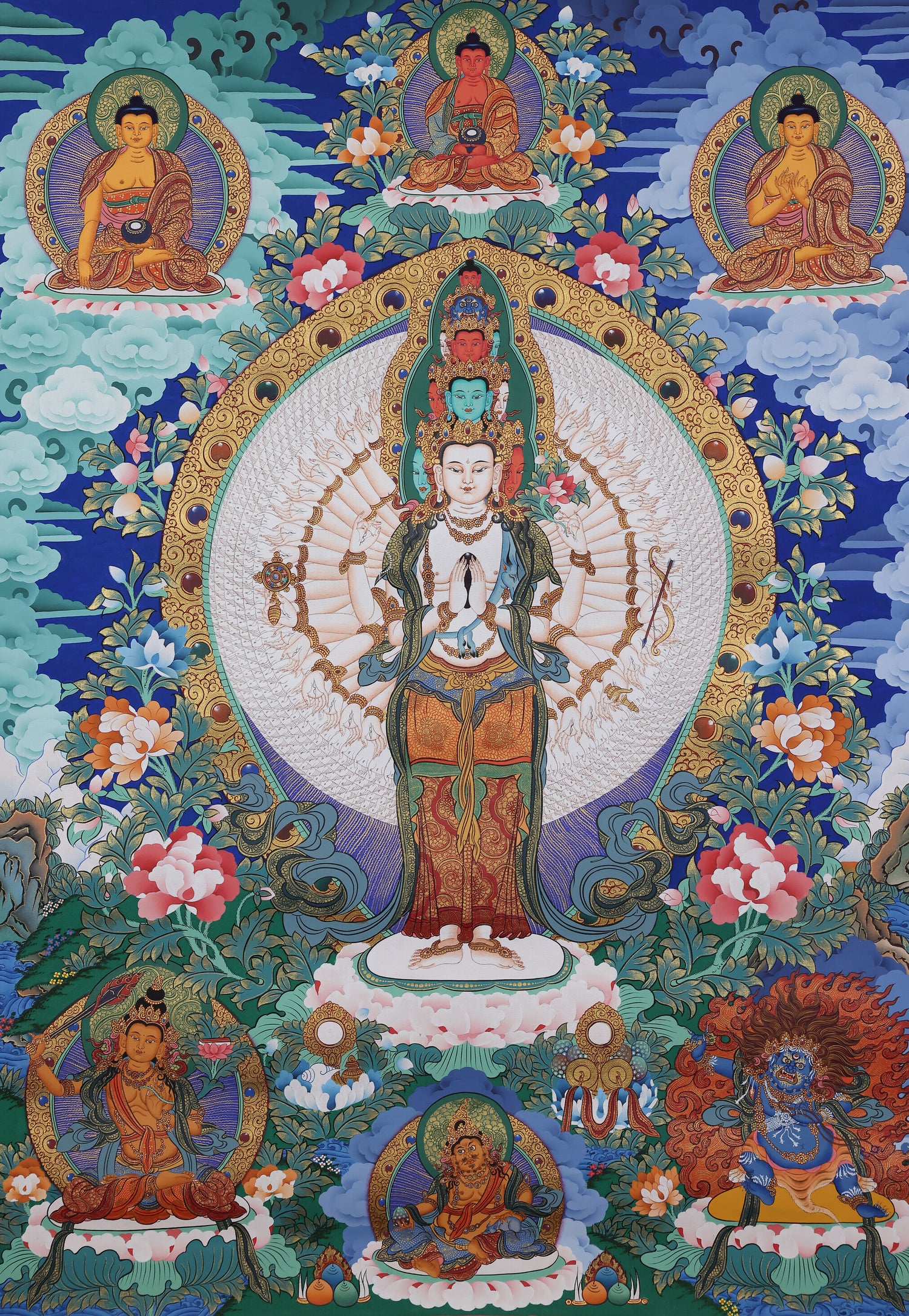
The lotus pedestal, clouds, and floral elements are not mere decoration; they serve as integral components of Manjushri’s iconography.
Floral Background: Lotus and Peony
-
Lotus (pink and white): Represents the continuity of wisdom.
-
Peony (multicolored shading): Symbolizes complete and perfect merit.
-
Both surround the central deity, echoing the teaching: “Wisdom and merit arise together like lotus and peony” (Manjushri’s Vows and Aspirations).
Lotus Pedestal and Cloud Patterns
-
Thousand-Petal Lotus Pedestal: Supports the blue lion, symbolizing Manjushri’s stable abode in the lotus of bodhicitta.
-
Scroll Clouds (blue-green gradient): Symbolize the pervasion of Manjushri’s wisdom across the three realms. The dynamic flow of clouds and stable lotus base convey the idea that wisdom spreads broadly while bodhicitta remains firm.
4. Painting Techniques: Regong-Style Mineral Pigments and Gold Craftsmanship
Canvas Preparation
-
Double-layered linen from Tongren, Qinghai, soaked for 4 years in yak glue (three boils, two filtrations), stretched on cypress frames.
-
Polished with agate stone until smooth and translucent, ensuring adherence of mineral pigments and gold leaf.
Mineral Pigments and Gold Work
-
Base Color: Cinnabar and coral red in 3:1 ratio, water-milled to 15μm, layered five times to form a deep and rich red base (“Manjushri Red”).
-
Gold Detailing: Combination of gold line drawing and relief gold techniques. Main deity’s robes outlined in 24K gold mixed with ox gall; backlight relief gold adds dimensional texture (thickness 0.08mm).
-
Color Accents: Only high-purity lapis lazuli (blue), malachite (green), and realgar (yellow) are used; lapis for clouds and sword sheath, malachite for flowers and leaves, realgar for skin shading. Cold and warm tones create visual contrast and balance.
Technique Features
-
Lines: Orchid-leaf style for floral and robe outlines, precision error <0.02mm; combines gentleness of the Bodhisattva with the sharpness of the wisdom sword.
-
Face Painting: Five-layer technique, requiring 15+ years of experience, producing the serene, compassionate expression.
-
Pre-Mounting Ritual: Consecration by a living lama using consecrated water and cinnabar “wisdom seal” on the brow, transforming the painting from artwork into ritual implement.
5. Cultural Value: From Art Medium to Meditation Tool
This thangka embodies both ritual significance and artistic rarity.
Religious Dimension
-
Core implement for Manjushri practices; by visualizing the deity and reciting the mantra, practitioners cultivate wisdom and remove obstacles.
-
Particularly suited for academic and career decisions, or any situations requiring insight and guidance.
Artistic Dimension
-
Representative of Regong-style red-background and gold-detail thangka.
-
Uses 80g of high-purity cinnabar and 6g of gold powder, adhering to first-class thangka material standards.
In Tibetan Buddhist culture, the Lion’s Roar Manjushri Thangka is never a static decoration. The red background represents afflictive karma, gold details symbolize illuminating wisdom, and the blue lion represents courage in subduing obstacles. Essentially, it transforms prajna wisdom into visual symbols for contemplation, making it a vivid example of spiritual pursuit intertwined with practical application in Tibetan culture.
#TibetanThangka #ManjushriBodhisattva #LionRoarManjushri #HandPaintedThangka #TibetanBuddhism #WisdomDeity #BuddhistArt #SpiritualArt #MeditationTool #MineralPigmentArt #GoldThangka #BuddhistThangka #TibetanArt #ReligiousArt #ObstacleRemoval