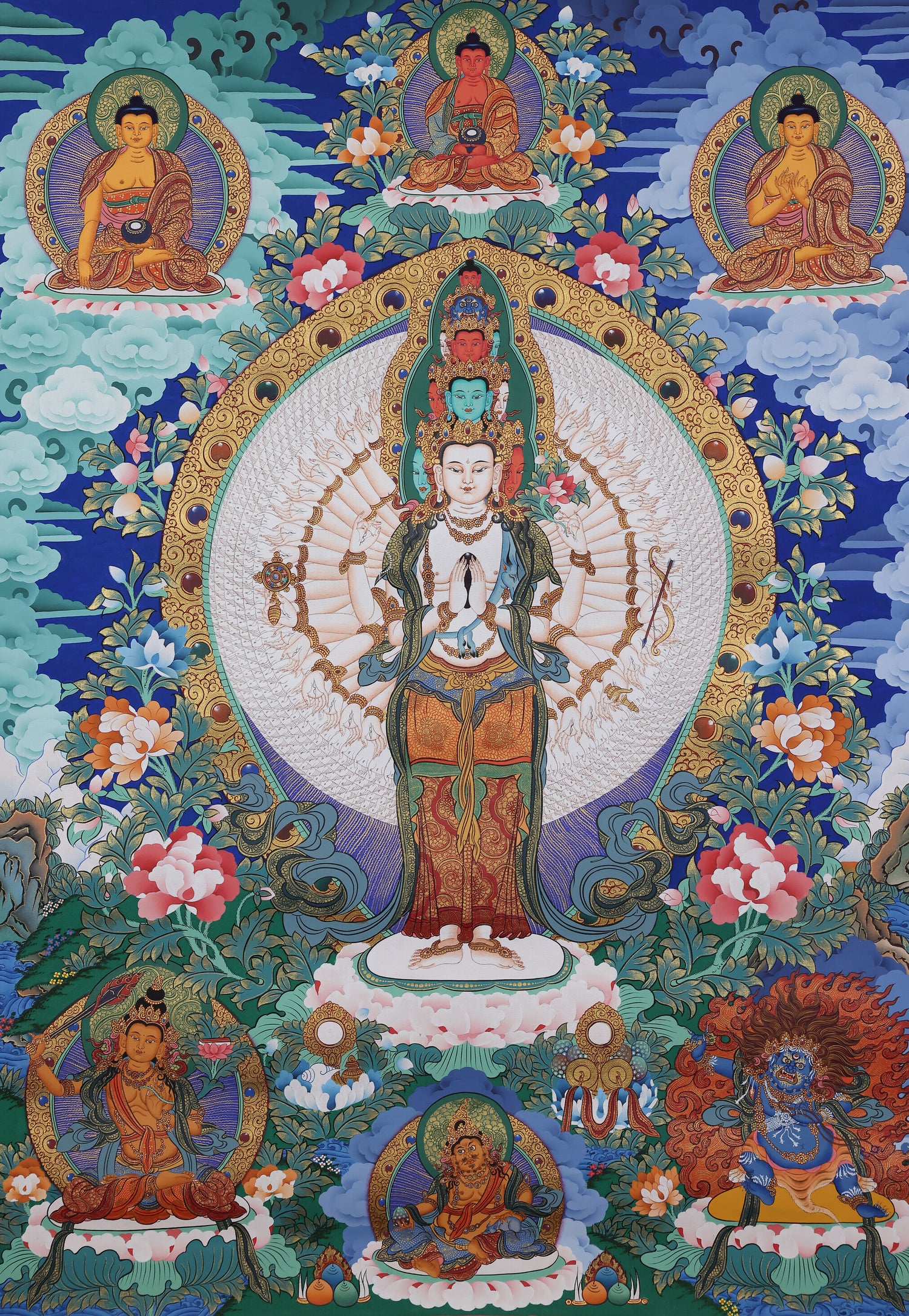
When a 40x60cm hand-painted Nepalese painted thangka hangs before your eyes, what you see is not just a vibrantly colored Buddha image—it is a zen-infused space where Tibetan Buddhist lineage intersects with Newari ethnic art. This is the Shakyamuni Buddha painted thangka we will dissect in depth today: it is both a "mobile Buddhist shrine" for home worship and a dual carrier of Tibetan Buddhist teachings and Newari craftsmanship.
1. Core Theme: The "Bhadrakalpa Lineage Map" Hidden in the Canvas
At its essence, this thangka is not merely a "Buddha painting"—it is a visual doctrinal carrier of the "transmission of the Thousand Buddhas of the Bhadrakalpa" in Tibetan Buddhism.
Tibetan Buddhism holds that the "Bhadrakalpa" (Auspicious Eon) is the time-space we inhabit, in which one thousand Buddhas will appear to liberate sentient beings; Shakyamuni is the fourth of these. This 40x60cm painted thangka uses a "central deity + retinue" structure to build a lineage loop of "past Buddhas → present Buddha → dharma transmitters":
- Temporal dimension: The past Buddhas above anchor the "continuity of the dharma"—the Buddha-dharma was not invented by Shakyamuni alone, but is an eternal truth proclaimed by Buddhas of the past, present, and future;
- Spatial dimension: The disciples below undertake the "grounding of the dharma"—the Buddha’s wisdom must be passed to worldly sentient beings through practice and written records.
For Newari families in Nepal, this thangka is far more than decoration: hung in a shrine or study, meditating on its layout is a daily practice of the belief that "the dharma lineage endures forever."
2. Iconography of the Central Deity: "Balanced Perfection" in Honey-Yellow Form
The Shakyamuni Buddha at the center of the painting strictly adheres to the Iconometric Canon and Newari aesthetic sensibilities; every detail unites religious symbolism with artistic expression:
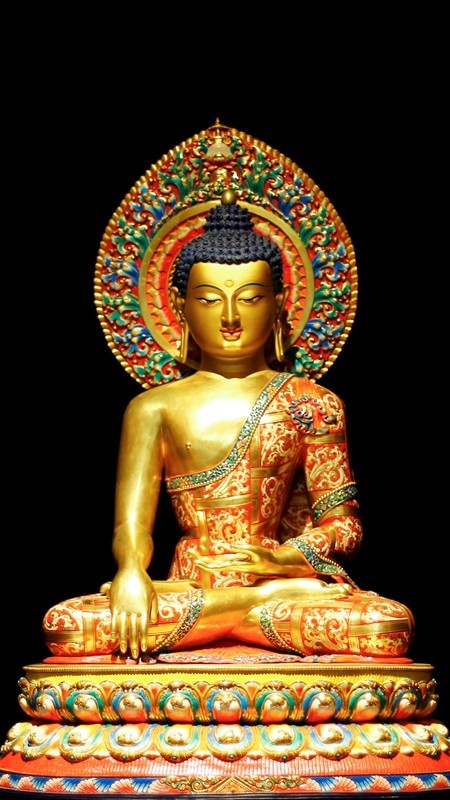
1. Physical Form: Visualization of the Thirty-Two Marks
The body bears the signature honey-yellow hue of the Newari school—a shade that is neither as fiery as the vermilion of past Buddhas nor as cool as the light blue of emptiness-focused Buddhas. It precisely corresponds to the Buddha’s core teaching of the "Middle Way": neither clinging to asceticism nor indulging in pleasure, fitting the spiritual capacity of sentient beings in the Saha World.
The tall cranial protuberance (ushnisha, symbolizing perfect wisdom), long earlobes (symbolizing profound merit), and full moon-like face (symbolizing all-encompassing compassion) are concrete manifestations of Tibetan Buddhism’s "Thirty-Two Marks and Eighty Secondary Characteristics": when practitioners meditate on this image, they can intuit that "the Buddha’s perfect form unites wisdom and compassion."
2. Posture and Lotus Seat: The Metaphor of Liberation as a Lotus Growing from Mud
Seated in full lotus posture (padmasana), the Buddha rests on a "double lotus seat":
- Lower layer: Vermilion lotus petals, symbolizing "renunciation of worldly afflictions," like a lotus growing from mud;
- Upper layer: White lotus seat, symbolizing "the purity of the dharma body," like a lotus that blooms without clinging to dust.
This imagery directly echoes the core of the Lotus Sutra: though the Buddha appears in the world, he does not cling to it, liberating sentient beings through his "emanation body" (nirmanakaya).
3. Mudra and Ritual Implement: "Dharma Food as Spiritual Provision" in the Alms Bowl
The left hand supports a monk’s alms bowl, while the right hand gently rests on its edge—this is the "alms bowl mudra" (also called the "receiving offerings mudra").
According to the Long Discourses (Digha Nikaya), after attaining enlightenment, the Buddha used alms begging to embody the "fundamental duty of a monk." The metaphor of "dharma food" in the bowl runs deeper: it represents "nourishing the spiritual lives of sentient beings with the Buddha-dharma"—it is both the Buddha’s worldly form and a tangible expression of "the Buddha-dharma as provision for liberation."
4. Three-Layered Aura: Progressive States of Self-Benefit → Benefiting Others → Dharmadhatu Unity
The Buddha’s aura has three layers, serving as visual symbols of "spiritual cultivation states" in Tibetan Buddhism:
- Innermost layer: Green circular body aura (adorned with golden lotus patterns), symbolizing compassionate vitality, corresponding to "perfect self-benefit";
- Middle layer: Deep blue radiating aura (adorned with fine gold lines), symbolizing all-pervading wisdom, corresponding to "benefiting others and liberating beings";
- Outermost layer: Golden boat-shaped head aura (adorned with scrollwork), symbolizing the perfection of the dharmadhatu, corresponding to "unity with the cosmic dharma realm."
3. Retinue Deities: "Temporal-Spatial Symbols" of Lineage Transmission
The "supporting figures" in the thangka are not mere decorations—they are key carriers of Tibetan Buddhist teachings, divided into two categories: "past Buddhas (temporal dimension)" and "disciples (spatial dimension)":
1. Two Buddhas Above: Lineage Anchors of the First Two Bhadrakalpa Buddhas
The two Buddhas above the central deity are Krakuchchanda Buddha (left, vermilion form) and Kanakamuni Buddha (right, light blue form)—the first two of the "Seven Past Buddhas" of the Bhadrakalpa:
- Krakuchchanda Buddha (first Buddha of the Bhadrakalpa): Vermilion body, seated with alms bowl, symbolizing "burning away sentient beings’ afflictions with the fire of compassion," corresponding to Tibetan Buddhism’s color symbolism of "red representing aspiration";
- Kanakamuni Buddha (second Buddha of the Bhadrakalpa): Light blue body, in the teaching mudra (right hand at chest), symbolizing "the dharma as light dispelling darkness," corresponding to "the coolness of emptiness wisdom."
Positioned above the central deity, they form the temporal sequence of "the first three Buddhas of the Bhadrakalpa"—reminding viewers that Shakyamuni is the "present 教主 who inherits the dharma lineage," and the Buddha-dharma is the shared truth of Buddhas of the past, present, and future.
2. Two Monks Below: Dual Carriers of Dharma Transmission
The two monks below the central deity are Shakyamuni’s two chief attendant disciples:
-
Mahakashyapa (left): Weathered features, holding a staff (khakkhara, the implement of a traveling monk), clad in dark robes. As the "foremost in asceticism," he represents "the experiential transmission of the dharma"—after the Buddha’s parinirvana, he received the Chan lineage through the "flower offering and smile," symbolizing "realizing the dharma through practice";
-
Ananda (right): Young and wise features, holding a staff, clad in the same style of robes. As the "foremost in hearing," he represents "the written transmission of the dharma"—all Buddhist sutras were memorized and compiled by him, making him the core carrier of "recording the dharma in text."
Together, they form a loop of "experience + text," echoing the Tibetan Buddhist cultivation sequence of "hearing (Ananda) → reflecting → practicing (Mahakashyapa)"—ultimately attaining the Buddha’s perfect state.
4. Newari Craftsmanship: "Zen Craftsmanship" in Natural Materials
This thangka is a classic work of the Newari painting school in Nepal; its techniques and style both adhere to Tibetan Buddhist rituals and integrate ethnic artistic genes:
1. Canvas and Pigments: The "Sacredness" of Natural Materials
-
Canvas process: Using linen from the Kathmandu Valley, it undergoes 7 steps including bleaching, coating with 糯米 glue and chalk paste, and repeated polishing—transforming rough linen into a smooth, fine base. This traditional process not only ensures pigment adhesion but also echoes the metaphor that "the Buddha-dharma must be polished pure on worldly foundations";
-
Mineral/earth pigments:
- Lapis lazuli (deep blue background): Derived from lapis lazuli, symbolizing the purity of emptiness;
- Malachite (body aura): Derived from malachite, symbolizing compassionate vitality;
- Cinnabar (red lotus petals): Derived from cinnabar, symbolizing renunciation of afflictions;
- Gold powder (ornamentation): Ground from gold leaf, symbolizing the light of wisdom;
- Ochre (central deity’s body): Derived from hematite, symbolizing the warmth of the Middle Way.
Pigments are bound with cow bone glue, ground through a 200-mesh sieve, and layered with glazing—resulting in saturated, long-lasting colors with a translucent "breathability."
2. Artistic Techniques: "Spiritual Cultivation" in Slow Work
-
Point-glazing method: Newari painters moisten brushes with their breath to control moisture, layering transparent pigments with small brushes; each gradient requires dozens of passes—this months-long technique is both a refinement of skill and a practice of "slow is wisdom";
-
Dense-style ornamentation: Details of lotuses and scrollwork clouds are extremely intricate, with gold lines outlining petal veins—this "dense style" showcases craftsmanship and symbolizes "the Buddha-dharma’s perfect virtue, hiding completeness in details";
-
Mandala layout: A centrally symmetrical stupa structure, with the central deity at the core and retinues arranged axially—corresponding to the Tibetan Buddhist concept that "the mandala is a microcosm of cosmic order": the central deity is the awakened mind, the retinues are lineage continuity, and symmetry is perfect balance.
3. 40x60cm Size: A "Mobile Buddhist Shrine" for Daily Practice
Unlike large temple thangkas in Tibet, this medium-small size is typical for "home worship" in Nepalese folk culture—practitioners can hang it in a shrine or study, accumulating merit through daily visualization, aligning with the Tibetan Buddhist concept that "life itself is practice."
Conclusion
This 40x60cm Nepalese painted thangka is both a "visual doctrine" of Tibetan Buddhist lineage and a "zen carrier" of Newari craftsmanship: it bears the lineage of past, present, and future Buddhas in the weight of mineral pigments; it interprets the details of cultivation through delicate glazing; it condenses the isomorphism of the cosmos and the Buddha-dharma in its mandala layout.
#NepalesePaintedThangka #ShakyamuniBuddhaThangka #NewariSchoolThangka #TibetanBuddhistThangkaAnalysis #MineralPigmentThangkaTechniques #40x60cmHandpaintedThangka #HandpaintedNepaleseThangka #MineralPigmentArt #TibetanBuddhistArt #NewariArtisanCraft #HomeAltarThangka #BuddhistLineageArt #ZenDecorArt #ShakyamuniIconography #TraditionalNepaleseArt